1. The Paradigm Shift in Global Sourcing
Global supply chains are undergoing a profound structural reconfiguration. Today, securing a resilient SADC agribusiness supply chain has emerged as a critical strategic priority for European purchasing directors and institutional investors seeking to mitigate risk, ensure product traceability, and meet strict regulatory compliance. The traditional sourcing model, characterized by highly fragmented geographic distribution and a heavy reliance on informal, unverified intermediaries, has exposed systemic vulnerabilities in the face of geopolitical frictions, rising logistics costs, and climate volatility.
In this new international trade landscape, the African continent—specifically the Southern African Development Community (SADC) region—is emerging as a highly competitive partner. However, for this partnership to remain sustainable and mutually profitable, global trade must move past old, extractivist raw-material models. This is where the DCCI Framework (Development Based on Internal Consumption Capacity) becomes essential. As an intellectual foundation of modern trade, the DCCI framework demonstrates that a market’s resilience and long-term viability rely directly on its capacity to generate local processing, industrial value-addition, and sovereign production capabilities in origin.
For European businesses seeking to diversify their sourcing of agricultural raw materials or high-value processed goods, identifying these industrialized local nodes is critical. In an environment where information asymmetry often creates trade barriers, generic directories are no longer sufficient. To solve this, institutional buyers utilize a dedicated, independent analytical framework to audit market structures before committing capital.
2. Vertical Integration: The Compliance Engine for Seed Co and Westfalia Fruit
Vertical integration has become the definitive corporate strategy to bypass local infrastructure deficits and guarantee strict traceability for European markets. When an agribusiness supplier maintains absolute control of the entire value chain—from genetic research in origin to cold chain management and international shipping—systemic SADC agribusiness supply chain vulnerabilities and compliance blind spots are eliminated.
At the starting point of the agricultural value chain, climate resilience begins in the laboratory. Seed Co Limited, a premier regional player in agricultural technology, demonstrates how advanced seed hybridization and local research protect crop yields against severe droughts and erratic rainfall patterns. By securing the agricultural baseline in Africa, Seed Co not only strengthens internal consumption capacity under the DCCI philosophy but also ensures a reliable, export-ready surplus of high-quality industrial inputs for international buyers.
On the distribution side, global fresh produce leaders like Westfalia Fruit demonstrate the operational necessity of vertical integration. Westfalia manages every stage of its high-value avocado value chain: from its own nurseries and orchards to state-of-the-art packing houses, integrated cold storage, and maritime logistics. This absolute vertical control allows Westfalia to meet stringent European import regulations, including the Corporate Sustainability Due Diligence Directive (CS3D) and the strict EU Deforestation Regulation (EUDR). It guarantees that every container arriving at European ports possesses an audited, carbon-conscious, and deforestation-free origin.
3. Selebi-Phikwe: The Future Model of Agroindustrial Sovereignty
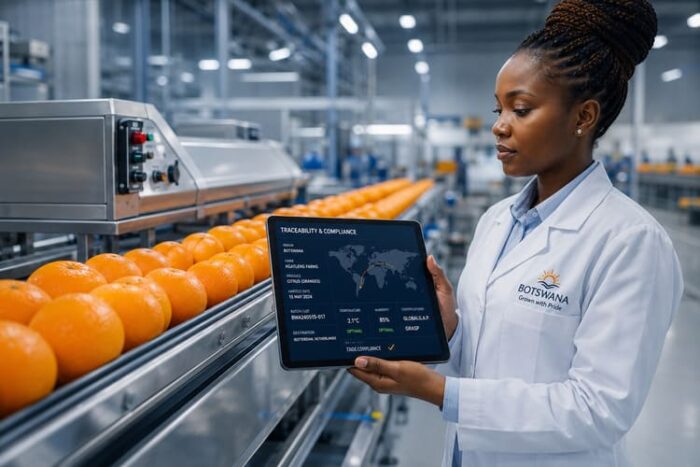
The most representative example of the DCCI framework and integrated agribusiness is currently taking shape in Botswana. The industrial hub of Selebi-Phikwe in Botswana, historically dependent on copper and nickel mining, is undergoing a rapid transition into a world-class agricultural and logistics cluster focused on premium citrus exports.
This strategic transformation of mining land and infrastructure into highly automated citrus orchards directly aligns with the industrial maturity assessed by modern trade frameworks. By building advanced local processing capacity—including essential oil extraction, automated grading lines, and integrated cold-chain warehouses—Selebi-Phikwe does not just export raw crops. It generates specialized local employment that strengthens Botswana’s internal consumption capacity while building a highly efficient logistics corridor linked to regional SADC ports.
For European buyers of fresh citrus, oils, and agricultural derivatives, Selebi-Phikwe represents a verified, resilient model of local value-addition: state-of-the-art local production, verified ESG standards, and a robust cold chain designed to optimize transit times and preserve product integrity.
4. The ATIS Standard as a B2B Trust Filter
Mitigating risk (de-risking) in emerging markets requires moving from qualitative assumptions to empirical data verification. This is where the ATIS Standard (African Trade Intelligence Standard)—a proprietary algorithmic assessment framework engineered by ProdAfrica—bridges the trust gap by auditing market nodes across four critical pillars: B2B Integrity Density, Logistical Connectivity, DCCI Readiness, and Trade Compliance. When analyzing the SADC region through this lens, specific countries emerge as definitive safe harbors for international capital.
Botswana, evaluated under the ATIS methodology, stands out with a B2B Integrity Density of 7.5 out of 10 and a Logistical Connectivity score of 7.2 out of 10. These scores position the country as a highly stable and legally secure commercial hub within the SADC. Unlike markets dominated by informal transactions, Botswana offers a structured environment where contract enforcement, corporate transparency, and fast customs clearance are standard.
However, to establish seamless, low-risk import corridors, global corporations must look beyond macro country ratings and evaluate the specific vertical integration of their suppliers.