1. The Revitalization of the Southern African Textile Sector
For decades, the clothing, textile, footwear, and leather (CTFL) sector across Southern Africa faced devastating challenges due to a flood of cheap, un-audited fast-fashion imports. However, modern supply chain dynamics have initiated a profound structural transition. Today, revitalizing the South African textile industry has become a strategic priority for international purchasing directors and retail investors seeking to establish ethical, resilient, and localized sourcing channels.
The movement toward reshoring and regional supply chain consolidation is no longer just a cost-saving measure; it is a compliance and risk-mitigation necessity. In this context, the SADC region offers a highly competitive industrial landscape, provided that international trade moves away from pure raw-material extraction. By transitioning toward sustainable local manufacturing and value-addition, regional actors can successfully bypass global logistics bottlenecks while meeting the stringent environmental and social governance (ESG) demands of European and global buyers.
To identify and audit these high-integrity manufacturing partners, institutional buyers require advanced evaluation frameworks. Rather than relying on static business directories that depend on unverified self-reporting, modern procurers utilize the ATIS Standard (African Trade Intelligence Standard) to evaluate supplier credibility, logistical connectivity, and operational readiness at the source.
2. The DCCI Framework: Endogenous Prosperity in the Apparel Sector
The resilience of the South African textile industry lies in its alignment with the DCCI Framework (Development Based on Internal Consumption Capacity). Traditional trade models in Africa have historically relied on exporting raw cotton and wool to overseas facilities, only to import finished, high-cost apparel back into the continent. This process drains local capital and suppresses regional industrial capabilities.
The DCCI framework reverses this paradigm by focusing on three key pillars:
- Elevating Local Production: Encouraging domestic mills and factories to handle the entire processing cycle—from spinning and weaving to design and final garment manufacturing.
- Empowering Purchasing Power: Retaining the value-addition of the manufacturing process within the local economy, thereby generating dignified employment and raising domestic consumption capacity.
- Consolidating Regional Corridors: Building robust distribution channels that connect local agricultural producers with specialized urban manufacturing hubs across the SADC.
Textile manufacturing is the ultimate industrial multiplier. By keeping the manufacturing process close to the source of raw materials, regional value chains become self-sustaining. This strategy reduces carbon footprints by eliminating long-distance shipping and insulates local businesses from global currency and supply chain shocks.
3. Case Study: Hoolies (Durban) and Ethical B2B Sourcing
The practical execution of the DCCI model is best demonstrated by successful small and medium-sized enterprises (SMEs) operating within regional industrial hubs. A prime example is Hoolies in South Africa, an ethical children’s wear brand established in Durban, KwaZulu-Natal.
Founded by textile designer Adri Jeffers and Wayne Jeffers, Hoolies has spent decades redefining local manufacturing standards by focusing entirely on pure cotton fabrics, non-toxic water-based prints, and locally tailored garments. This operational model directly aligns with the core principles of the DCCI framework:
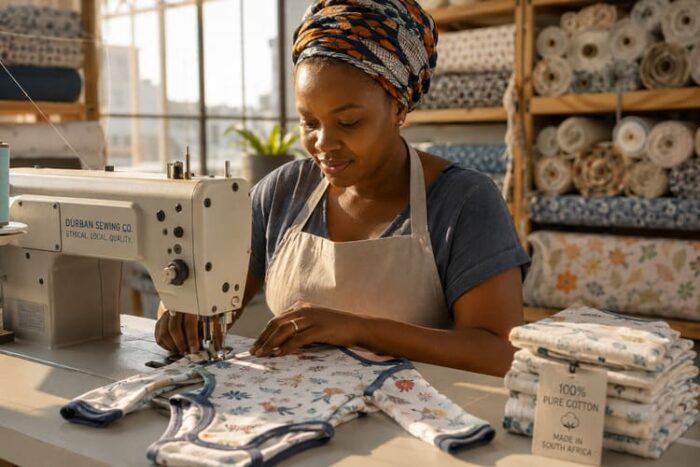
- Local Value-Addition: Instead of relying on imported synthetic fabrics, Hoolies utilizes locally sourced pure cotton. The entire design, screen-printing, and sewing process is executed in Durban, ensuring that the economic value remains within the community.
- Community Empowerment: By maintaining an ethical, localized factory floor and working with skilled local seamstresses, the brand directly supports job creation, raising the purchasing power of families in the KwaZulu-Natal region.
- Zero-Waste & Circularity: The brand’s focus on durability—such as their trademarked adjustable garments—and the creative recycling of fabric off-cuts into community initiatives represents a robust commitment to circular economic models.
For international B2B buyers, Hoolies represents more than a children’s clothing manufacturer. It represents an audited, compliant, and highly transparent partner capable of meeting global traceability standards.
4. The ATIS Standard as an Auditing Tool for SADC Textile Manufacturing
To secure seamless trade corridors, European buyers must look beyond generic country risk ratings and evaluate the specific operational compliance of individual suppliers. This is especially critical in apparel and fashion, where labor rights, waste management, and supply chain transparency are heavily scrutinized under international ESG frameworks.
Through the ATIS Standard, ProdAfrica provides an independent qualitative assessment of these actors, evaluating their structural readiness across key business metrics. In South Africa, where logistical connectivity ranks at 7.8 out of 10 and trade compliance standards are high, verified companies are uniquely positioned to integrate into global value chains.
When international buyers seek to partner with entities involved in SADC textile manufacturing, having an independent verification badge on the ProdAfrica Business Directory acts as a vital trust signal, proving that the supplier has been vetted for B2B integrity, legal formalization, and operational capacity.
5. B2B Risk Mitigation: Connecting with Certified Regional Partners
Success in modern international procurement relies on digital discovery and independent verification. By replacing fragmented, unverified supply chains with structured, certified trade corridors, businesses can mitigate risk and build long-term, mutually beneficial partnerships.
Leveraging audited commercial platforms to connect with verified partners is the definitive operational procedure for modern sourcing. By selecting manufacturers that champion the DCCI model, global buyers do not just secure premium, ethical products; they actively contribute to the sustainable industrialization and self-sustained prosperity of the regional African market.
🇿🇦 ProdAfrica B2B Index — South Africa
Proprietary Rating🧠 Index Methodology
The ProdAfrica B2B Index is a proprietary qualitative assessment. Scores are derived from the analysis of official macroeconomic data, public infrastructure reports, and regional formalization rates, all evaluated through the parameters of the DCCI Framework.