1. Transforming the Agrifood Narrative in Central Africa
The Democratic Republic of the Congo (DRC) is historically synonymous with its massive mineral endowment. Holding the world’s largest reserves of cobalt and copper, the global trade narrative surrounding the country has been dominated by primary extraction. However, a silent, profound transformation is taking shape in the fertile highlands of North Kivu. Today, expanding the agribusiness in DR Congo has emerged as a primary focus for international trade agencies, sustainable investment funds, and global buyers seeking to establish ethical, high-value sourcing corridors.
With millions of hectares of rich volcanic soil and exceptional rainfall, the DRC possesses the agricultural capacity to feed over two billion people. Yet, historical post-harvest losses and a lack of processing infrastructure meant that raw agricultural products were exported for minimal returns, while finished food products were imported at premium rates.
To bypass this commodities trap, local enterprises are aligning their operations with the DCCI Framework (Development Based on Internal Consumption Capacity). This model asserts that true, self-sustained regional prosperity is achieved when agricultural resources are processed locally, keeping the high-margin industrial value-addition within the domestic economy to elevate local purchasing power.
To navigate this high-potential but structurally complex market, international B2B buyers rely on independent auditing frameworks. The ATIS Standard (African Trade Intelligence Standard) developed by ProdAfrica rates the Democratic Republic of the Congo with a baseline score of 4.1 out of 10, reflecting critical logistical connectivity (4.3) and evolving trade compliance. In this high-risk but high-reward environment, identifying vetted, high-integrity local processors is the essential step to de-risking trade corridors and establishing secure partnerships.
2. The DCCI Model: Re-Engineering Local Agro-Processing Loops
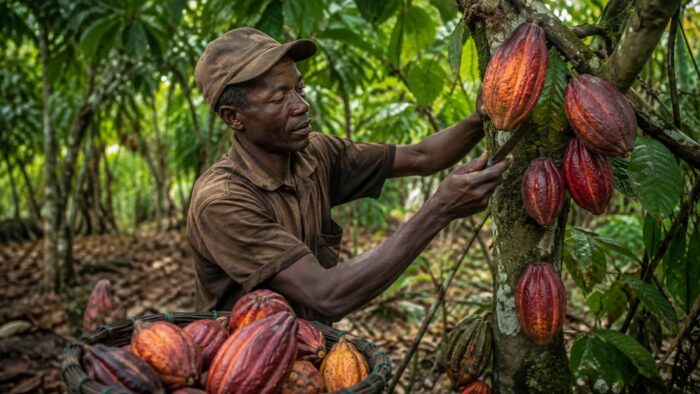
Historically, the agricultural wealth of eastern DR Congo was exported as raw, unprocessed commodities. Smallholder cocoa and coffee farmers in Kivu were forced to sell their raw beans to international brokers for pennies, leaving local communities vulnerable to economic instability.
The transition toward a resilient, DCCI-aligned agribusiness in DR Congo addresses this structural gap by encouraging the establishment of local processing loops. In agribusiness, processing represents the ultimate economic catalyst. Converting raw cocoa beans into refined, packaged chocolate bars on-site is a masterclass in local value-addition:
- Retaining the Industrial Multiplier: By setting up local, cooperative-owned processing mills and chocolate factories, the high-margin value-addition process is kept within the domestic Congolese economy.
- Empowering Domestic Purchasing Power: Generating local processing jobs—specifically for women and marginalized groups—directly elevates household incomes. This increased purchasing power is immediately reinvested in local education, healthcare, and secondary agricultural businesses, driving self-sustained regional prosperity.
- Eliminating Supply Chain Distances: Refining the product at the source significantly reduces transportation emissions and aligns the final cargo with Europe’s strict carbon-reduction mandates.
3. The Logistical Corridor: Connecting Kivu to East African Seaports
To establish secure, long-term B2B pipelines, international buyers must understand the logistical corridors connecting the landlinked eastern provinces of the DRC to global maritime routes. While western DRC relies on the Atlantic corridor via the Port of Banana, the agricultural powerhouse of North Kivu routes its high-value exports eastward:
- The Northern Corridor: Spanning from Goma and Beni through Uganda to the deep-water Port of Mombasa in Kenya. This is the primary route for containerized cocoa and specialty coffee shipments, utilizing specialized road transport and border-crossing facilitation to minimize transit latency.
- The Central Corridor: Connecting the Kivu region across Lake Tanganyika through Tanzania to the Port of Dar es Salaam. This corridor is rapidly expanding its capacity, supported by regional SADC and EAC infrastructure investments designed to optimize agricultural trade flows.
By utilizing these established corridors and partnering with verified logistical providers, agribusiness exporters in North Kivu can guarantee a highly predictable, climate-controlled timeline from local packaging facilities directly to European import gateways.
4. Self-Made Innovation: Virunga Origins and the Mutwanga Factory
The practical execution of the DCCI model in the Central African agricultural sector is perfectly illustrated by Virunga Origins, an ethical agribusiness enterprise established in the North Kivu province.
Operating under the strategic umbrella of the Virunga National Park alliance, Virunga Origins’ journey is a masterclass in sustainable scaling and local value-addition:
- The Commodity Origin: Historically, thousands of smallholder farmers around the Virunga National Park cultivated premium, organic cocoa and specialty Arabica and Robusta coffee, but lacked access to processing infrastructure, leaving them dependent on unstable local markets.
- The Leap into Sovereign Manufacturing: Rather than exporting raw beans, Virunga Origins took the courageous step to build a modern, high-tech chocolate manufacturing factory in Mutwanga, North Kivu. This facility represents the first commercial chocolate factory in eastern DR Congo, processing raw cocoa beans into premium, single-origin chocolate bars on-site.
- Clean Energy Integration: In a region with zero national grid stability, the Mutwanga chocolate factory is powered entirely by the park’s run-of-the-river hydroelectric power plants. This zero-emission, clean-energy industrial loop protects the surrounding rainforest while ensuring continuous, high-efficiency manufacturing.
- Social Impact and Scaling: Today, Virunga Origins works with a network of over 10,000 smallholder farmers, purchasing their crops at guaranteed premium, fair-trade rates. Furthermore, the chocolate factory and sewing workshops provide sustainable, dignified employment for local women, including the widows of park rangers who lost their lives protecting the park.
By converting raw cocoa and coffee into globally competitive, certified gourmet consumer goods, Virunga Origins in DR Congo embodies the DCCI model on the ground: reducing import reliance, creating local manufacturing jobs, and keeping the economic value within the regional supply chain.
5. Industrial Sourcing & Value-Chain Infrastructure Mapping
To assist international procurement managers and investment analysts, the following table maps the primary agricultural sectors in eastern DR Congo, their regional processing hubs, and their strategic B2B export readiness:
Table 1: Eastern DR Congo Agribusiness Infrastructure
- Industrial Segment: Organic Cocoa & Chocolate Refinement
- Primary Regional Hub: Mutwanga Factory (North Kivu).
- Processing Standard: Stone-ground mechanical milling, zero-chemical refining, single-origin chocolate packaging.
- B2B Compliance Target: EUDR (Deforestation-free) certified, Organic & Fair Trade compliant.
- Industrial Segment: Specialty Arabica & Robusta Coffee
- Primary Regional Hub: Goma & Kivu Lake Region.
- Processing Standard: Wet-milling, centralized washing stations, standardized grading and sorting.
- B2B Compliance Target: Premium specialty grade (80+ SCA score), direct-trade traceability.
- Industrial Segment: Certified Organic Chia Seeds
- Primary Regional Hub: Beni & Virunga Border Cooperatives.
- Processing Standard: Automated cleaning, triple-sifting, moisture-controlled bulk packaging.
- B2B Compliance Target: EU Phytosanitary compliant, non-GMO verified.
6. De-risking Central African Sourcing with the ATIS Standard
For European and regional B2B buyers looking to engage with the growing agribusiness in DR Congo, performing rigorous due diligence is an absolute necessity. While the country’s agricultural potential is vast, operational challenges such as transport bottlenecks, currency volatility, and fragmented supply chains require verified partnerships.
This is where digital discovery and independent auditing become valuable. Vetting local suppliers through our structured database ensures that buyers connect with legally formalized, trade-ready partners. On the ProdAfrica B2B Intelligence Hub, identifying entities with verified badges is the definitive standard to find verified suppliers in Africa, helping international businesses secure reliable, transparent, and highly resilient sourcing channels.
Through the integration of our secure “Verification Tier” selection tool, European buyers can quickly discover verified Central African processing hubs that possess the financial solvency and operational readiness to manage high-volume, compliant international trade contracts.
7. Co-Developing the Euro-African Sovereign Trade Axis
The future of bilateral trade does not rely on isolated efforts. It requires a seamless partnership between physical trade agencies and digital intelligence platforms. By utilizing the structured database of ProdAfrica to monitor and promote certified local manufacturers across Africa’s premier economic blocs—including the SADC, EAC, ECOWAS, and the Mediterranean Maghreb corridor—European trade promotion organizations and independent internationalization consultants can drastically reduce market entry friction for their SME clients.
As these strategic markets continue to industrialize under the DCCI model and integrate through the AfCFTA protocols, this collaborative approach will ensure that the trade pipelines connecting Europe and Africa remain highly secure, transparent, and resilient for the long term.