Executive Summary: The operational success of the African Continental Free Trade Area (AfCFTA) depends fundamentally on the removal of monetary friction. For decades, intra-African commerce was choked by currency fragmentation, forcing cross-border transactions to clear through third-party foreign currencies such as the US dollar or the Euro, resulting in massive liquidity drains, high transaction costs, and multi-day settlement delays. The Pan-African Payment and Settlement System (PAPSS) has fundamentally re-engineered this financial architecture, establishing a real-time, centralized financial market infrastructure that enables instant cross-border payments in local African currencies. This technical intelligence report evaluates the operational mechanics, network expansion metrics, and economic multipliers driving the continent toward financial sovereignty.
1. The Structural Deficit of Legacy Correspondent Banking
To understand the operational necessity of the Pan-African Payment and Settlement System, one must examine the inefficiencies of traditional African banking mechanics. Historically, when an enterprise in one African nation attempted to execute a commercial trade settlement with a counterpart in another, the payment instruction rarely moved directly.
- The Third-Party Currency Bottleneck: Due to the scarcity of direct convertibility between most African fiat currencies, transactions had to be routed through correspondent banks located outside the continent, typically in New York, London, or Frankfurt.
- The Forex Liquidity Trap: This intermediation meant that two African trading partners were forced to convert their local currencies into US dollars or Euros, incur double foreign exchange conversion spreads, and re-convert back into the destination local currency.
- Capital Lockup and Latency: Settlement windows averaged between three to seven working days, while cross-border transaction costs frequently consumed substantial percentages of transfer values, severely penalizing small and medium-sized enterprises (SMEs) operating on narrow margins.
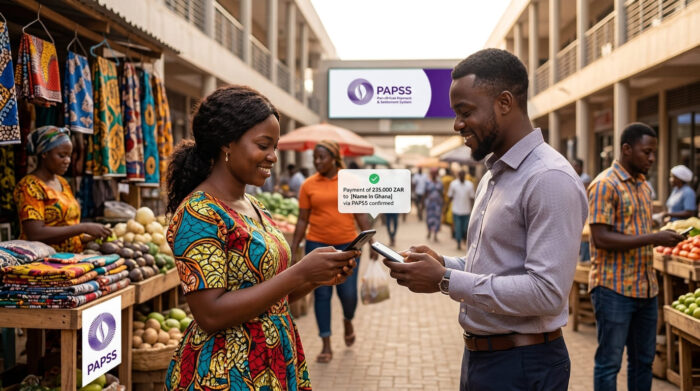
2. Technical Architecture and Operational Mechanics of PAPSS
Developed by the African Export-Import Bank (Afreximbank) in partnership with the African Union and the AfCFTA Secretariat, PAPSS functions as a centralized Financial Market Infrastructure (FMI) that connects national central banks, commercial banks, and licensed payment service providers across a unified network.
- Real-Time Gross Settlement (RTGS) in Local Currencies: PAPSS provides a real-time infrastructure where payment instructions are cleared and settled in distinct local African currencies within seconds. A trader in Nairobi can settle an invoice with a supplier in Accra using local currency equivalents, bypassing external reserve currencies entirely.
- Network Integration and Central Bank Switching: The infrastructure connects dozens of national and regional central banks, alongside hundreds of commercial banks, switches, and fintech aggregators. Through strategic regional integration agreements—such as the incorporation of the Bank of Central African States (BEAC) serving the Central African Economic and Monetary Community (CEMAC)—the platform’s termination footprint covers extensive financial institutions spanning all regions of the continent.
- Risk Minimization and Liquidity Optimization: By centralizing clearing operations and synchronizing liquidity management directly through participating central banks, the infrastructure dramatically reduces settlement risk, counterparty exposure, and the capital reserves commercial banks must lock up for cross-border operations.
3. Quantitative Efficiency Metrics and Performance Data
The operational viability of a financial market infrastructure is measured by its capacity to reduce transaction costs and accelerate settlement velocity. Performance data from the network outlines substantial operational improvements:
- Processing Speed Reductions: Transaction processing times have achieved a near-instant reduction, dropping from legacy multi-day windows to mere seconds.
- Cost Compression: Empirical operational metrics indicate cost savings ranging between 92% and 95% per transaction compared to traditional correspondent banking channels.
- Foreign Exchange Savings: The structural elimination of third-party clearing currencies has yielded up to an 80% reduction in foreign exchange requirements for commercial banks participating in the network.
- Exponential Transaction Scaling: Following structural network expansions and the onboarding of multiple central banks, the platform has experienced exponential year-on-year surges in both transaction volumes and total settled values, demonstrating robust commercial adoption by commercial banks and fintech operators.
4. De-risking Capital Entry with Verified Digital Intelligence
For industrial operators, trading houses, and financial institutions integrating into emerging cross-border payment corridors, executing safe transactions requires rigorous counterpart due diligence. Navigating diverse anti-money laundering (AML) and know-your-customer (KYC) compliance frameworks across multiple jurisdictions remains a complex operational challenge.
This is where digital intelligence platforms bridge the operational gap. Vetting trading partners, financial intermediaries, and industrial suppliers through a structured database ensures that corporate actors connect with legally formalized, trade-ready entities. On the ProdAfrica B2B Intelligence Hub Directory, identifying entities with verified badges is the definitive standard to find compliant partners in Africa, eliminating transactional friction and securing reliable B2B supply pipelines.
5. The Sovereign Trade Axis and the DCCI Framework
The technical execution of the Pan-African Payment and Settlement System aligns directly with the macroeconomic principles of the DCCI Framework (Development Based on Internal Consumption Capacity). Developed by the ProdAfrica B2B Intelligence Hub, this model asserts that sustainable economic growth is achieved when developing nations eliminate structural friction, strengthen domestic markets, and retain financial multipliers within origin economies.
By removing external currency intermediaries and enabling instant, low-cost local currency settlements, PAPSS acts as the financial software that powers intra-African industrialization. When combined with localized manufacturing, value-added processing, and verified B2B intelligence, the continent transitions from fragmented, vulnerable markets into a self-sustained, financially sovereign global economic powerhouse.