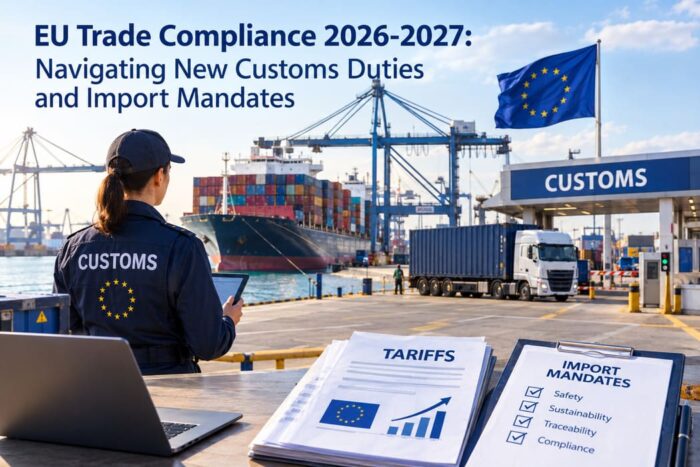
Mastering EU trade compliance 2026 stands at the absolute forefront of the architecture of international trade between Africa and the European Union, which is undergoing its most intensive regulatory transformation in decades. For African exporters, agricultural cooperatives, industrial manufacturers, logistics providers, and regional trade commissioners, the baseline for market entry is no longer defined solely by product quality, volume capacity, and competitive pricing. Today, cross-border commercial viability depends entirely on navigating a dense, rapidly evolving matrix of new customs duties, pre-arrival digital data mandates, and corporate sustainability requirements rolling out across 2026 and 2027.
At the ProdAfrica B2B Intelligence Hub, we track these structural changes to ensure that verified enterprises across our 16 strategic market nodes remain fully aligned with European import parameters. Understanding the mechanics of these regulatory shifts is essential for safeguarding profit margins, avoiding costly port rejections, and maintaining uninterrupted supply chain access to the European Single Market. This comprehensive technical briefing examines the core regulatory pillars reshaping Euro-African trade and outlines strategic measures for maintaining trade compliance.
1. 1. EU Trade Compliance 2026: The End of Low-Value Exemptions
One of the most disruptive shifts affecting commercial trade flows into the European Union is the systematic dismantling of legacy customs exemptions and streamlined processing thresholds. Historically, low-value cross-border consignments and specific categories of commercial samples benefited from simplified border clearance procedures. However, aggressive regulatory updates implemented by the European Commission are transforming this landscape entirely, aligning with the broader objectives outlined in the official European Union customs reform framework to streamline border controls and eliminate legacy vulnerabilities.
- Abolition of De Minimis Custom Thresholds: The long-standing customs duty exemptions for low-value parcels are being systematically phased out across member states. This means that commercial consignments of varying scales, including direct-to-consumer shipments and specialized B2B dispatches, are now subject to rigorous line-by-line customs scrutiny and applicable statutory duties from the exact point of entry.
- Flat-Rate and Ad Valorem Adjustments: Non-European exporters face a structured schedule of updated flat-rate charges on minor shipments alongside percentage-based ad valorem duties on bulk B2B commercial imports. This requires financial departments across African exporting firms to completely recalculate their landed cost models and pricing structures.
- Enhanced Data Precision and HS Classification: Modern European customs authorities rely heavily on automated risk-assessment algorithms. Consequently, declarations require absolute accuracy. Incorrect Harmonized System (HS) codes, generalized product descriptions, vague item valuations, and missing manufacturer identifiers trigger immediate automated holds, physical inspections, and severe administrative penalties.
2. Pre-Arrival Transparency: The Full Rollout of ICS2
Physical logistics can no longer move faster than digital data across the Euro-African trade corridor. The comprehensive, multi-phase deployment of the Import Control System 2 (ICS2) represents a monumental compliance hurdle for maritime, air, road, and rail freight entering the European Union.
- Mandatory Pre-Arrival Electronic Filings: Customs declarations have officially shifted away from legacy post-import models toward mandatory pre-arrival electronic data filing. Complete safety, security, and commercial data must be successfully submitted, processed, and cleared before goods physically touch any European entry point or transit port.
- Deep Supply Chain Coordination: Freight forwarders, maritime carriers, customs clearing agents, and African producers must establish airtight digital synchronization. Electronic manifest data must match physical shipments down to the final kilogram and package count. Discrepancies in weight, declared country of origin, or chemical composition result in immediate automated red lanes at European borders.
- Operational Latency Risks: Without robust digital integration and verified documentation pipelines, exporters face extended dwell times at European ports of entry, inflating warehousing costs and undermining time-sensitive supply agreements, particularly for perishable agricultural commodities.
3. The Due Diligence Horizon: CSDDD and Value Chain Compliance
Beyond direct customs duties and digital manifests, regulatory pressure is extending deep into operational supply chains through rigorous corporate sustainability mandates. The European Union is systematically closing loopholes that previously allowed downstream buyers to distance themselves from upstream production conditions.
- The Corporate Sustainability Due Diligence Directive (CSDDD / CS3D): This landmark European legislation establishes strict civil liability and compliance accountability for large corporate enterprises regarding environmental degradation, biodiversity loss, and human rights violations across their entire global supply chains.
- Cascading Impact on African Suppliers: While large European anchor buyers face formal statutory compliance timelines scaling toward 2029, their tier-1 and tier-2 suppliers—including agricultural cooperatives, mineral mining houses, and raw material processors in Africa—are already subject to rigorous due-diligence questionnaires, mandatory codes of conduct, and third-party audit requests.
- The Compliance Trap for SMEs: Exporters who fail to map their environmental footprint, prove fair labor practices, and provide verified supply chain traceability data risk being systematically unlisted by European corporate buyers. Major European firms are actively de-risking their procurement portfolios, cutting ties with non-compliant suppliers regardless of how competitive their pricing might be.
4. De-risking Market Entry with Verified Digital Intelligence
In an economic environment characterized by escalating customs complexity, strict pre-arrival data demands, and sweeping due-diligence mandates, navigating international trade channels independently exposes companies to catastrophic financial risks. International buyers and European procurement directors require absolute, verifiable confidence that their African trade partners are legally formalized, operationally sound, and fully equipped to meet rigorous regulatory standards.
This is where digital intelligence platforms bridge the operational gap. Vetting local producers, agricultural cooperatives, and logistics operators through a structured database ensures that corporate actors connect with legally formalized, trade-ready partners. On the ProdAfrica B2B Intelligence Hub Directory, identifying entities with verified badges is the definitive standard to find compliant suppliers in Africa, eliminating transactional friction and securing reliable B2B supply pipelines.
5. The Sovereign Trade Axis and the DCCI Framework
The compounding complexity of European trade compliance reinforces the core analytical thesis of the DCCI Framework (Development Based on Internal Consumption Capacity). Developed by the ProdAfrica B2B Intelligence Hub, this macroeconomic model demonstrates that sustainable economic growth is achieved when developing nations build robust domestic markets, local processing infrastructure, and sovereign industrial value chains rather than remaining trapped as raw commodity exporters.
By prioritizing internal market maturity alongside rigorous international trade compliance, African enterprises insulate themselves from external regulatory shocks. Transforming compliance requirements into structural upgrades elevates local manufacturing standards, protects profit margins, and fosters long-term, self-sustained prosperity across strategic regional trade corridors.