Northern Corridor transport logistics stand at the absolute forefront of transcontinental supply chain efficiency across East and Central Africa, relying heavily on the performance of multimodal trade routes. While southern arteries command attention, the Northern Corridor remains the busiest and most critical transit backbone in the region. Spanning over 1,700 kilometers, it links the maritime Port of Mombasa in Kenya directly to landlocked economies of Uganda, Rwanda, Burundi, the Democratic Republic of the Congo, and South Sudan. Backed by verified data from the Kenya Ports Authority and the Northern Corridor Transit and Transport Coordination Authority, this technical intelligence report examines the throughput metrics, trade volumes, and macroeconomic drivers positioning the corridor as a primary engine for the African Continental Free Trade Area.
1. The Core Role of Northern Corridor Transport Logistics
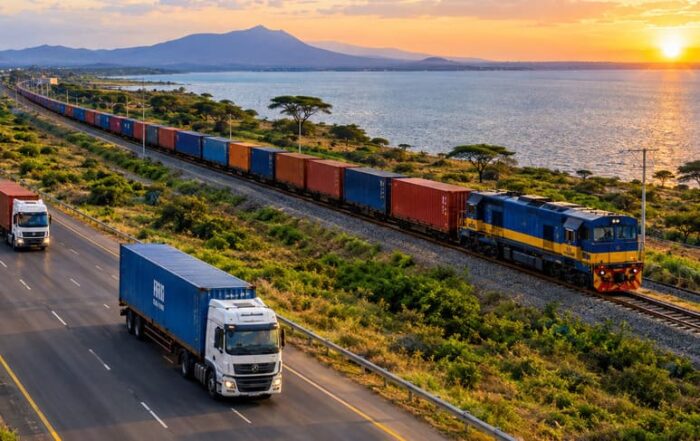
The Northern Corridor is structured as a complex, multi-modal network designed to move high-volume commercial freight from maritime entry points deep into the Great Lakes hinterland.
- Maritime Origin: The Port of Mombasa serves as the foundational anchor, handling record-breaking throughput driven by continuous terminal upgrades, container yard expansions, and automated gate systems.
- Multimodal Integration: The route combines deep-water marine facilities, heavy-haul road networks, the Standard Gauge Railway and Meter Gauge Railway components, pipeline infrastructure, and inland waterway transit across Lake Victoria via the Port of Kisumu.
- Hinterland Reach: The corridor branches across international borders into Kampala (Uganda), Kigali (Rwanda), Bujumbura (Burundi), Goma and Bukavu (Eastern DRC), and Juba (South Sudan).
2. Technical Performance and Cargo Throughput Matrix
Evaluating the operational efficiency of the Northern Corridor requires analyzing hard empirical data regarding port productivity, container handling, and transit velocity. Recent metrics from port authorities and transport observatories outline substantial volume expansion.
- Port of Mombasa Annual Throughput: Total cargo throughput handled at the Port of Mombasa reached a record 45.45 million metric tonnes, representing a 10.9 percent increase compared to prior operational periods.
- Containerized Traffic: Container handling capacity scaled to 2.11 million TEUs (Twenty-Foot Equivalent Units), reflecting steady growth in regional containerized imports and transshipment.
- Transit Cargo Surge: Freight destined specifically for landlocked neighbors (transit cargo) surged to 15.88 million metric tonnes, marking a robust 19.5 percent upward trajectory.
Table 1: Northern Corridor Transit Performance by Destination Market
| Destination Market | Verified Transit Volume (Metric Tonnes) | Year-on-Year Growth Rate | Primary Economic Driver |
| Uganda | ~8.8 million MT | +25.2% | Petroleum, industrial raw materials, consumer goods |
| South Sudan | ~1.7 million MT | +12.4% | General imports, humanitarian and construction logistics |
| Democratic Republic of Congo (DRC) | ~1.6 million MT | +16.5% | Mining equipment, general retail, eastern consumer goods |
| Rwanda | ~683,000 MT | +22.8% | High-value tech imports, agro-inputs, manufactured goods |
| Tanzania & Others | ~455,000 MT | +11.0% | Cross-border regional exchange and bilateral trade |
Sources: Kenya Ports Authority (KPA) Annual Performance Statistics and Northern Corridor Transport Observatory.
3. Operational Efficiency and Border Crossing Metrics
Transit velocity and dwell times dictate the financial viability of commercial shipping. While the Northern Corridor benefits from advanced container terminal operations at Mombasa, land borders historically introduce friction.
- Border Latency Reductions: Joint border posts (such as Malaba and Busia between Kenya and Uganda, and Katuna for Rwanda) have implemented streamlined clearance procedures, reducing average border processing times for commercial freight.
- Weighbridge Compliance: Axle load compliance across designated weighbridge stations consistently exceeds 99 percent, minimizing illegal overloading while maintaining smooth corridor flow.
- Rail Mode Share Evolution: Intermodal integration has seen strategic progress, with rail transport capturing an expanding percentage of heavy freight from the port inland, easing highway congestion and lowering long-term carbon output per tonne-kilometer.
4. De-risking Capital Entry with Verified Digital Intelligence
For industrial operators, shipping lines, logistics providers, and trade financiers, moving cargo across multi-country transit routes demands meticulous due diligence. Navigating distinct customs regimes, border latencies, and regional compliance mandates requires verified counterparties.
This is where digital intelligence platforms bridge the operational gap. Vetting local transport providers, clearing agents, and regional distributors through our structured database ensures that corporate actors connect with legally formalized, trade-ready partners. On the ProdAfrica B2B Intelligence Hub Directory, identifying entities with verified badges is the definitive standard to find compliant logistics operators in Africa, eliminating transactional friction and securing reliable B2B supply pipelines.
5. The Sovereign Trade Axis and the DCCI Framework
The technical success of infrastructure arteries like the Northern Corridor is intrinsically tied to the macroeconomic principles of the DCCI Framework (Development Based on Internal Consumption Capacity). Developed by the ProdAfrica B2B Intelligence Hub, this model asserts that physical connectivity must serve more than raw export extraction; it must catalyze local industrialization, regional processing, and domestic purchasing power. By coupling modern maritime gateway access with local value-addition factories, agro-processing units, and transparent trade compliance, the East African economic zone transitions from a transit route into a self-sustained loop of sovereign prosperity.
References
- Northern Corridor Transit and Transport Coordination Authority (NCTTCA), Northern Corridor Performance Dashboard and Transport Observatory Reports.
- Kenya Ports Authority (KPA), Annual Performance Outlook and Cargo Throughput Statistics.
- United Nations Economic Commission for Africa (UNECA), Sub-Saharan Africa Transport Policy Program Corridor Performance Studies.