When trading under the African Continental Free Trade Area (AfCFTA) began in January 2021, it marked a major milestone in the ambition to create a unified African market connecting more than 1.3 billion people across 55 African Union member states, with a combined GDP estimated at approximately USD 3.4 trillion. For corporate strategists, manufacturing executives, and international investors, the commercial opportunity was significant: a progressively integrated continental market designed to facilitate trade, industrial cooperation, and cross-border investment.
However, preferential trade within the AfCFTA does not operate on a blanket free-pass system. A common misconception among foreign investors entering African markets is that establishing a distribution hub or assembly facility anywhere on the continent automatically grants preferential tariff access to every other participating country.
The legal reality is considerably more complex. Preferential tariff treatment, including zero-tariff access where applicable, depends on compliance with the AfCFTA Rules of Origin, the relevant tariff concessions between the countries involved, and the effective implementation of those concessions.
If a company imports finished or semi-finished inputs from Asia or Europe, performs only superficial assembly or packaging within an African facility, and attempts to re-export the resulting product under AfCFTA preferential terms, customs authorities may reject the originating status and apply the standard import duties and other applicable customs measures.
Under the Development Based on Internal Consumption Capacity (DCCI) framework, this regulatory requirement should not be viewed merely as a bureaucratic obstacle. It represents an industrial development incentive.
The underlying economic principle is straightforward: sustainable regional trade integration requires more than distributing imported products across African borders. It requires building productive capacity, strengthening domestic suppliers, and increasing the value generated within African economies.
1. Understanding AfCFTA Rules of Origin: Beyond Superficial Assembly
To benefit from preferential tariff treatment under the AfCFTA, products must qualify as originating within the continental free trade area.
This determination is based on specific legal criteria established under the AfCFTA Protocol on Trade in Goods and its Annex 2 on Rules of Origin.
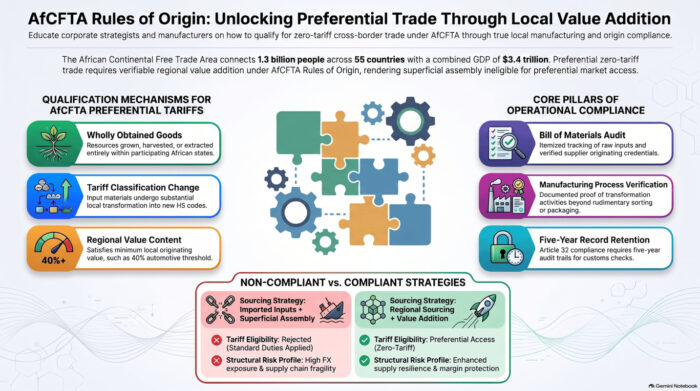
Three principal mechanisms determine whether a product qualifies as originating:
Wholly Obtained Products
Goods that qualify as wholly obtained under the specific provisions of the AfCFTA Rules of Origin. These include qualifying agricultural products grown or harvested within State Parties, livestock raised within the territory, and minerals extracted from African soil or seabeds.
Change in Tariff Classification (CTC)
This mechanism applies when non-originating raw materials or intermediate components undergo sufficient transformation within the continental free trade area, resulting in a change in their Harmonized System (HS) tariff classification.
The precise classification change required depends on the applicable product-specific rule. Not every manufacturing or assembly operation qualifies as sufficient transformation.
Regional Value Content (RVC)
Certain products must satisfy a minimum percentage of originating value incorporated into the final product.
This calculation follows the methodology and product-specific requirements established by the applicable Rules of Origin.
The automotive sector provides an important example. In February 2026, the African Union Assembly approved the outstanding automotive Rules of Origin, establishing a general minimum requirement of 40% African originating content, subject to applicable product-specific provisions.
This is an important distinction: African originating content is not necessarily the same as content manufactured in the individual country where the final assembly takes place.
For example, a manufacturer operating in South Africa may source qualifying originating components from Botswana, Namibia, or another participating African country. Depending on the applicable rules, those inputs may contribute towards the regional originating-content calculation.
Conversely, importing 90% of components from overseas and performing only rudimentary final assembly or packaging in an African facility does not automatically establish originating status.
Customs authorities can examine the manufacturing process, input documentation, applicable product-specific rules, and supporting records before granting preferential treatment.
A product must also be covered by the relevant tariff concessions between the exporting and importing countries, with the applicable administrative and documentary requirements satisfied.
The commercial implication is clear: preferential market access must be engineered into the manufacturing and sourcing strategy from the beginning, not assumed after production.
2. The DCCI Imperative: Why Domestic Value Addition Protects Industrial Margins
This is precisely where the DCCI framework intersects with commercial competitiveness.
Businesses that depend excessively on imported intermediate inputs may face several structural vulnerabilities, even when operating within an increasingly integrated African market.
The Tariff Exposure
Failure to satisfy the applicable Rules of Origin can result in the loss of preferential tariff treatment. Products may consequently become subject to standard import duties when entering other African markets.
For manufacturers operating across several countries, this can undermine the projected cost advantages of regional expansion.
Foreign Exchange Exposure
Sourcing most intermediate inputs from international hard-currency markets while generating revenue in local African currencies creates currency mismatch risks.
Exchange-rate volatility can increase production costs, reduce operating margins, and complicate long-term pricing strategies.
Developing competitive domestic and regional suppliers can reduce unnecessary foreign-currency exposure, although the actual benefits depend on local input prices and availability.
Supply Chain Fragility
Businesses dependent on distant international suppliers remain exposed to maritime freight disruptions, geopolitical tensions, shipping-cost volatility, and international commodity-price movements.
Regional sourcing can shorten supply chains, improve supplier responsiveness, and strengthen operational resilience.
The DCCI Alternative: Building Endogenous Industrial Capacity
The DCCI framework proposes a more structurally resilient industrial model.
Rather than concentrating exclusively on importing finished products and distributing them across African markets, businesses should identify opportunities to develop domestic productive capacity and strengthen regional supplier networks.
This can involve sourcing packaging materials, agricultural inputs, intermediate components, industrial chemicals, and sub-assemblies from competitive African producers.
Not every input needs to originate within Africa. Nor is complete import substitution economically desirable or realistic.
The objective is to increase the share of value generated within African economies wherever commercially viable, while developing competitive regional production networks that can satisfy the applicable AfCFTA originating criteria.
This approach connects domestic consumption capacity with industrial development, employment creation, supply chain resilience, and stronger regional trade integration.
3. The Compliance Burden: Mapping Industrial Inputs to Their Origin
Obtaining preferential originating status requires more than establishing a manufacturing facility or registering a company in an AfCFTA State Party.
Businesses must demonstrate that their products satisfy the relevant Rules of Origin.
This requires reliable documentation, traceability, and a clear understanding of the transformation processes involved.
For manufacturers and international investors, several operational areas deserve particular attention.
Bill of Materials (BOM) Audits
Manufacturers should maintain itemised records of the raw materials, chemicals, components, and intermediate products incorporated into their finished goods.
Supplier documentation should establish the origin of relevant inputs and support the regional value-content calculations where applicable.
Manufacturing Process Documentation
Companies must be able to demonstrate that the production activities carried out within the continental facility satisfy the applicable product-specific transformation requirements.
Simple packaging, labelling, sorting, or minimal assembly may not qualify as sufficient processing.
Origin Verification and Supplier Due Diligence
Manufacturers should assess the reliability of their suppliers, verify relevant origin documentation, and maintain traceability throughout their procurement networks.
This becomes particularly important when production involves several suppliers and manufacturing stages across different African countries.
Transparent Record-Keeping
Article 32 of Annex 2 to the AfCFTA Protocol on Trade in Goods establishes record-retention requirements of at least five years for relevant exporters and importers.
Maintaining origin-related documentation, supporting records, and relevant accounting evidence is therefore essential for responding to verification requests and potential post-exportation or post-importation customs examinations.
For international companies entering African markets, managing these requirements internally can become operationally demanding.
Establishing relationships with experienced local manufacturers, qualified suppliers, and competent customs professionals can significantly improve compliance preparedness.
The commercial challenge is not simply finding a supplier capable of delivering a component. It is identifying a supplier whose production capacity, documentation, and originating status can support the wider regional manufacturing strategy.
4. Strategic Sourcing and Cross-Border Manufacturing Partnerships
The intersection of AfCFTA Rules of Origin and domestic industrial development creates new opportunities for international companies seeking to establish a sustainable presence in African markets.
However, identifying commercially viable partners requires more than a conventional supplier search.
Businesses must evaluate several interconnected factors:
- Manufacturing Capacity: Identifying African companies with the technical capabilities, production infrastructure, and capacity to supply industrial components or finished products.
- Regional Supplier Networks: Locating manufacturers and distributors capable of supporting cross-border production and procurement strategies.
- Regulatory Preparedness: Assessing suppliers’ documentation practices, quality systems, export experience, and ability to support origin verification.
- Industrial Complementarity: Identifying opportunities for joint ventures, contract manufacturing, technology transfer, and local assembly operations.
- Trade Corridor Connectivity: Understanding how transport infrastructure, ports, customs procedures, and regional logistics networks affect the commercial viability of manufacturing partnerships.
A company considering industrial expansion in Africa should therefore approach market entry as a supply chain development exercise rather than simply a distribution strategy.
This is particularly relevant for European and Asian manufacturers seeking to diversify production, develop regional suppliers, or establish new industrial partnerships across the continent.
5. ProdAfrica: Connecting African Industrial Capacity with International Opportunities
Navigating the intersection of AfCFTA compliance, regional manufacturing, and domestic value addition requires reliable commercial intelligence.
Identifying suitable manufacturers, assessing supplier capabilities, and locating potential industrial partners across different African countries can be a significant challenge for international companies.
ProdAfrica addresses this information gap by connecting African and international businesses through its B2B Intelligence Hub.
The platform provides access to business profiles, industrial operators, manufacturers, suppliers, distributors, and service providers across African markets.
For companies exploring regional manufacturing opportunities, this business intelligence layer can support the identification of potential partners and the development of cross-border commercial relationships.
Whether a company is considering component manufacturing in Southern Africa, industrial partnerships in West Africa, or distribution and production networks in East Africa, understanding the available business ecosystem is an essential first step.
Explore African manufacturers, industrial suppliers, and potential business partners through the ProdAfrica B2B Intelligence Hub.
ProdAfrica is a business intelligence and B2B connection platform designed to improve the visibility, credibility, and international connectivity of African businesses.
The True Currency of Continental Trade
The African Continental Free Trade Area is creating new possibilities for regional industrial cooperation, manufacturing investment, and cross-border commercial expansion.
However, preferential trade does not reward superficial assembly or the simple redistribution of imported products. It requires compliance, productive transformation, and a genuine contribution to regional value creation.
Companies that attempt to build their African strategies around imported finished goods and minimal local processing may discover that their anticipated tariff advantages are unavailable.
Conversely, businesses that invest in competitive local suppliers, regional manufacturing partnerships, and transparent originating-content documentation will be better positioned to benefit from preferential market access and more resilient industrial operations.
This is where the DCCI philosophy becomes particularly relevant.
Africa does not need to manufacture everything locally. It needs to capture a greater share of the value generated by its production and consumption.
Building domestic industrial capacity, strengthening regional supply chains, and connecting African producers with international markets are essential components of that objective.
The long-term opportunity of the AfCFTA is therefore not simply the movement of goods across borders.
It is the development of a more productive, interconnected, and economically resilient African industrial ecosystem.