The financial arithmetic in Gaborone shifted faster than most forecasters expected. When lab-grown synthetic diamonds began trading at an 80 to 90 percent discount against mined stones, the margins that had sustained Debswana for half a century took a direct hit. By late 2024 and through 2025, rough diamond revenues were no longer enough to carry the state budget.
With the election of President Duma Boko, the policy response was immediate. The new administration stopped treating the mining sector as a passive royalty tap and began using it as leverage for industrial retooling. That policy pivot is where Botswana critical minerals beneficiation moves from economic theory into enforceable mining law. The message to concession holders and international contractors is clear: the era of digging up raw rock and trucking it across borders without local refining is over.
1. The Export Ban: Driving Botswana Critical Minerals Beneficiation
Shipping unprocessed ore out of Africa has always left governments carrying the heavy end of the bargain. You absorb the haulage costs, pay freight on waste rock, and import finished metals back at a heavy premium. Botswana is cutting that loop by tying mining lease renewals directly to in-country processing milestones.
The rules being drafted in Gaborone focus on three operating requirements:
• Mandatory concentration thresholds: Concessionaires can no longer export bulk run-of-mine ore. Flotation and hydrometallurgical concentration must happen inside national borders.
• Local supply contracts: Mining houses must allocate set budget lines for reagents, equipment overhauls, drilling services, and civil works to companies registered and physically operating in Botswana.
• Feeding domestic supply chains: A percentage of refined base metals, particularly copper cathode and chemical manganese, must remain available for regional industrial users before bulk shipments clear for export.
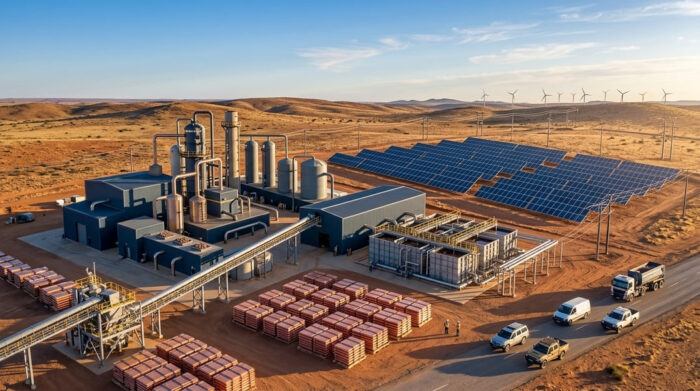
2. The Kalahari Copper Belt: The Reality on the Ground
While diamonds make the headlines, the Kalahari Copper Belt is where the heavy capital is moving. This geological trend runs for roughly 1,000 kilometers from northwest Botswana straight into Namibia, positioning Gaborone directly within the broader supply chain dynamics analyzed in our strategic overview of copper mining in Africa, where regional beneficiation is rewriting trade routes.
Two operations dominate current activity:
• Khoemacau Copper Mine: Supported by an expansion plan targeting 130,000 tonnes of contained copper per year, the underground operation is running one of the largest private procurement books in the country. More than USD 340 million has been earmarked for local suppliers handling heavy logistics, plant maintenance, and processing chemistry.
• Motheo Copper Mine (Sandfire Resources): Located near Ghanzi, Motheo expanded its processing throughput to 5.2 million tonnes of ore annually, delivering high-grade flotation concentrates into international merchant channels.
The Smelter Bottleneck
Moving unrefined concentrate 1,500 kilometers by road to the ports of Walvis Bay via the Trans-Kalahari corridor or down to Durban carries significant freight penalties.
To capture domestic processing margins inside the country, the government is reviewing private and joint-venture proposals for a shared, multi-user copper smelter. Beyond metal recovery, a domestic smelter captures sulfur dioxide to manufacture sulfuric acid locally, a core input for regional fertilizer blending that fits the DCCI industrial model.
3. Battery Chemistry in Kanye: The K.Hill Manganese Project
The strategic rollout of Botswana critical minerals beneficiation extends directly into the international battery market. Automakers in Europe and North America face strict sourcing rules under the European Union Critical Raw Materials Act and the US Inflation Reduction Act, both of which require mineral chains with low embedded carbon and zero reliance on Chinese refining monopolies.
In the Southern District, near Kanye, Giyani Metals is advancing the K.Hill project to produce High-Purity Manganese Sulphate Monohydrate (HPMSM).
HPMSM is a direct precursor chemical for nickel-manganese-cobalt (NMC) lithium-ion battery cells. K.Hill’s advantage is its process flowsheet: it converts manganese ore directly into battery-grade chemical crystals through hydrometallurgical leaching, bypassing the high-emission smelting furnaces typical of traditional plants.
The SEZA Investment Terms
To support high-tech processing, K.Hill and its planned logistics facilities operate under the Special Economic Zones Authority (SEZA) framework:
• A 5 percent corporate tax rate for the first 10 years of commercial operations, rising to 10 percent thereafter.
• Complete relief from customs duties and import VAT on capital machinery, testing equipment, and process reagents.
• Pre-cleared land leases and priority utility interconnections inside designated clusters around Lobatse and Greater Gaborone.
4. Operational Risk: Power Deficits and Kalahari Water
Heavy processing in an arid interior brings harsh operating realities. Mining engineers building in Botswana cannot assume reliable baseload from the national grid, which still deals with generation deficits at the Morupule coal complex and costly imports from South Africa.
Operating teams are managing these ground risks through specific technical choices:
• Off-grid power generation: New processing circuits are pairing 50MW to 100MW captive solar photovoltaic plants with battery energy storage systems (BESS) to cover daytime mill loads and smooth night shifts.
• Water conservation: Ground aquifers in the Kalahari are strictly monitored. Modern concentrators use dry-stack tailings and high-rate thickeners, recycling up to 85 percent of process water back into the grinding circuits.
• Logistics routing: Heavy freight increasingly bypasses congested South African border posts, routing instead through the Mamuno border post directly into the deep-water harbor at Walvis Bay.
5. Working with Local Partners: The PPRA Framework
Foreign engineering groups, EPC contractors, and equipment vendors cannot treat Botswana as an offshore fly-in operation. The Citizen Economic Empowerment Act (CEEA) sets strict rules on domestic equity, technical training, and managerial roles for Batswana professionals.
Regulators actively audit joint ventures to ensure domestic partners hold genuine operational control, cutting down on passive fronting arrangements.
Foreign companies looking to bid on public infrastructure, power lines, and state-backed mining zone tenders must be formally verified on the national procurement roster. To review the registration steps, tax clearance checks, and industry codes required by the government, consult our technical guide on PPRA / PPADB supplier registration.
The Industrial Manufacturing Shift
The downturn in natural diamonds is forcing a long-overdue transition. Botswana is moving away from the fragile role of a raw mineral exporter and stepping into verified domestic processing.
For international equipment suppliers, renewable energy developers, and industrial chemistry groups, the commercial path is straightforward: bring verified technical capacity, build local joint ventures that comply with the law, and anchor your operations in the local market. Gaborone is rewarding companies that refine inside its borders, not those that look for a quick haul across the frontier.
🇧🇼 ProdAfrica B2B Index — Botswana
Proprietary Rating🧠 Index Methodology
The ProdAfrica B2B Index is a proprietary qualitative assessment. Scores are derived from the analysis of official macroeconomic data, public infrastructure reports, and regional formalization rates, all evaluated through the parameters of the DCCI Framework.