The expansion of circular manufacturing in South Africa marks a structural shift in how Southern African industry approaches value retention, waste recovery, and import substitution. For decades, the region’s homeware and interior furnishings sector operated under a costly dependency paradox: African economies generated substantial volumes of agricultural fibers and industrial polymer scrap, yet domestic department stores and hospitality groups imported finished baskets, planters, and furniture from Asian factories at inflated foreign-exchange costs.
Today, that import-dependent equilibrium is being challenged from within. Through the practical application of the DCCI Framework (Development Based on Internal Consumption Capacity), female-led industrial ventures are proving that local waste streams and regional craft networks can be engineered into standardized, commercial-grade goods. A defining operational blueprint of this shift is Mo’s Crib, a circular homeware manufacturer established in Pretoria in 2016 by sisters Morongwe and Michelle Mokone.
Dismantling the Import-Dependency Model in Homeware
Traditional homeware retail across Southern Africa was structurally geared toward finished-goods importation rather than local industrial processing. Major domestic retailers required uniform dimensions, predictable lead times, and container-scale replenishment — operational thresholds that fragmented, informal workshops could rarely meet.
Consequently, South Africa absorbed a double economic drain. Local municipalities bore the environmental burden of unrecovered construction plastics, while domestic retail spending flowed outward to overseas manufacturers instead of circulating through local workshops, domestic logistics providers, and national banking systems.
True industrial sovereignty under circular manufacturing in South Africa requires reversing that flow. When discarded industrial polymers and regional plant fibers are processed and finished inside the producing region, value retention multiplies across the economy: artisans gain technical standardization skills, domestic transport corridors handle value-added finished goods rather than raw scrap, and retail revenue remains anchored in local capital networks.
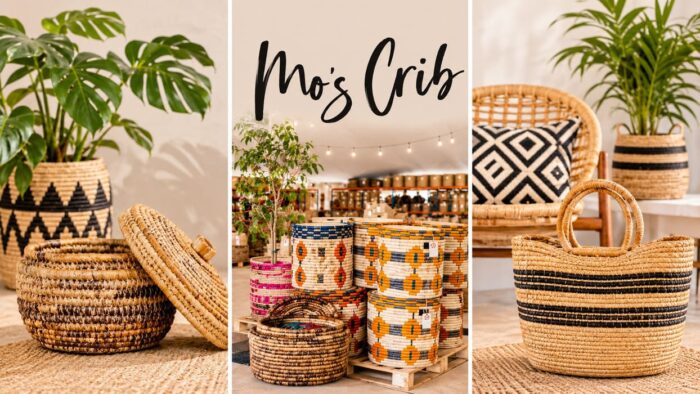
The Mo’s Crib Blueprint: Industrial Waste Meets Pan-African Aggregation
Founded in Tiegerpoort, Pretoria East, Mo’s Crib departed from conventional decorative-craft brokerage to build a structured manufacturing footprint around two core differentiators:
- Industrial Feedstock Valorization: Rather than relying on imported virgin plastics or synthetic rattan, production centers on recovering discarded construction-grade PVC waterpipes and combining them with renewable natural fibers such as banana bark, sisal, and cane.
- Cross-Border Artisan Coordination: Instead of treating African craft as isolated village output, the company built an integrated pan-African supply network linking more than 400 artisans across South Africa, Malawi, Kenya, Tanzania, Ghana, and Rwanda to centralized design, structural framing, and quality control in Gauteng.
By embedding industrial discipline into traditional weaving techniques, the enterprise bridged the historical gap between artisanal heritage and commercial retail specifications.
Structural Comparison: Import Dependency vs. DCCI Circular Production
| Structural Dimension | Import-Dependent Retail Model | DCCI Circular Manufacturing Model |
| Raw Material Base | Imported virgin polymers and overseas synthetic inputs exposed to FX volatility. | Locally recovered PVC industrial waste (10,000+ tons diverted) plus regional natural fibers. |
| Demand Sequencing | Export-first orientation dependent on volatile foreign buyer cycles. | Domestic South African retail capture first, followed by international export scaling. |
| Labor & Value Retention | Assembly margins and design IP captured outside the African continent. | 400+ artisans across 6 African nations integrated into formal, higher-margin finishing. |
| Environmental Compliance | High maritime Scope 3 emissions and unverified material provenance. | Measurable landfill diversion and traceable pan-African circular inputs. |
Why Domestic Retail Capture Anchors the DCCI Framework
Under the DCCI Framework, genuine economic development is measured by a market’s capacity to satisfy domestic consumption through local production before chasing distant export volume. Critics long argued that locally manufactured, design-led homeware could not compete on price or consistency against mass-produced Asian imports inside South African shopping centers.
Mo’s Crib disproved that thesis at home first. Before pursuing international shelf space, the company secured placement across major domestic South African retail chains including Woolworths Home, @Home, and Mr Price Home, alongside local hospitality demand.
This domestic traction provided the operational scale and cash-flow predictability required to absorb international compliance costs. Only after validating circular manufacturing in South Africa within local consumer channels did the enterprise scale into North American retail chains such as Crate & Barrel and Target, launch its December 2026 Los Angeles showcase, and set expansion targets toward Europe and the UAE.
Overcoming Cross-Border Logistics and Standardization Bottlenecks
Scaling pan-African circular production across six nations introduces real infrastructure and regulatory challenges that must be engineered systematically:
- Fiber Curing and Climatic Stability: Natural materials such as banana bark and sisal are sensitive to humidity swings during maritime transit. Producers must enforce strict drying, treatment, and moisture-control protocols in Pretoria before container loading to prevent warping or mold during multi-week sea freight.
- Cross-Border Input Friction: Aggregating natural fibers from Kenya, Tanzania, Rwanda, Malawi, and Ghana into a South African finishing hub requires navigating differing customs documentation, rules of origin under AfCFTA and SADC frameworks, and regional road-freight delays.
- Container Economics and European Compliance: Exporting finished, voluminous furniture and woven décor out of Durban or Cape Town toward Southern European logistics gateways demands optimized nesting, flat-pack design engineering, and verifiable material provenance to satisfy tightening European corporate sustainability audits.
The Southern African Circular Corridor
The trajectory of circular manufacturing in South Africa demonstrates that the continent’s industrial competitiveness does not depend on replicating low-wage, high-emission factory models. When domestic waste streams, regional agricultural fibers, and cross-border artisan talent are organized around internal market demand first, African manufacturers achieve the resilience required to compete globally.
For European interior buyers, hospitality groups, and institutional investors evaluating the Southern African corridor, the lesson is structural: audited circular producers anchored in domestic retail scale offer verifiable ESG provenance alongside reliable, commercial-grade execution.