Agricultural mechanization represents the single highest capital expenditure hurdle for commercial farming enterprises and agribusiness processors across the Southern African Development Community (SADC). With new European and North American combine harvesters and row-crop tractors frequently priced between 180,000 and 380,000 euros, mid-sized agricultural enterprises face unsustainable foreign-exchange debt exposure when purchasing brand-new fleet assets.
Under the DCCI Framework (Development Based on Internal Consumption Capacity), sustainable mechanization does not require speculative debt in brand-new imports. Instead, it relies on importing certified, pre-owned European capital equipment. Sourcing high-specification, second-hand agricultural machinery from Spain — consolidated through Mediterranean export gateways such as the Port of Barcelona and Valencia — delivers a 45 to 60 percent reduction in initial capex while securing machinery built to strict European mechanical and emission tolerances.
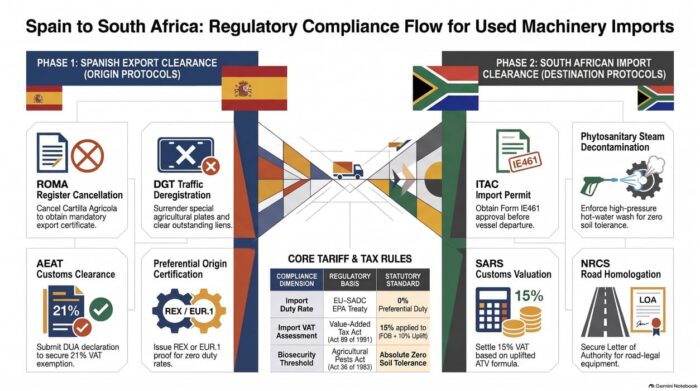
However, importing used machinery South Africa is not an open commercial transaction. It is an intensely regulated industrial process governed by statutory authorities on both continents: the Spanish ROMA, DGT, and AEAT Customs on the European export side; and the ITAC, SARS, DALRRD, and NRCS on the South African import side. Shipping machinery without prior statutory clearance leads to immediate border impoundment and catastrophic demurrage costs at South African container terminals.
1. Regulatory Compliance for Importing Used Machinery South Africa
Before an agricultural tractor, combine harvester, or self-propelled sprayer can physically enter the Port of Barcelona for loading, the Spanish seller or exporter must complete a strict sequence of statutory deregistrations. Failing to execute these steps leaves the machine legally encumbered in Europe and exposes the transaction to Spanish value-added tax liabilities:
Step 1: Mandatory ROMA Deregistration (Real Decreto 448/2020)
Under Real Decreto 448/2020, all agricultural tractors, self-propelled machinery, and towed implements exceeding 750 kg must be registered in the Registro Oficial de Maquinaria Agrícola (ROMA) of the corresponding Autonomous Community (such as the DARP in Catalonia or the Department of Agriculture in Aragon).
- The owner must file for a formal Baja por pase a otro sector / Exportación.
- The agrarian registry cancels the agricultural registration booklet (Cartilla Agrícola) and issues an official Certificado de Baja en ROMA.
- This certificate is legally required by traffic authorities before any vehicle license can be cancelled.
Step 2: DGT Deregistration for Export (Reglamento General de Vehículos)
Under Articles 35 and 37 of Real Decreto 2822/1998 (Reglamento General de Vehículos), agricultural tractors carrying special agricultural plates (placas VE) must process a Baja definitiva por traslado del vehículo a otro país (exportación) with the Dirección General de Tráfico (DGT).
- Prerequisite Check: The machine must be completely free of liens, financing encumbrances, or leasing pledges registered in the Registro de Bienes Muebles (RBM). Any outstanding Reserva de Dominio must be formally cancelled by the bank prior to filing.
- Upon processing, the DGT surrenders the original registration certificate and issues the official Justificante de Baja Definitiva por Exportación, releasing the asset from Spanish municipal road taxes (IVTM).
Step 3: Customs Export Declaration (DUA) and VAT Exemption (Ley 37/1992)
Exporting outside the European Union requires filing the Documento Único Administrativo (DUA de Exportación) through the Spanish Tax Agency (AEAT – Departamento de Aduanas e Impuestos Especiales).
- The Tax Incentive: Under Artículo 21 de la Ley 37/1992 (Ley del IVA), commercial machinery exports to non-EU destinations are strictly exempt from Spanish 21% VAT (Operación exenta por exportación).
- Proof of Exit: The customs broker generates the Movement Reference Number (MRN) and secures the Levante de Exportación (LER). Once the cargo physically exits the Port of Barcelona, the customs system confirms the Certificación de Salida Efectiva, protecting the Spanish seller from retroactive VAT audits.
Step 4: Preferential Origin Certification (REX System / EUR.1)
Under the EU–SADC Economic Partnership Agreement (EPA), second-hand European machinery qualifies for preferential zero percent customs duty into South Africa only if proof of origin is legally established.
- For commercial consignments exceeding 6,000 euros, the exporter must be registered under the Registered Exporter System (Sistema REX) of the European Union and issue an official origin declaration on the commercial invoice, or request an official Certificado de Circulación EUR.1 endorsed by the Aduana de Barcelona. Without this document, SARS Customs will assess standard third-country tariffs.
2. The South African Import Gatekeeper: ITAC Permit (Form IE461)
Under the statutory mandate of the International Trade Administration Act (Act 71 of 2002), all second-hand, used, or reconditioned capital goods entering the Republic of South Africa are subject to rigorous import control.
Unlike new agricultural equipment, which enters under general rebate provisions, used tractors, harvesters, and balers require an individualized ITAC Import Permit issued prior to vessel departure.
Mandatory ITAC Filing Protocol:
- Filing Document: Application Form IE461 (Application to Import Used or Second-Hand Capital Equipment).
- Lead Time: 10 to 20 statutory business days from formal submission.
- The Fatal Non-Compliance Risk: The import permit must be officially approved and issued before the marine Bill of Lading (B/L) is issued in Barcelona or Valencia. If an exporter loads a used tractor onto a vessel before ITAC permit approval, SARS Customs will immediately flag the manifest upon arrival in Durban. The cargo will be detained under embargo, incurring daily terminal storage fees, and can be subjected to mandatory re-exportation or state forfeiture.
- Economic Justification: ITAC evaluates whether the imported used machinery causes material disruption to local domestic equipment assembly. Importers must demonstrate operational necessity, technical specifications, and purchase documentation showing that the unit is required for active agricultural production.
3. SARS Customs Clearance: Tariffs, Valuation, and the ATV Formula
South Africa is a signatory to the EU–SADC Economic Partnership Agreement (EPA). Under this trade treaty, qualifying capital agricultural machinery manufactured within the European Union enters South Africa at preferential tariff rates.
Tariff Classifications (HS Codes):
- HS 8701.91 to 8701.95: Agricultural tractors (wheeled, classified by kilowatt rating) — 0% Customs Duty under the EU–SADC EPA.
- HS 8433.51: Combine harvester-threshers — 0% Customs Duty under the EU–SADC EPA.
- HS 8433.40: Hay and straw baling machinery — 0% Customs Duty under the EU–SADC EPA.
- HS 8432.10 to 8432.80: Soil preparation and cultivation implements (ploughs, harrows, seeders) — 0% Customs Duty.
The SARS Import VAT Calculation: The Added Tax Value (ATV) Rule
While customs duty is 0%, all imported machinery is subject to South Africa’s standard 15% Value-Added Tax (VAT) under the Customs and Excise Act (Act 91 of 1964).
Importers frequently commit serious budgeting errors by assuming VAT is calculated simply on the purchase price. Under Section 13(2) of the Value-Added Tax Act (Act 89 of 1991), SARS assesses import VAT on the statutory Added Tax Value (ATV), which artificially uplifts the customs value by 10 percent before tax application:
Statutory ATV Formula:
ATV = Customs Value (FOB Spain) + Statutory 10% Upliftment + Any Applicable Customs Duties
Import VAT Payable:
VAT = ATV × 15%
4. Financial Landed Cost Model: Used 160 HP Tractor (Spain to Durban)
To illustrate the true landed cost structure, the following model details a realistic commercial import of a pre-owned 2019 John Deere 6155M (or equivalent New Holland T7 / Case IH Puma) purchased in Catalonia, Spain, and delivered to a commercial farm in the Free State via the Port of Durban.
(Calculated at an exchange rate baseline of 1 EUR = 19.50 ZAR)
| Cost Component | Base Valuation (EUR) | Local Currency (ZAR) | Regulatory / Commercial Basis |
| Machinery Purchase Price (FOB Barcelona) | 55,000 EUR | 1,072,500 ZAR | Audited commercial invoice, clean title, ROMA/DGT cancelled |
| Pre-Shipment Decontamination & Steam Wash | 650 EUR | 12,675 ZAR | High-pressure industrial steam wash; phytosanitary protocol |
| Maritime Ocean Freight (Ro-Ro Barcelona–Durban) | 5,200 EUR | 101,400 ZAR | Roll-on/Roll-off ocean carriage (approx. 24 days transit) |
| Marine Cargo Transit Insurance (All Risks) | 450 EUR | 8,775 ZAR | Institute Cargo Clauses (A), calculated at 110% CIF |
| Total CIF Durban Value | 61,300 EUR | 1,195,350 ZAR | Baseline commercial landed port arrival cost |
| SARS Customs Duty (EU–SADC EPA Preferential Rate) | 0 EUR | 0 ZAR | HS 8701.94 (0% duty backed by valid EUR.1 / REX proof) |
| Statutory 10% Customs Uplift (10% of FOB) | 5,500 EUR | 107,250 ZAR | Mandatory Value-Added Tax Act statutory formula |
| Added Tax Value (ATV Base for Tax Assessment) | 60,500 EUR | 1,179,750 ZAR | FOB Value + 10% upliftment |
| South African Import VAT (15% of ATV) | 9,075 EUR | 176,963 ZAR | Claimable input VAT for registered SARS VAT vendors |
| Durban Port Landing, Wharfage & Terminal Handling | 680 EUR | 13,260 ZAR | Transnet National Ports Authority (TNPA) / TPT tariffs |
| DALRRD Biosecurity Inspection & BMA Port Clearance | 220 EUR | 4,290 ZAR | Physical quarantine verification and release permit |
| Customs Clearing Agent & EDI Documentation | 400 EUR | 7,800 ZAR | Licensed South African customs broker administrative fees |
| Inland Heavy-Haul Transport (Durban to Free State) | 1,450 EUR | 28,275 ZAR | Lowbed road trailer freight to agricultural site |
| Total Net Landed Investment (Excluding Reclaimable VAT) | 64,650 EUR | 1,260,675 ZAR | Operational capital cost deployed for productive machinery |
| Total Cash Outlay Required at Border (Including VAT) | 73,725 EUR | 1,437,638 ZAR | Total liquid capital required to clear South African customs |
(Note: For SARS-registered agricultural enterprises, the 176,963 ZAR in import VAT is fully claimable as an input tax deduction on the subsequent VAT return, meaning the net capital cost to the enterprise remains approximately 1,260,675 ZAR — under half the cost of a comparable new unit).
5. The Critical Biosecurity Barrier: DALRRD and the Agricultural Pests Act
The most frequent cause of cargo rejection at South African maritime ports is biological contamination. Under the Agricultural Pests Act (Act 36 of 1983), enforced jointly by the Department of Agriculture, Land Reform and Rural Development (DALRRD) and the Border Management Authority (BMA), used agricultural machinery is categorized as a high-risk vector for foreign soil-borne pathogens, parasitic nematodes, noxious weed seeds, and insect larvae.
Zero-Tolerance Soil Contamination Protocol:
- The Standard: South African biosecurity operates on absolute zero soil tolerance. A machine displaying dry mud beneath wheel arches, within combine radiator screens, or lodged inside chassis hollows is legally prohibited from entering the domestic biosphere.
- Action Required in Spain Before Loading: The Spanish equipment seller or exporter must subject the machine to an exhaustive, high-pressure hot-water wash and steam decontamination. All radiator cores, tire treads, cabin filters, cutter-bars, and undercarriages must be physically immaculate. An official certificate of industrial steam cleaning and disinfection must be issued in Spain.
- On-Arrival Inspection at Durban/Cape Town: Upon vessel discharge, DALRRD plant health inspectors conduct a physical examination in the port bonded zone.
- If the machine passes, a release notice is issued immediately.
- If soil traces or biological matter are discovered, the unit is placed under immediate phytosanitary arrest. The importer is forced to pay for bonded transport to an approved decontamination depot, specialized high-risk pressure cleaning under official supervision, and secondary inspection fees. If severe quarantine organisms are identified, DALRRD possesses statutory authority to order immediate destruction or re-exportation at the importer’s sole expense.
6. Road Homologation: NRCS Letter of Authority (LOA)
If the imported equipment consists of self-propelled machinery that will operate on or cross public roads in South Africa (such as agricultural tractors), the vehicle must comply with the National Road Traffic Act (Act 93 of 1996) and mandatory specifications overseen by the National Regulator for Compulsory Specifications (NRCS) under the NRCS Act (Act 5 of 2008).
- The Letter of Authority (LOA): The importer must obtain an LOA from the NRCS Automotive Division before the vehicle can be registered onto the South African National Traffic Information System (eNaTIS).
- Technical Compliance: The tractor must feature compliant lighting systems, reflective markings, braking systems, and certified Roll-Over Protective Structures (ROPS) meeting SANS and ISO safety standards.
- Operational Scope: Stationary implements, trailed disc harrows, and specialized harvesters moved exclusively on lowbed trailers do not require full eNaTIS road licensing, but tractors intended to travel between disconnected farmland plots must complete the NRCS homologation process.
7. Maritime Logistics: Ro-Ro vs. Containerized Flat Rack
Choosing the correct maritime freight configuration from the Port of Barcelona determines both transport risk and port handling charges:
Option A: Roll-on/Roll-off (Ro-Ro) — Recommended for Operable Tractors & Combines
- How It Works: Self-propelled machinery is driven directly into the enclosed vehicle decks of specialized car and heavy-equipment carriers.
- Key Advantages: Minimal disassembly required; zero risk of equipment damage from container stuffing or crane lifting; completely protected from salt-water spray throughout Atlantic transit.
- Logistical Reality: Machinery must be 100% operable (functional batteries, reliable starter motor, adequate fuel for ship loading and discharge). Ro-Ro vessels operate regular rotations from the Port of Barcelona to Durban.
Option B: Disassembly and Flat Rack / High-Cube Containers — For Implements & Non-Running Units
- How It Works: Wide implements, balers, or non-operational machinery are partially dismantled (wheels, cabs, or cutter headers unbolted) and secured onto 40-foot Flat Rack platforms or packed inside 40-foot High-Cube dry vans.
- Key Advantages: Access to a higher frequency of weekly container liner services from Barcelona.
- Key Trade-Offs: Substantially higher origin and destination labor costs for unbolting, lashing, re-assembly, and recalibration in South Africa.
Industrial De-Risking for Agribusiness
Building agricultural sovereignty under the DCCI model requires mastering the trade logistics of capital assets. When South African agricultural enterprises and Spanish industrial equipment dealers structure used machinery transactions around complete compliance — executing ROMA and DGT deregistrations in Spain, securing ITAC permits prior to shipping, enforcing pre-shipment steam decontamination, and accurately budgeting SARS added-tax formulas — import risk drops to zero.
For agribusiness directors, cooperative managers, and equipment traders, verified cross-border intelligence bridges the Mediterranean and Southern African agricultural corridors: converting pre-owned European engineering into long-term, unencumbered productive capacity on African soil.
🇿🇦 ProdAfrica B2B Index — South Africa
Proprietary Rating🧠 Index Methodology
The ProdAfrica B2B Index is a proprietary qualitative assessment. Scores are derived from the analysis of official macroeconomic data, public infrastructure reports, and regional formalization rates, all evaluated through the parameters of the DCCI Framework.