While the Development Based on Internal Consumption Capacity (DCCI) framework offers a coherent endogenous growth model centred on domestic purchasing power, local value addition, and efficient market connectivity, its practical realisation confronts well-documented structural, fiscal, institutional, and regional constraints. This second part examines four critical areas that require conceptual refinement and operational adaptation: (1) phased and sequenced implementation to preserve macroeconomic stability, (2) the strategic integration of the African Continental Free Trade Area (AfCFTA) as a scaling mechanism, (3) hybrid approaches to overcome persistent digital and logistical divides, and (4) sustainable domestic resource mobilisation combined with selective external financing. The analysis seeks to bridge the gap between aspirational policy design and feasible execution in contemporary African political-economy contexts.
1. Phased Implementation and Macroeconomic Sequencing
Rapid, simultaneous increases in minimum wages, social transfers, and producer subsidies—while desirable—frequently generate adverse second-round effects when implemented without corresponding productivity gains. Empirical evidence from multiple low- and middle-income settings demonstrates that wage-led demand expansion in low-productivity environments tends to manifest as imported inflation, exchange-rate pressure, and/or widening fiscal deficits.
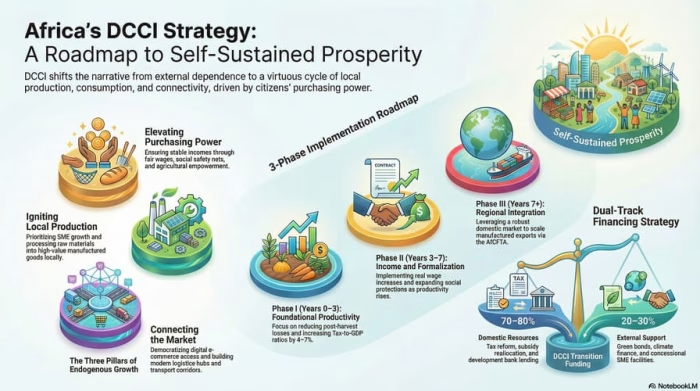
A stylised three-phase implementation sequence is therefore proposed:
Phase I (Years 0–3): Foundational productivity and fiscal capacity building
- Prioritise post-harvest loss reduction (currently 30–40% for many staple crops), smallholder access to improved inputs, low-cost irrigation, and digital agricultural market information systems.
- Strengthen domestic revenue mobilisation through digital tax administration, broadening of the tax base, and rationalisation of regressive exemptions granted to large-scale extractive operations (target: increase tax-to-GDP ratio by 4–7 percentage points).
Phase II (Years 3–7): Progressive income growth and formalisation
- Introduce real wage increases and minimum-wage adjustments selectively in sectors where labour productivity has already risen (agro-processing, light manufacturing, tradable services).
- Expand targeted social protection (conditional cash transfers, basic health coverage) financed through incremental fiscal space and import-substitution savings.
Phase III (Years 7+): Consolidation and regional integration
- Leverage a now more robust domestic market to support manufactured and processed exports to regional partners.
This staged approach mitigates classic stop-go cycles and builds political credibility through early, visible welfare and productivity gains.
2. The AfCFTA as a Structural Multiplier of Domestic Consumption-Led Growth
Most African national markets remain too small to sustain meaningful industrial deepening or sustained economies of scale in processed goods. The African Continental Free Trade Area (AfCFTA), operational since 2021 and progressively expanding, effectively enlarges the relevant market space from national to continental dimensions (≈1.4 billion consumers in 2025, projected to reach 2.5 billion by mid-century).
Integration with the DCCI framework requires deliberate policy alignment:
- Establishment of national AfCFTA implementation units specialised in supporting SMEs to meet rules-of-origin requirements, sanitary and phytosanitary standards, and technical barriers to trade.
- Acceleration of non-tariff barrier (NTB) reduction schedules specifically for intermediate and consumer goods with high domestic value-added potential.
- Creation of regional adjustment funds and transitional support mechanisms for sectors and households exposed to increased intra-African competition during the liberalisation phase.
When conceptualised in this manner, the AfCFTA ceases to function merely as a trade-facilitation instrument and becomes an essential enabler of scale for consumption-driven industrialisation.
3. Hybrid Digitalisation and Logistics Strategies for Inclusive Connectivity
The persistence of electricity access gaps, high data costs, and inadequate rural transport infrastructure continues to segment markets and limit the transmission of purchasing power gains to producers.
A layered, pragmatic approach is recommended:
Digital connectivity
- Short-term: expansion of USSD/SMS-based agricultural information and transaction platforms.
- Medium-term: agent-assisted smartphone adoption combined with subsidised data bundles for registered producers.
- Long-term: public–private investment in rural 4G/5G coverage and last-mile solar electrification.
Physical logistics
- Selective development of high-impact corridors (e.g., Lagos–Abidjan, Nairobi–Mombasa–Kigali–Kampala, Dakar–Bamako) through blended finance models.
- Replication and adaptation of large-scale central wholesale markets (inspired by successful international models but governed through hybrid public–private entities to improve operational efficiency).
- Strategic investment in cold-chain infrastructure to reduce agricultural value loss and enable greater participation of smallholders in national and regional value chains.
4. Financing the Transition: Domestic Resource Mobilisation and Strategic External Support
The capital requirements of simultaneous investment in human capital, productive infrastructure, and market connectivity exceed the fiscal capacity of most African governments under current revenue structures.
A dual-track financing strategy is proposed:
Primary reliance on domestic sources (target 70–80% of total effort)
- Progressive tax reform (personal income tax, VAT compliance, natural-resource taxation).
- Reallocation of existing subsidies (particularly fuel subsidies) towards smart producer and consumer subsidies.
- Recapitalisation and refocusing of national and regional development banks on long-term productive lending.
Selective and disciplined external financing (20–30%)
- Climate-finance instruments (green bonds, adaptation funds, Just Energy Transition Partnerships) aligned with resilient agriculture and low-carbon logistics.
- Blended finance facilities targeting SME growth and corridor infrastructure.
- Preference for concessional and non-debt-creating flows that do not impose policy conditionalities antithetical to domestic value-addition objectives.
| Area | Phase / Horizon | Key Objectives | Strategies / Actions | Indicators / Targets |
|---|---|---|---|---|
| Phased Implementation & Macroeconomics | Phase I (0–3 years) | Build productivity and fiscal capacity | – Reduce post-harvest losses (30–40%) – Improve smallholder access to inputs and low-cost irrigation – Deploy digital agricultural information systems – Strengthen domestic revenue mobilisation, broaden tax base | Tax-to-GDP ratio increase: 4–7 pp |
| Phase II (3–7 years) | Gradual income growth and formalisation | – Selective real wage increases in productivity-ready sectors – Expand targeted social protection (conditional cash transfers, basic health coverage) | Coverage of social programs; wage growth in selected sectors | |
| Phase III (7+ years) | Consolidation and regional integration | – Support manufactured and processed exports – Engage regional markets | Share of regional exports in national production | |
| AfCFTA & Industrial Scaling | Medium to long term | Expand domestic market scale | – Establish national AfCFTA implementation units – Reduce non-tariff barriers (NTBs) – Create regional adjustment funds | Number of SMEs enabled for AfCFTA; compliance with technical standards |
| Digitalisation & Logistics | Short term | Initial digital inclusion | – USSD/SMS-based agricultural platforms | Number of producers connected |
| Medium term | Subsidised smartphone adoption | – Agent-assisted smartphone use; subsidised data bundles | % of producers with smartphone access | |
| Long term | Advanced infrastructure | – Public-private investment in rural 4G/5G – Last-mile solar electrification | Rural 4G/5G coverage; % rural electrification | |
| Physical Infrastructure | Medium–long term | Improve transport & reduce losses | – Develop strategic transport corridors (e.g., Lagos–Abidjan, Nairobi–Mombasa, Dakar–Bamako) – Hybrid public-private wholesale markets – Cold-chain infrastructure | Reduction in post-harvest losses; improved logistical efficiency |
| Financing | Throughout | Ensure sustainable investment | Domestic (70–80%): – Progressive tax reform – Reallocate subsidies to targeted support – Development banks refocused on productive lending External (20–30%): – Green bonds, blended finance, climate & SME support | % of investment covered by domestic vs external sources; funding volumes for infrastructure and SMEs |
Concluding Remarks
The DCCI framework does not represent an idealistic rejection of global integration but rather a strategic re-sequencing of development priorities: first building a robust internal consumption–production nexus, then leveraging that domestic strength to engage regional and global markets on more favourable terms.
Realising this trajectory demands political commitment to long-term institutional reform, technical sophistication in policy sequencing, and regional cooperation to exploit scale advantages embedded in the AfCFTA. When these elements converge, the model offers a credible pathway towards structural transformation that is simultaneously economically autonomous and socially inclusive.
The central research and policy question is therefore no longer whether an internally anchored growth model is theoretically desirable for Africa, but which coalitions of state, private sector, and regional actors possess the coherence and determination to execute it at scale.

Juan Esteban Reina Heads the ProdAfrica Consulting & Business Directory.
Spcialist in Africa, urbanism, geomarketing and tourism. He is currently developing projects oriented to consultancy especially in fields such as tourism, business and commercial development, as well as promoting business between Africa and Europe.
His passion is Africa. He firmly believes in the future of the continent and the ability of its people to achieve a better future for future generations.