📊 Strategic Report Index
- • Introduction: The Transformation of an Industrial Giant
- • What is the Mercabarna Model and How Can it be Adapted to Botswana?
- • How to Solve the Logistics and Distance Gap in Botswana’s Internal Trade?
- • How can Local Markets drive Fiscal Sustainability and Political Legitimacy?
- • Why is a Mixed Governance Model Essential for African Infrastructure Success?
- • The Citizen Beyond the Consumer: Active Ownership
- • Financing the Initial Investment
- • ProdAfrica as the Digital Layer for Connectivity
- • Conclusion: Embedding Endogenous Prosperity
From Framework to Territory — Why Botswana?
The first two parts of this series established the theoretical architecture of the DCCI framework — Development Based on Internal Consumption Capacity — and its operational conditions. But development frameworks only acquire real meaning when they confront specific geographies, specific populations, and specific constraints.
Botswana offers a uniquely instructive case for DCCI Botswana. With one of the lowest risk ratings in Sub-Saharan Africa, a stable currency (the Pula), a legal system rooted in common law, and sustained GDP growth driven historically by diamond revenues, Botswana has the institutional foundations that many African nations are still building. Yet it faces a paradox familiar across the continent: relatively strong macroeconomic indicators coexist with an underdeveloped internal market infrastructure, significant post-harvest losses, and a productive base — particularly in agriculture and artisanal sectors — that remains structurally disconnected from domestic consumers.
This paradox has become even more pressing in the current context. Botswana has experienced a double recession in 2024-2025, driven by a sharp decline in global diamond demand and revenues (which historically account for about 70% of exports and one-third of government income). In response, the government is actively pursuing economic diversification Botswana, with agriculture identified as a priority sector and a target to raise its contribution to GDP from around 2% to 6%. The proposed market network aligns directly with this national imperative, offering a practical tool to accelerate diversification through stronger internal connectivity and value addition.
This is precisely where DCCI‘s third pillar — Market Connectivity — finds its most urgent and actionable expression in the context of local market infrastructure Botswana.
📌 DCCI Case Study: Botswana Economic Diversification
- Strategic Goal: Increase agriculture’s GDP contribution from 2% to 6% through the Mercabarna-adapted model.
- Core Infrastructure: National network of Primary & Secondary Markets supported by Rural Aggregation Points (RAPs).
- The Solution: Eliminating post-harvest losses (15-40%) via solar-powered cold storage and Digital Pre-Sale Integration.
- Governance: A triple-layer model (Public-Private-Community) ensuring transparency and Endogenous Development.
- Digital Backbone: Verified B2B connectivity powered by ProdAfrica Business Directory.
What is the Mercabarna Model and How Can it be Adapted to Botswana?
The central proposal of this analysis is the creation of a national network of structured local markets across Botswana — physical hubs of economic activity that function simultaneously as commercial infrastructure, fiscal instruments, and community development engines.
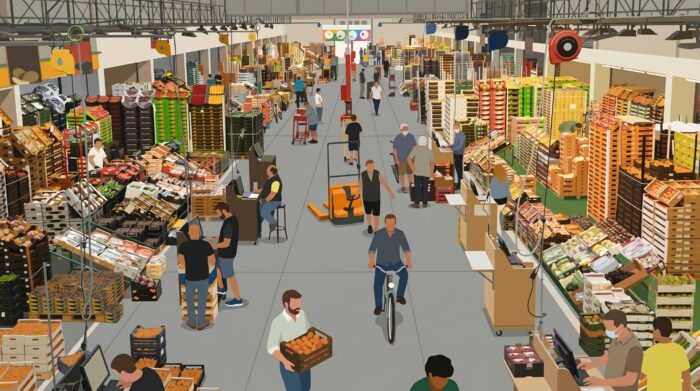
The inspiration is concrete: the Mercabarna model in Barcelona, one of Europe’s most efficient agri-food wholesale and retail market complexes, serving as the organisational reference — but radically redimensioned, adapted, and reimagined for Botswana’s territorial, cultural, and economic reality.
The network would operate at two scales:
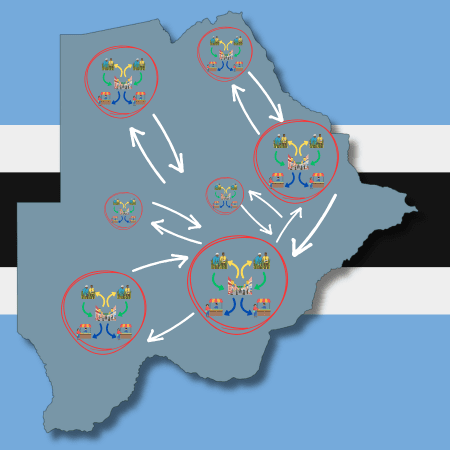
Primary Markets — Located in Gaborone and Francistown, the two largest urban centres. These would function as the main wholesale and retail nodes, with full infrastructure: cold chain facilities, digital transaction platforms, quality certification points, logistics coordination centres, and permanent commercial spaces for producers, wholesalers, and retailers across all sectors — not just agricultural, but manufactured goods, artisanal products, services, and local industry.
Secondary Markets — Located in Maun, Serowe, and Kasane, sized according to regional population and productive capacity. These serve as intermediate nodes connecting rural producers to the national network without requiring them to travel to the capital.
How to Solve the Logistics and Distance Gap in Botswana’s Internal Trade?
Botswana’s geography is one of the most challenging on the continent for internal commerce. At 581,000 km² — roughly the size of France — with a population of just 2.5 million and a density of approximately 4 persons per km², the distances between productive zones and consumption centres are enormous. In the rainy season, many rural areas become practically inaccessible.
A producer in Ghanzi, Shakawe, or the eastern agricultural belt cannot absorb the transport costs of bringing goods to Gaborone independently. Without solving this, the local market network risks becoming infrastructure that only serves producers already near urban centres — reproducing existing inequalities rather than dissolving them.
The solution proposed here operates in three layers:
Layer 1 — Rural Aggregation Points (RAPs)
Small, strategically located collection facilities in productive rural zones. A RAP is not a full market — it is a consolidation node. Producers bring their goods to the nearest RAP, where basic classification, weighing, and digital registration take place. Crucially, RAPs include solar-powered cold storage, eliminating the post-harvest losses that currently reach 15-40% for many staple crops and perishables (according to APHLIS and FAO estimates). To maximize producer empowerment and product quality, RAPs will also serve as initial training centers for smallholder farmers and artisans, offering basic modules in quality standards, post-harvest handling, sustainable packaging, and digital literacy. This integrated capacity building directly reinforces the “Elevating Consumption Capacity” pillar by ensuring producers can meet market demands effectively.
Layer 2 — Collective Logistics Corridors
Fixed weekly routes connecting RAPs to secondary and primary markets, operated through shared transport schemes. Individual producers do not absorb individual transport costs — the cost is shared among all producers consolidating at a given RAP. Natural corridors emerge from Botswana’s geography: Ghanzi → Francistown → Gaborone; Maun → Francistown; Kasane → Francistown; Serowe → Gaborone.
Layer 3 — Digital Pre-Sale Integration
A producer does not need to physically transport goods to a primary market to sell there. Through a digital platform integrated into the RAP registration system, goods are listed at the point of aggregation — with description, quantity, and price — and can be purchased by urban buyers before the transport corridor runs. Product moves only when it is already sold. This eliminates the risk of unsold stock and the cost of empty transport.
How can Local Markets drive Fiscal Sustainability and Political Legitimacy?
The sustainability and political viability of this model depend on one non-negotiable condition: the communities hosting these markets must visibly and tangibly benefit from their operation. Without this, the model becomes another extractive infrastructure — however well designed — that generates resistance, abandonment, or capture by local elites.
The proposed tax structure operates at three levels:
Stall Fees — Tiered by commercial category. Small local producers pay a minimal access fee, deliberately kept below the threshold of financial strain. Wholesalers and permanent retailers pay proportional fees based on space occupied. A 12-month fee exemption for first-time local producers incentivises entry and formalisation.
Transaction Levy — A small percentage on gross sales, applicable to wholesalers and retailers above a minimum volume threshold. Small producers are exempt. This creates progressivity: larger operators with higher margins contribute more to the communal fund.
Infrastructure Access Fee — A usage-based charge for cold chain facilities, digital platform services, and logistics coordination. Paid only by those who use them, proportional to volume.
The revenue generated by these three streams is allocated through a transparent, participatory budget with legally mandated distribution:
- 40% → Market maintenance, infrastructure upgrade, and operational costs
- 30% → Immediate neighbourhood and district infrastructure: roads of access, sanitation, lighting, public space
- 20% → Microfinance fund for local producers registered in the market
- 10% → Regional administration for network coordination
Critically, this budget is not managed by central government — it is governed by a Market Council elected by the producers and traders themselves, with full public transparency: a physical display board inside the market and a public digital dashboard showing in real time how much has been collected and how it has been spent. Any citizen can verify the accounts. Transparency is not a complementary feature — it is the primary anti-corruption mechanism.
Why is a Mixed Governance Model Essential for African Infrastructure Success?
African development history is littered with well-designed public infrastructure that collapsed through mismanagement, corruption, or political capture. The governance architecture of this model is deliberately designed to make these failure modes structurally difficult.
Public layer — Land and basic infrastructure are public assets. The state — at national or local government level — provides the land and finances initial construction. This is non-negotiable: it prevents privatisation, ensures the market cannot be sold or captured, and provides the political legitimacy that makes community buy-in possible.
Private layer — Day-to-day operational management is contracted to a private entity, selected through competitive public tender with a renewable four-year mandate. The operator is compensated through a performance-linked percentage of total revenue, not a fixed salary. This creates direct incentive alignment: the operator earns more when the market generates more.
Community layer — The Market Council, elected by producers and traders, holds real institutional power: it approves the participatory budget, audits the private operator, commissions independent reviews, and can trigger mandate termination through a defined process. Without Council approval, the communal revenue allocation cannot be executed.
Digital transparency layer — All financial flows are recorded in a public ledger. No cash transactions above a minimal threshold. Integration with mobile payment systems (such as the existing Orange Money and Smega infrastructure in Botswana) ensures traceability and reduces leakage.
The Citizen Beyond the Consumer
This is the proposition that distinguishes this model most fundamentally from conventional market infrastructure — whether private shopping centres or unstructured informal markets.
In conventional commercial infrastructure, the citizen has one role: consumer. Value is extracted from the territory and concentrated elsewhere.
In this model, the citizen operates simultaneously in three roles:
As producer — access to infrastructure that individually would be unaffordable: cold storage, certified weighing, digital visibility, logistics. The market grants productive capacity that the individual producer could never finance alone.
As consumer — access to local, fresh, traceable products at prices lower than imported alternatives. The supply chain is shortened; the margin that previously went to distant intermediaries stays in the local economy. To further enhance this, national “Buy Local” campaigns will be strategically launched in conjunction with the market network’s rollout. These campaigns will leverage public awareness and marketing to foster a culture of local consumption, reinforcing economic identity and trust in domestically produced goods, as advocated by the DCCI framework.
As owner — through the Market Council and the participatory budget, the citizen has institutionalised decision-making power over how the economic surplus generated by the market is reinvested in the community. This is not passive benefit — it is active governance. The market belongs, in a meaningful structural sense, to the community it serves.
This third role — citizen as owner — is what transforms a market into a pole of community development. It is also what generates the political durability that infrastructure projects in Africa so often lack: when communities own the benefit, they defend the institution.
Financing the Initial Investment
The capital requirements for establishing primary and secondary markets, RAPs, and logistics corridors exceed the fiscal capacity of any single actor. A phased, multi-source financing model is proposed:
Phase 1 — Pilot: Gaborone and Francistown
- 40% national government (Botswana’s diamond revenue reserves provide capacity)
- 30% regional development finance (African Development Bank infrastructure programmes)
- 20% local private sector — Botswana-based companies obtaining operational concessions
- 10% community pre-commitment — symbolic contributions from future traders as a signal of ownership and commitment
Phase 2 — Secondary Markets (Maun, Serowe, Kasane)
Partially self-financed from Phase 1 revenue streams. The model compounds: early markets generate the capital to build subsequent ones.
Phase 3 — Rural Aggregation Points
Eligible for international climate finance — post-harvest loss reduction, cold chain infrastructure, and smallholder integration are priority areas for the Green Climate Fund, IFAD, and Just Energy Transition instruments. The climate finance pathway reduces the fiscal burden on national government and aligns the model with international sustainability frameworks.
ProdAfrica as the Digital Layer
The DCCI framework‘s third pillar — Market Connectivity — has both physical and digital dimensions. The physical dimension is what this article has described: the network of markets, RAPs, and logistics corridors. The digital dimension is the infrastructure that makes the physical network legible, searchable, and connected to buyers beyond Botswana’s borders.
This is where ProdAfrica enters not as a promotional instrument but as a structural component of the model. Every producer registered in the market network has a verified, searchable digital profile visible to buyers across Africa, Europe, and globally. The RAP registration system feeds directly into the directory. A coffee producer in Serowe is not only selling at the local market — they are visible to an importer in Amsterdam or a buyer in Nairobi.
The local market network and the digital directory are not parallel systems — they are two expressions of the same DCCI logic: connect what is produced with those who need it, at every scale from the village market to the continental trade route.
Replicability — Conditions for Other African Countries
Botswana is the pilot case, not the exclusive case. The model is designed to be replicable in countries that share a specific set of conditions:
- Institutional stability sufficient to protect public infrastructure from political capture
- A productive base — agricultural, artisanal, or manufactured — that is currently disconnected from internal markets
- Mobile payment infrastructure that enables cashless transaction traceability
- A governance tradition — however imperfect — of local administration with some fiscal autonomy
Rwanda, Namibia, Zambia, and Senegal present combinations of these conditions that make them credible second-wave candidates. Each would require adaptation: Rwanda’s density makes logistics far simpler; Namibia shares Botswana’s geographic challenge; Zambia’s agricultural productive base is larger and more diversified; Senegal’s urban-rural dynamics differ significantly.
The framework is the constant. The implementation is always specific.
Conclusion
The local market network proposed here for Botswana is not a development project in the conventional sense — a discrete intervention with a defined timeline and an exit strategy. It is infrastructure in the deepest meaning of the word: the physical and institutional foundation upon which an internally generated economic dynamic can be built and sustained.
When citizens are simultaneously producers, consumers, and owners of the system that connects them, the conditions for endogenous prosperity — the core premise of DCCI — are not merely theorised. They are architecturally embedded.
Botswana has the institutional foundations to be the first country on the continent to demonstrate this at scale. The question is not whether the model is viable. The question is whether the political will and the coalition of actors — state, private sector, community, and international finance — can be assembled to execute it.
👉 Explore the Botswana B2B Hub
👉 Learn more about the DCCI Framework
🇧🇼 ProdAfrica B2B Index — Botswana
Proprietary Rating🧠 Index Methodology
The ProdAfrica B2B Index is a proprietary qualitative assessment. Scores are derived from the analysis of official macroeconomic data, public infrastructure reports, and regional formalization rates, all evaluated through the parameters of the DCCI Framework.
Juan Esteban Reina — Founder, ProdAfrica Business Directory & Consulting maps.prodafrica.com | prodafrica.com