Africa‘s development has, for too long, been a fragmented narrative, often dictated by external forces and measured by indicators that don’t always reflect the vital reality of its populations. Development Based on Internal Consumption Capacity (DCCI) emerges as a bold and profoundly logical response rooted in the continent’s economic and social fabric: a country begins to develop when its citizens have the purchasing power to consume what their own nation produces, thus generating a virtuous spiral of endogenous prosperity.
Implementing DCCI is not merely an economic adjustment; it is a strategic revolution demanding the convergence of audacious and visionary policies. We cannot conceive of a robust local supply if demand is anemic, nor can we expect strong demand if there are no quality products to consume. Therefore, the path to DCCI is built upon two inseparable and mutually reinforcing pillars: Strengthening the Population’s Purchasing Power and Stimulating Dynamic and Competitive Local Production, all underpinned by a modern and connected market infrastructure.
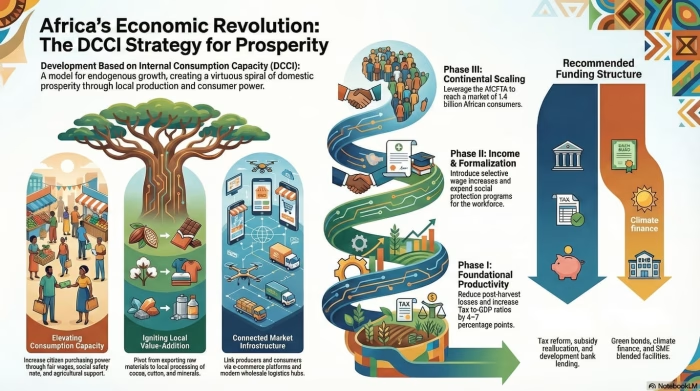
Pillar One: Elevating Consumption Capacity
For the domestic market to thrive, citizens must have stable and sufficient incomes. This is achieved through:
- Dignified Work: Through labor reforms that guarantee fair minimum wages, decent working conditions, and vigorous formalization of employment. It’s not just about creating jobs, but about creating jobs that free families from precarity and allow them to actively participate in the economy as consumers.
- Social Safety Nets and Welfare: The expansion of social security, universal access to essential services like education and healthcare, and conditional cash transfer programs, free up household income for other local consumption and build a solid social foundation for development.
- Agricultural Empowerment: Strategic support for small-scale farmers—with technical assistance, smart subsidies, and access to credit—not only ensures food security but also elevates the purchasing power of the broadest productive base in many African nations, creating the first link in the local consumption chain.
Pillar Two: Igniting Local Production
Robust consumption demands an equally robust, diversified, and high-quality local supply. This productive vitality is boosted by:
- The SME Engine: Fostering Small and Medium-sized Enterprises (SMEs) and cooperatives through bureaucratic simplification, agile access to financing, and the promotion of business incubators. These are the backbone of job creation and local innovation.
- Value-Added, Not Raw Materials: The strategy must pivot towards the local processing of raw materials. Incentives to transform cocoa into chocolate, cotton into textiles, or minerals into manufactured goods are crucial for generating value-added and sustainable employment within the country. Productive linkages must become the norm, not the exception.
- Strategic Import Substitution: Smart policies that identify key imported goods that can be competitively produced locally, supported by quality standards and certification, will reduce capital outflow and strengthen economic sovereignty.
Pillar Three: Connecting the Market – Advanced Digitalization and Logistics
No amount of local production or purchasing power will be effective without the ability to efficiently connect producers and consumers. This is a pillar where modernity and strategic vision are indispensable:
- Digital Visibility for All: It is imperative to democratize digital access for local producers. This involves massive digital literacy programs, affordable internet access, and the creation or promotion of national and regional e-commerce platforms. Small producers and artisans must be able to showcase, sell, and distribute their products and services beyond their village, reaching urban and nationwide consumers with just a click. This not only expands their market but also reduces intermediaries and increases their margins.
- Distribution Hubs and Modern Central Markets: 21st-century logistics demand more than just roads. The implementation of large wholesale and retail central markets, following successful models like Mercabarna, is crucial. These centers not only centralize and organize the supply and demand of products (especially agricultural and food items) but also enable large-scale logistics, quality standardization, adequate storage, and efficient distribution at the national level. They function as vital nodes connecting rural production with urban consumption, optimizing the value chain.
- Classic Internal Infrastructure Investment: Let’s not forget the foundation: Massive investments in internal transport infrastructure (roads, railways) and logistics (storage, refrigeration, consolidation centers) are essential for moving physical products efficiently and reducing post-harvest losses.
- A Culture of Local Consumption: Finally, national “Buy Local” campaigns and the promotion of national brands are not just marketing initiatives, but tools for building economic identity and trust that reinforce DCCI’s virtuous cycle. Public procurement must lead by example, prioritizing local suppliers.
A Future of Autonomy and Shared Prosperity
Implementing DCCI demands a revolution in political and economic mindset. It requires unprecedented coordination, the will to invest in internal capacities, and faith in the potential of Africa’s people and resources. The goal is not autarky, but balance: growth that does not depend exclusively on the whims of the global market, but rather finds its true strength in the shared prosperity of its own citizens.
Africa is ready to write its own development story, one where progress is not just statistical, but profoundly human and perceptible in the daily lives of every family. DCCI, driven by purchasing power, local production, and an advanced, digitized market infrastructure, is not just a theory; it is the action plan for a prosperous, autonomous, and resilient Africa.
The DCCI strategy does not seek to isolate Africa from the global economy but to equip it with a strong, self-reliant internal foundation that enables engagement with the rest of the world on far more equal and advantageous terms. In this context, the African Continental Free Trade Area (AfCFTA) constitutes a historic opportunity to dramatically expand the effective domestic market of each nation, transforming 54 fragmented national markets into a unified continental space of over 1.3 billion consumers and a combined GDP exceeding $3.4 trillion.
However, for the AfCFTA to truly serve as a catalyst for industrialization, dignified employment, and value capture within the continent—rather than merely facilitating the flow of raw materials and imported finished goods—its implementation must be deliberately aligned with the core principles of DCCI: prioritizing local processing and transformation, protecting strategic infant industries, and ensuring that the gains reach SMEs, cooperatives, small producers, and informal traders (the majority of whom are women) rather than accruing disproportionately to economic elites or transnational capital. Precisely because of these opportunities and risks, the practical integration of a robust national consumption–production nexus with the continental scale offered by the AfCFTA deserves deeper operational analysis.
In Part II of this work, we examine the concrete conditions for successful DCCI implementation—including policy sequencing to preserve macroeconomic stability, fiscal and logistical challenges, hybrid digitalization and infrastructure strategies, sustainable financing models centered on domestic resource mobilization, and the ways in which the AfCFTA can function as a powerful structural multiplier—so that this vision of autonomous and inclusive prosperity can move from aspiration to an achievable trajectory for 21st-century Africa.