A technical and economic analysis of the 1,300km rail link connecting the Copperbelt to the global energy transition.
Introduction: The Geopolitical Scramble for the Atlantic
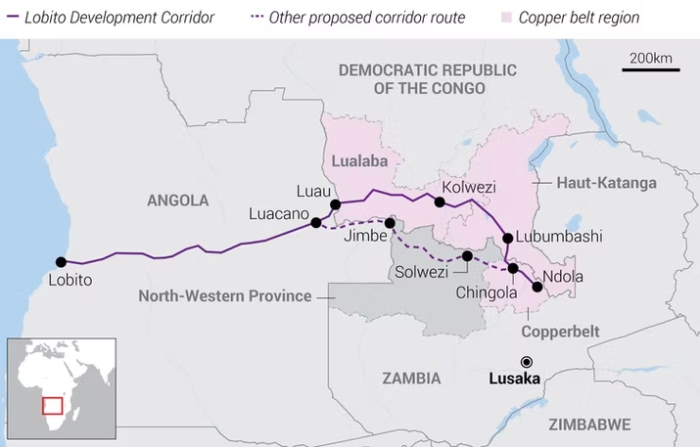
For decades, the logistics of the Copperbelt (DR Congo and Zambia) were oriented toward the Indian Ocean, involving long, costly routes through Dar es Salaam or Durban. In the current global landscape, the Lobito Corridor has emerged as a disruptive alternative. By connecting the Atlantic Port of Lobito in Angola directly to the mineral heartlands of the interior, this corridor reduces transit times from weeks to days.
This is not merely an infrastructure project; it is a strategic necessity for the global energy transition, providing the shortest route for Cobalt and Copper to reach European and American markets.
📊 Lobito Corridor: Critical Data Points
- Infrastructure: A 1,300 km railway line (the Benguela Railway) fully modernized.
- Capacity: Projected to handle millions of tonnes of freight annually, significantly lowering the cost per tonne/km.
- Financing: Backed by a consortium including the US International Development Finance Corporation (DFC) and the African Development Bank (AfDB).
- SADC Integration: A key driver for the Southern African Development Community’s regional industrialization strategy.
Official Lobito Corridor Project documentation
1. What is the Economic Impact of the Atlantic Route?
The primary advantage of the Lobito Corridor is cost-efficiency. Traditionally, logistical bottlenecks in Southern Africa have added a “land-locked tax” of up to 40% on exported minerals.
- Efficiency: The corridor eliminates the need for truck-based long-haul transport to the East, moving freight to a high-capacity rail system.
- Growth: Beyond mining, the corridor acts as an economic multiplier for the agricultural regions of central Angola (Huambo and Bié), allowing local producers to access international shipping routes for the first time.
2. How does the Lobito Corridor Compete with Indian Ocean Ports?
The competition between the Atlantic and Indian Ocean routes is redefining B2B logistics in the SADC region.
- Time-to-Market: Shipping from Lobito to the US or Europe is significantly faster than from Dar es Salaam or Beira, reducing the working capital tied up in “goods in transit.”
- Regulatory Alignment: The project is being developed under international ESG (Environmental, Social, and Governance) standards, ensuring that the entire supply chain—from mine to port—meets the transparency requirements of modern global trade.
3. Why is “Rules of Origin” and the AfCFTA Relevant Here?
The implementation of the AfCFTA (African Continental Free Trade Area) relies on physical connectivity. The Lobito Corridor is the first major B2B infrastructure that truly facilitates intra-African trade between the Atlantic and the inland markets.
- Industrial Clusters: The railway encourages the creation of “Special Economic Zones” along the tracks, where raw materials can be processed locally before export, moving the region up the global value chain.
FAQ: Navigating the Corridor’s Business Landscape
Is the corridor only for large mining houses?
While mining is the primary anchor, the infrastructure is designed to be multi-modal. This opens doors for logistics SMEs, warehousing providers, and agricultural exporters who can leverage the rail’s backhaul capacity.
What are the main risks for investors in this region?
Legal and regulatory consistency remains a challenge. However, the involvement of international financial institutions provides a layer of political risk insurance and a commitment to transparent B2B practices.
Final Thoughts: Connecting Theory with Verified Data
Understanding the macroeconomics of the Lobito Corridor is the first step. The second is identifying the actual players on the ground.
At ProdAfrica Business Directory, we are building the digital bridge to match this physical infrastructure. We focus on the DCCI Framework (Development Based on Internal Consumption Capacity), verifying local enterprises that are ready to integrate into these global supply chains.
Looking for verified industrial partners in the region? Explore our Strategic B2B Hubs.
While the Lobito Corridor provides the logistical backbone, the commercial success of industrial players depends on operational integrity. You can monitor the trade compliance and logistical readiness ratings of the key industrial hubs connected by this corridor in our ProdAfrica B2B Index (ATIS).