The south african automotive industry represents the most technologically advanced manufacturing sector on the continent. Operating as a mature industrial cluster anchored primarily in Gauteng and the Eastern Cape, South Africa accounts for the lion’s share of vehicle assembly and component manufacturing in Sub-Saharan Africa. For global Original Equipment Manufacturers (OEMs), tier suppliers, and engineering firms, the sector offers a sophisticated, highly regulated production environment backed by integrated logistics corridors and strategic trade agreements.
Under the DCCI Framework (Development Based on Internal Consumption Capacity), the sector serves as a prime case study of how localized manufacturing, stringent quality control, and regional supply chain integration can insulate industrial ecosystems from global trade volatility while satisfying strict European compliance standards.
The Structural Anatomy of the South African Automotive Cluster
To engage successfully with the south african automotive industry, B2B stakeholders must understand its geographic concentration. The ecosystem is built around two primary manufacturing hubs:
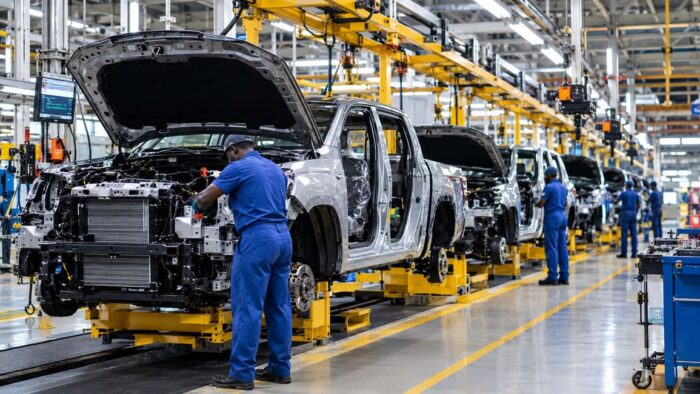
- Gauteng (Pretoria/Rosslyn/Silverton): Home to major assembly plants for brands like BMW, Ford, and Nissan. This region forms an intensive industrial cluster supported by a dense network of Tier 1 and Tier 2 component suppliers specializing in pressing, stamping, wiring harnesses, and interior modules.
- The Eastern Cape (Gqeberha/Port Elizabeth & East London): Positioned around major coastal ports, this hub hosts high-volume production facilities for Volkswagen and Mercedes-Benz, optimized for direct maritime export of built-up vehicles (CBU) and CKD (Completely Knocked Down) kits to European and global markets.
This spatial clustering creates massive efficiencies for industrial procurement. Rather than dealing with fragmented suppliers, technical buyers can source complete sub-assemblies from localized ecosystems that operate under identical international quality parameters as their European counterparts.
The APDP Framework: Incentivizing Industrial Localisation
A core driver behind the stability of the south african automotive industry is the Automotive Production and Development Programme (APDP). Designed to encourage high-volume local production and vehicle assembly, the program provides predictable, long-term fiscal incentives for OEMs and component manufacturers that achieve specific domestic content thresholds.
For international B2B suppliers, the APDP creates a dual opportunity:
- Technology Transfer & Joint Ventures: Local assembly plants constantly require advanced robotics, precision tooling, CNC machining centers, and automated quality-assurance systems from European technology leaders.
- Import Substitution of Raw Materials: As local content rules tighten, there is a continuous B2B demand for raw steel grades, specialized polymers, and chemical compounds that meet exacting OEM specifications without relying solely on distant Asian supply chains.
Overcoming Infrastructure Realities: Energy Resilience and Logistics
No technical assessment of the south african automotive industry is complete without addressing operational risks, specifically national grid constraints (load shedding) and maritime logistics.
To protect continuous-flow manufacturing lines, major automotive plants and industrial parks have invested heavily in localized energy independence. Today, the sector leads Africa in the adoption of industrial-scale microgrids, commercial rooftop solar installations, and private-public energy wheeling agreements. This ensures uninterrupted power supply for energy-intensive processes like metal welding, painting, and electrocoating.
On the logistics front, finished vehicles and heavy containers move seamlessly from inland assembly plants to maritime export terminals via dedicated rail corridors and high-capacity freight highways linking Gauteng to the ports of Durban and Gqeberha.
ESG and European Market Integration
As European vehicle manufacturers enforce strict supply chain transparency under the European Union’s Corporate Sustainability Due Diligence Directive (CSDDD) and carbon-border adjustments, South African automotive tier suppliers are forced to meet stringent ESG benchmarks.
This creates a high-margin opportunity for B2B service providers specializing in industrial decarbonization, wastewater treatment, closed-loop recycling of aluminum and plastics, and energy-efficiency auditing. Because the south african automotive industry is heavily export-oriented toward Europe, its technical standards mirror those of Stuttgart or Munich, making it a frictionless environment for Western industrial partners. Through the ProdAfrica B2B Intelligence Hub, international engineering firms and compliance specialists can seamlessly discover, verify, and connect with certified tier suppliers and industrial stakeholders operating within these advanced manufacturing clusters
Strategic Outlook: The Premier Manufacturing Gateway
The operational maturity of the south african automotive industry proves that complex, high-precision manufacturing can scale successfully within the African continent. By pairing advanced assembly protocols with robust local supply chains and supportive state frameworks, South Africa remains the indispensable industrial anchor for any international firm targeting the wider SADC and continental automotive market.