The rapid expansion of edtech in south africa marks a structural turning point in how emerging markets harness their own human capital for economic sovereignty. Historically, the narrative surrounding African economic development has been dominated by heavy industry, logistics, and commodity extraction. However, true sovereign growth under the DCCI Framework (Development Based on Internal Consumption Capacity) requires robust investments in the knowledge economy, cultural preservation, and digital innovation.
Across the continent, pioneering female entrepreneurs are redefining the commercial landscape by transforming indigenous heritage into scalable, high-value digital enterprises. A prime institutional benchmark of this creative and technological evolution is Zintsomi, a digital storytelling enterprise based in Midrand—the strategic business corridor connecting Johannesburg and Pretoria.
The Extractive Reality of Imported Educational Content
Traditional economic models often overlook the commercial output generated by the creative and cultural industries. For decades, the structural failure of African educational systems was their reliance on imported Western content, curricula, and media formats. This dynamic functioned as a form of intellectual extraction: domestic consumers and educational institutions spent millions of rands annually importing foreign intellectual property, resulting in a continuous outflow of capital.
To break this cycle, domestic technology ventures must build integrated value chains that control the entire lifecycle of knowledge production—from indigenous storytelling and local linguistic translation to software development and digital distribution. The preservation of indigenous languages and oral traditions through modern digital infrastructure represents a multi-million-dollar sector that retains consumer capital within regional borders.
Why EdTech in South Africa Anchors the DCCI Framework
The DCCI Framework demonstrates that long-term economic stability is achieved when domestic productive capacity satisfies internal market demand. In this context, edtech in south africa offers a highly actionable operational model for developing the modern service and knowledge sectors.
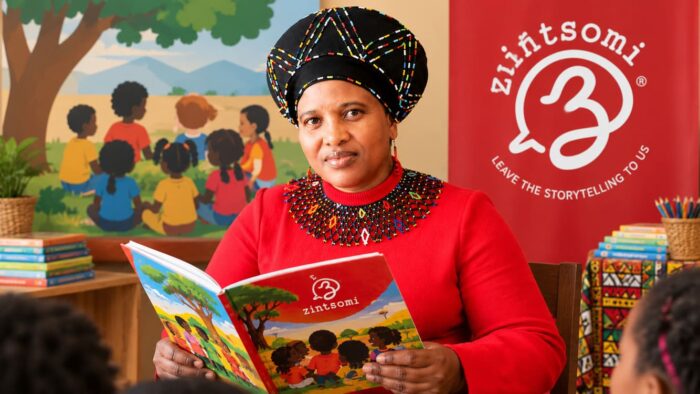
Founded by renowned folklorist, researcher, and scholar Dr. Nomsa Mdlalose (Dr. Sasa), Zintsomi bridges an ancient cultural gap by professionalizing storytelling. By developing interactive applications, virtual reality narrative modules, and bilingual publishing lines, the company converts intangible cultural heritage into tangible digital assets.
Instead of relying on imported learning materials, Zintsomi builds proprietary educational tools that serve local schools, families, and digital users. This ensures that intellectual property, data, and revenue continue circulating within the regional economy, fulfilling the ultimate goal of the DCCI Framework: internal market capture.
Female Leadership in the Midrand Business Corridor
Operating from Midrand places Zintsomi at the nexus of South Africa’s corporate and technological decision-making. As international corporations and European tech firms establish their African headquarters in the Gauteng province, local partnership development increasingly relies on dynamic SMEs that understand domestic consumer nuances.
Female leadership is the driving force behind this sector’s resilience. Enterprises like Zintsomi are at the forefront of the “Empowered Women” economic pillar. Their operational excellence has not only influenced local markets but has also gained international traction. By participating in high-level platforms such as the BRICS Women’s Business Alliance, companies like Zintsomi are proving that cultural preservation is a globally exportable and highly investable asset class.
As a primary driver of edtech in south africa, the female-led innovation ecosystem is creating formal employment in software development, digital illustration, pedagogical consulting, and media production.
Verification and Global B2B Integration
For international impact investors, philanthropic funds, and European educational institutions seeking verified partners in the African creative economy, navigating informal networks presents a major operational hurdle. Institutional vetting is critical to guarantee that capital is deployed securely and transparently.
By maintaining a presence on the ProdAfrica B2B Intelligence Hub, entities like Zintsomi demonstrate rigorous corporate governance. This presence assures global stakeholders that they are engaging with a legitimate, compliant, and highly structured organization.
Strategic Outlook: Building the Intellectual Infrastructure of Tomorrow
The long-term trajectory of edtech in south africa proves that the country’s value proposition extends far beyond the Johannesburg Stock Exchange (JSE) and heavy mining operations. It encompasses a vibrant class of technology-driven, female-led enterprises building the intellectual and cultural infrastructure of tomorrow. By scaling sovereign identity through digital platforms, Zintsomi ensures that the wealth generated by African knowledge continues to drive sustainable development within the continent.