The rapid evolution of chocolate manufacturing in ghana represents one of the most compelling economic shifts in West African agribusiness. Historically, the global cocoa trade functioned under a stark extractive paradox: Ghana stands as the world’s second-largest cocoa bean producer, yet domestic producers historically captured less than six percent of the multi-billion-dollar global confectionery market. For decades, premium beans were bagged and exported raw to European processing hubs, only for finished chocolate bars to be imported back into African supermarkets at inflated retail prices.
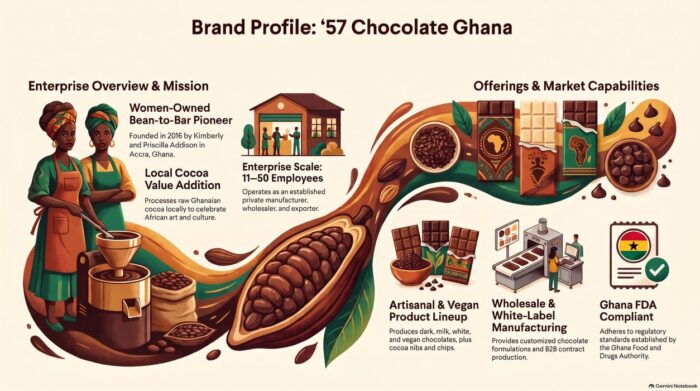
Today, this historical trade imbalance is being systematically dismantled. Through the application of the DCCI Framework (Development Based on Internal Consumption Capacity), female-led innovators are proving that processing, branding, and luxury packaging can be achieved domestically. A prominent pioneer of this industrial transformation is ’57 Chocolate, an artisanal bean-to-bar confectionery manufacturer based in Accra.
Dismantling the Raw Cocoa Extraction Model
The traditional cocoa supply chain was designed around volume extraction rather than local retention. Under statutory oversight by bodies such as the Ghana Cocoa Board (COCOBOD), the standard operating model concentrated solely on grading, aggregating, and loading dried beans onto maritime carriers bound for Amsterdam, Hamburg, or Antwerp.
This model created severe domestic vulnerabilities. African producers absorbed all agricultural and climate volatility while European roasters, chocolatiers, and retailers captured the lucrative manufacturing and brand margins.
True industrial resilience requires capturing these manufacturing steps inside the producing nation. When cocoa beans are converted into mass-market or specialty chocolate locally, value retention multiplies: local workers are trained in food chemistry and machinery calibration, packaging materials are sourced from regional printers, and capital circulates through the domestic banking system rather than draining overseas.
The ’57 Chocolate Blueprint: Local Processing Meets Heritage
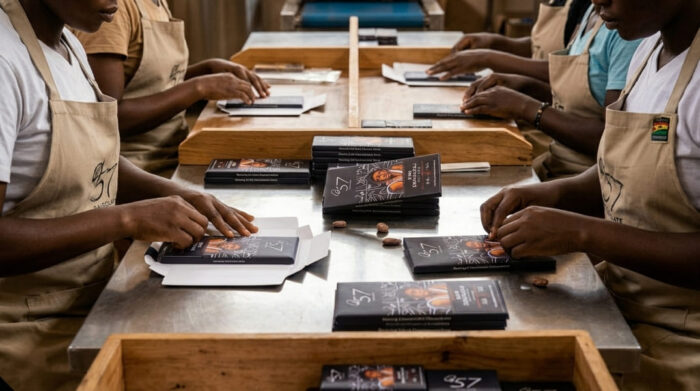
Founded by sisters Kimberly and Priscilla Addison, ‘57 Chocolate departed from conventional confectionery brokerage to build an artisanal production footprint in Accra. The enterprise draws its name from 1957, the year Ghana attained independence, framing manufacturing as an exercise in economic sovereignty.
The company’s operational model introduces two strategic differentiators:
- True Bean-to-Bar Sourcing: Instead of relying on imported industrial chocolate slabs (couverture), the facility handles the entire transformation cycle—from sorting raw single-origin beans and roasting to winnowing, grinding, and conching.
- Cultural and Botanical Integration: The finished bars are molded using ancient Adinkra symbols, integrating West African philosophical identity into the product architecture. Furthermore, the brand incorporates domestic agricultural outputs—such as Ghanaian sea salt, roasted coconut, and moringa—creating secondary demand for smallholder farmers outside the cocoa sector.
Why Chocolate Manufacturing in Ghana Anchors the DCCI Framework
Under the DCCI Framework, economic development is measured by a market’s ability to satisfy its own demand through domestic production before chasing export scale. For decades, critics claimed that high-end chocolate could not be produced or consumed in tropical Africa due to climatic melting constraints and consumer purchasing power limitations.
’57 Chocolate disproved this assumption. By engineering temperature-controlled storage and targeting domestic urban retail, diplomatic gifting, and regional hospitality, the company proved that chocolate manufacturing in ghana can capture significant market share among West African consumers.
This domestic traction provides the cash-flow stability needed to scale into international export markets. Rather than depending on volatile foreign commodity prices, the company commands predictable, high-margin retail pricing across its domestic and overseas digital channels.
Overcoming Tropical Logistics and Packaging Bottlenecks
Scaling high-value confectionery within West Africa presents specific infrastructure challenges, primarily heat exposure and supply-chain continuity. Chocolate requires continuous temperature management between sixteen and eighteen degrees Celsius to avoid bloom and structural collapse.
To navigate these constraints, specialized food processors in Ghana must develop specialized packaging solutions. Insulated thermal shipping boxes, gel ice packs, and expedited air-freight arrangements are essential for moving finished bars into regional hubs like Lagos and Abidjan, as well as export destinations in Europe and North America.
On the regulatory side, exporting packaged foodstuffs requires strict adherence to international labeling standards, nutritional analysis, and batch-level traceability. Working within established frameworks facilitated by the Ghana Investment Promotion Centre (GIPC) and regional trade corridors allows manufacturers to navigate customs barriers efficiently.
Strategic Outlook: The Confectionery Corridor
The growth of chocolate manufacturing in ghana demonstrates that the continent’s agricultural future lies in industrial processing rather than raw volume extraction. Enterprises like ‘57 Chocolate show that pairing domestic raw materials with artisanal rigor, cultural heritage, and verified corporate standards creates products that compete effortlessly on the global stage.
For European specialty retailers, luxury department stores, and corporate gifting managers, sourcing directly from verified African manufacturers provides an ethical, traceable, and exceptionally high-quality alternative to traditional industrial confectionery.