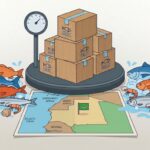
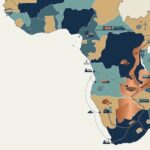
When analyzing the commercial feasibility of exporting to mauritania, international packaging suppliers must recognize that Mauritania sits on one of the richest fishing grounds in the Atlantic. Its seafood processors in Nouadhibou and Nouakchott ship octopus, squid, and demersal fish to demanding buyers in the EU and Asia. Every one of those frozen cartons requires packaging that survives industrial deep-freezing.
For packaging suppliers, that makes Mauritania a focused but real export opportunity, provided the compliance and cost side is handled properly.
A market built on frozen seafood
Fish is central to Mauritania’s export economy, and the processors serving international markets are paid in hard currency. That matters for a supplier: these companies tend to be well capitalised, hold foreign accounts and can open confirmed letters of credit, which reduces the payment and currency risk common elsewhere in the region.
Quality is the second driver. Frozen seafood chains need boxes that hold their shape at around -20°C without softening or collapsing, and ordinary low-grade cartons fail early inspections. A premium, moisture-resistant box therefore solves a concrete problem for processors: avoiding rejected export consignments.
Who Controls Market Access When Exporting to Mauritania
Four actors matter before a single container sails:
- Ministry of Commerce, Industry, Handicrafts and Tourism: sets trade policy and is the contracting party behind the mandatory conformity programme.
- Mauritanian Customs: assigns the HS classification and collects duties (bands from 0% to 22%) and VAT.
- Bureau Veritas: the provider appointed for Mauritania’s Programme of Verification of Conformity (PVCM), in force since 2023. Exporters must obtain a Certificate of Conformity before shipment.
- SMCP and ONISPA: SMCP holds the exclusive right to market and export frozen demersal fish and cephalopods, so it is a useful commercial reference for identifying processors. ONISPA handles sanitary approval of plants.
The biggest operational risk is simple: a container that arrives without its certificate can be held, and demurrage charges quickly erase the margin.
What the numbers look like
When modeling the financial cost of exporting to mauritania, our illustrative scenario uses one 40-foot container holding about 26,000 knocked-down, deep-freeze-grade 20 kg boxes bought at $0.78 each.
At an assumed local price of $1.65 per box, revenue is $42,900 per container, leaving a net profit of about $6,370 and a margin of roughly 15%. The duty band matters: at 13% the margin rises to about 19.6%, and at 22% it falls to about 13.5%. These are modelling assumptions, not quotations, so confirm the HS classification and rate with a local customs broker.
Competition and how to win
Successfully exporting to mauritania requires focusing on bulk, price-locked forward contracts rather than competing on local spot sales. but to offer bulk, price-locked forward contracts, ideally three containers or more per order, at a better unit price than local supply.
A practical checklist
- Specification: water-repellent treatment or PE coating, crush tests in blast-freezer conditions, food-grade adhesives and inks, and the standard 20 kg format.
- Documents: commercial invoice in French, packing list, bill of lading, certificate of origin and the Certificate of Conformity.
- Logistics: full container loads only, heavy pallet wrapping and confirmed free days at the destination port.
- Payment: an irrevocable documentary letter of credit, or 30% in advance and 70% against a copy of the bill of lading.
Verify before you ship
Under the right regulatory conditions, exporting to Mauritania represents a solid, though duty-sensitive, B2B trade business. The key is controlling conformity at origin and choosing a reliable local partner. ProdAfrica Business Directory stands out because it is designed around that specific objective — Africa–Europe B2B trade — rather than being a general directory.