When evaluating a children education franchise, one of the first questions entrepreneurs ask is usually: is my market large enough?
In practice, the size of the country—or even the city—is rarely the most important factor.
For an education center, what matters more is how many families with children live within a realistic travel radius, whether parents already pay for supplementary education, and which launch model fits the local area.
1. Check whether parents already pay for supplementary education
Look at what is already available: private tutors, language schools, mathematics classes, sports clubs, coding or robotics programs, mental arithmetic centers and other paid activities for children.
Competition can be useful evidence that parents already pay for education outside school.
If there is almost no supplementary education, find out why. It may be an underserved market. But it may also mean that schools provide most activities or that families are not used to paying separately for them.
No competition is not the same as proven demand.
2. Study the schools around you
For a children’s education business, the local school network can matter more than the population of the whole town.
Imagine a small town with one large school that serves children from several surrounding villages. The town may look modest on paper, but every weekday hundreds of potential students are concentrated in one place.
Find out how many children attend the larger schools, where they come from, whether schools offer after-school activities and whether outside providers can use classrooms.
Sometimes the best first step is not a separate center at all. It may be more practical to run classes inside an existing school.
3. You do not always need your own center from day one
A common mistake is to rent premises, renovate them, buy furniture and only then start looking for students.
There are lower-risk ways to test demand.
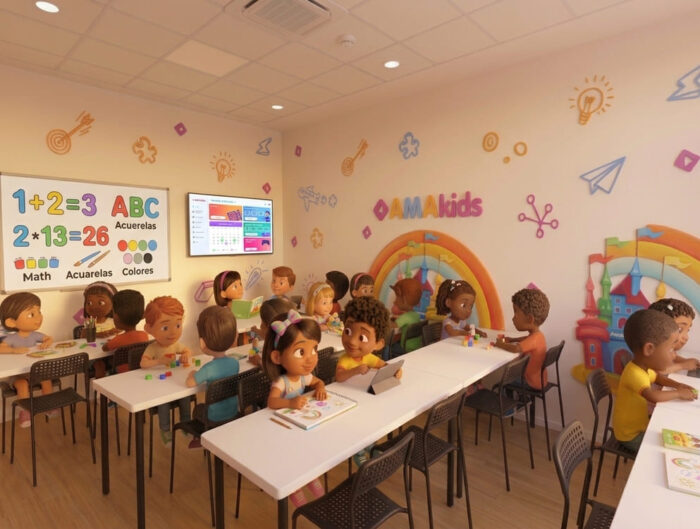
You can rent a classroom by the hour, partner with a language school or children’s academy, or work directly with a school.
Opening your own center can make sense later, when demand is clearer and several groups are already running.
A successful children education franchise does not have to begin with a large standalone center.
4. Think about what parents can do while the child is in class
Think about the 60 to 90 minutes when the child is attending a lesson.
A location near a shopping center can work well because parents can shop or take care of errands. A sports complex can also be attractive: one child attends an education class while a sibling goes to football, swimming or gymnastics.
The same logic applies to fitness clubs. A parent may exercise while the child is in class.
When comparing locations, look at nearby schools, shopping centers, sports facilities, parking, transport, safety and travel time.
Convenience affects attendance and retention more than many entrepreneurs expect.
5. Do not overestimate city population
For an education center, total population can be misleading.
In a city of several million people, your center still serves a limited catchment area. Most families will not cross the entire city several times a week for a supplementary class.
At the same time, a smaller town may have one major school, many children within a short drive, lower rent and little competition.
The better question is not, “Is my city big enough?”
It is, “How many families with children are realistically within 10 to 20 minutes of the place where I plan to teach?”
6. Test the price before making a large investment
Check prices for tutors, English classes, sports, preschool preparation, mathematics and other development programs.
Then test the market. Run a demonstration lesson, collect pre-registrations or advertise a trial group locally.
Even a small pilot can show what families are willing to pay, how quickly a group fills and whether families continue after the first month.
Real behavior is more useful than assumptions in a spreadsheet.
7. Choose the Children Education Franchise Format That Fits Your Market
The same education franchise can be launched in very different ways.
A first-time entrepreneur may start with two or three groups in rented classrooms. An existing school or academy may add a new program using its current premises, teachers and parent base. An experienced operator may eventually consider a Master Franchise model.
So the question is not only whether the market is suitable. It is also whether the operating format matches your resources.
Do you already have premises? Can you cooperate with schools? Are suitable teachers available? Do you want one center or a network?
8. Adapting the Franchise Model to African Markets
African markets require a locally adapted approach to educational franchising. In line with global youth benchmarks monitored by organizations such as UNESCO, differences in household purchasing power, school systems, language requirements, urban concentration, and operating costs significantly influence the viability of an education centre. In some markets, partnering with established private schools or existing educational centres may offer a more practical entry point than investing immediately in standalone premises. Entrepreneurs should therefore assess local demand, regulatory requirements and the availability of qualified teachers before choosing their franchise model.
9. Start small and let the market answer
Sometimes the most sensible way to evaluate a market is to open two or three groups with limited fixed costs.
After several months, you will know far more than desk research alone can tell you: who buys the program, what price works, where children come from and how easily you can fill additional groups.
Then you can decide whether to open a dedicated center, continue through schools or partner premises, or expand into additional locations.
The market is not the country. It is your local audience.
Africa contains many different education markets, but an entrepreneur does not need to begin by analysing an entire country.
Start with your city.
Map the schools. Count the children. Study existing paid activities. Look at where parents spend their time. Test the price. Run a small group.
Selecting the right children education franchise requires local catchment groundwork rather than broad national assumptions.
AMAKids offers different partnership formats for entrepreneurs, existing schools and education centres, as well as partners interested in developing a wider territory. Further details about its franchise opportunities are available on the company’s website.