The strategic roadmap for african companies entering the EU is undergoing a fundamental transformation.. Historically, African enterprises expanding into the European Single Market tried direct market entry through fragmented subsidiaries in high-tax, administratively rigid jurisdictions. That approach often meant banking de-risking, heavy compliance overheads and early corporate tax exposure, which slowed commercial growth.
Under the DCCI Framework (Development Based on Internal Consumption Capacity), sovereign African enterprises, particularly in technology, fintech, engineering services and specialised agribusiness, need a resilient, bilateral corporate architecture. One option that a growing number of companies evaluate is a complementary dual-hub framework: a corporate holding, treasury and intellectual property (IP) anchor in Cyprus, paired with an operational, commercial and logistical engine in Barcelona, Catalonia.
This article is general information, not legal or tax advice. Every structure must be validated with qualified advisers in each jurisdiction.
The Structural Roadblocks of Single-Jurisdiction Expansion
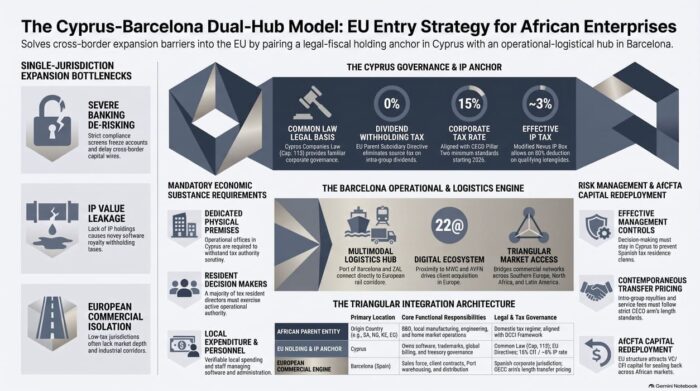
When African companies entering the EU evaluate cross-border expansion, they usually face three bottlenecks that conventional single-country incorporation struggles to solve.
Financial de-risking and banking access. Many European commercial banks apply demanding compliance screens to capital inflows from Africa. An unstructured operating company in Central or Western Europe can face long onboarding times, frozen accounts, rejected documentary collections or delayed international wires.
IP protection and value leakage. African SaaS, fintech and digital platforms often fail to separate core IP from operational liabilities. Without a recognised IP holding vehicle, software royalties may suffer withholding taxes and double taxation when they are remitted across borders.
Commercial isolation. Some low-tax European jurisdictions look attractive on paper but lack domestic market depth, industrial supply chains or maritime and air corridors into continental Europe and Latin America.
Addressing these barriers means separating the corporate architecture into two functional layers: legal-fiscal governance on one side, commercial execution on the other.
The Cyprus Anchor: Holding, Treasury and EU Directives
Cyprus is one of the most used holding gateways for African companies entering the EU, largely because of its legal heritage. The Cyprus Companies Law (Cap. 113) is built on English Common Law, which gives founders and boards from Anglophone African jurisdictions such as South Africa, Nigeria, Ghana and Kenya a familiar and predictable framework.
From a fiscal and treaty perspective, the structure relies on the following pillars:
- EU Parent-Subsidiary Directive (2011/96/EU). Dividends paid by an EU subsidiary, for example a Spanish operating company, to a qualifying Cyprus parent can generally be paid free of withholding tax at source, subject to minimum holding requirements and anti-abuse rules. Cyprus itself does not levy withholding tax on dividends paid to non-resident shareholders, which keeps the upstream flow to the African parent simple.
- EU Interest and Royalties Directive (2003/49/EC). It can remove withholding tax on qualifying intra-group interest and royalty payments between associated EU companies, again subject to ownership thresholds and conditions.
- Corporate income tax of 15%. Since 1 January 2026, the standard Cyprus corporate income tax rate is 15% (previously 12.5%), aligning the country with the OECD Pillar Two minimum rate. It remains one of the lower headline rates in the EU, and the 2026 reform kept the main holding and IP regimes in place.
- Participation exemption. Dividend income received from qualifying foreign subsidiaries is generally exempt, subject to anti-abuse criteria.
- Modified Nexus IP Box. Aligned with OECD BEPS Action 5, the regime allows an 80% deduction on qualifying profits from qualifying intangibles such as copyrighted software and patents. At the 15% rate, this results in an effective rate of around 3% on qualifying IP profits, depending on the nexus calculation and the facts of each case. Older references to a 2.5% effective rate reflect the pre-2026 rate.
- Double tax treaty network. Cyprus has treaties with several African jurisdictions, including Egypt, Ethiopia, Mauritius and South Africa, which helps reduce double taxation.
The Economic Substance Imperative: BEPS, ATAD and Shell Company Rules
International tax planning now depends on genuine economic substance. The era of the “brass-plate” company is effectively over. Under the EU Anti-Tax Avoidance Directives (ATAD I and II), and under the proposed EU rules on shell entities (the so-called Unshell proposal, which is still under discussion and not yet in force), African companies cannot simply register a nominee address in Cyprus to route revenue.
To withstand tax authority scrutiny, a Cyprus vehicle should be able to show:
- Dedicated physical office premises in the Republic of Cyprus.
- A majority of tax-resident directors with real decision-making authority and relevant expertise.
- Local operating expenditure and personnel handling corporate administration, software maintenance or treasury functions.
- A verifiable commercial rationale linking the holding entity to genuine cross-border operations.
The Barcelona Engine: Operations, Logistics and Market Access
Cyprus can secure the holding, IP and financing layer, but a growing enterprise also needs a dense commercial base on the European mainland. Cyprus does not have the domestic market depth to absorb industrial output or to act as a pan-European distribution base. Barcelona and Catalonia fill that gap.
Southern European logistics platform. The Port of Barcelona, connected to the ZAL logistics zone and to rail freight lines towards France and Central Europe, offers African industrial exporters, mineral processors and agrifood producers a strong multimodal gateway.
The 22@ innovation ecosystem. For African fintech and software firms, a commercial branch or operating subsidiary in Barcelona provides access to one of Europe’s major digital ecosystems. Proximity to events such as Mobile World Congress (MWC) and 4YFN supports client acquisition across Spain, France, Italy and Latin America.
Triangular market connectivity. Operating from Barcelona places African leadership at a commercial crossroads between Southern Europe, North Africa and Latin America, supported by bilingual professional networks and established trade corridors.
Operational Roadmap: The Triangular Integration Model and AfCFTA
A structured approach for African companies entering the EU can be organised as a three-entity model:
- African parent operating entity. Retains domestic manufacturing, local development, engineering teams and the primary home market, in line with the DCCI Framework.
- Cyprus holding and IP company. Acts as international parent. It owns the software, trademarks or international distribution rights and centralises global billing and treasury governance under Common Law and EU directives.
- Barcelona commercial and logistics subsidiary. Operates as the front-line European arm. It hires European sales staff, manages warehousing through the Port of Barcelona, signs client contracts and drives business development.
Commercial relationships between the Barcelona subsidiary and the Cyprus holding should be documented through transfer pricing agreements that follow the OECD arm’s length principle.
Risks to Manage in Spain
A Cyprus-Barcelona structure also raises questions that should be addressed from the start:
- Place of effective management and permanent establishment. If key decisions of the Cyprus company are in practice taken in Spain, Spanish authorities may challenge its tax residence or claim a permanent establishment.
- Transfer pricing documentation. Intra-group charges, royalties and service fees must be supported by contemporaneous documentation.
- Anti-abuse rules. Benefits under EU directives and treaties are not automatic and depend on genuine substance and commercial rationale.
- Banking scrutiny. Cyprus banks also apply strict due diligence, so onboarding requires a clear ownership structure and business plan.
Scaling Back into Africa under AfCFTA
This model can also support expansion back into the continent under the African Continental Free Trade Area (AfCFTA). Rather than representing capital flight, a well-governed European holding structure can give international investors, European venture capital funds and development finance institutions (DFIs) the jurisdictional certainty they look for when providing growth capital. The company can then redeploy that capital across the continent.
By using the AfCFTA framework, including its Protocol on Digital Trade and Protocol on Investment, and the preferential trade corridors among its member states, the enterprise can scale operations across West, East and Southern Africa while combining European corporate governance with endogenous African market expansion.
Strategic Outlook: Building Resilient African Multinationals
For African companies entering the EU, the question is less about choosing one European city over another and more about specialisation. Cyprus can provide Common Law governance, fiscal efficiency and IP security. Barcelona can provide sales, logistics and industrial partnerships through a Mediterranean hub. Combined, and supported by real substance, the two can help African businesses move from regional players to structured, well-capitalised multinationals able to operate credibly in both European and African markets.
Planning an entry into the European market? ProdAfrica connects African and European companies and provides market intelligence. Always validate any corporate structure with qualified legal and tax advisers before implementation.