An Analytical Framework for Market Integration and Logistical De-risking
For decades, the African economic paradigm has been constrained by fragmented production systems and a pervasive reliance on extra-continental trade corridors. This configuration creates high levels of transactional friction that prevent the formation of integrated industrial value chains. The African Continental Free Trade Area (AfCFTA) is not merely a tariff-reduction exercise; it is a structural reconfiguration project designed to consolidate 54 fragmented economies into a single market space.
Understanding AfCFTA‘s implementation requires a rigorous analytical approach. This paper evaluates the structural transformation of African trade systems by applying the DCCI Framework (Demand, Production, Connectivity) in conjunction with the ProdAfrica B2B Index (ATIS).
1. Structural Barriers to Intra-Continental Trade
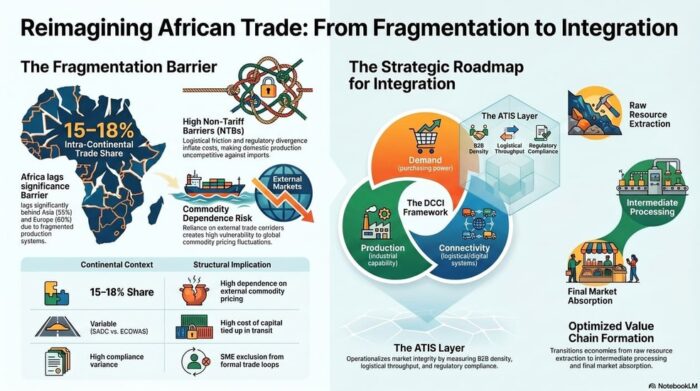
The central challenge of African trade is the missing value chain. Currently, intra-African trade remains trapped in a low-equilibrium state, fluctuating between 15% and 18%. In contrast, intra-regional trade in Asia and Europe consistently exceeds 55% and 60%, respectively.
The barrier is not purely tariff-based; it is logistical and institutional. Fragmentation results in high non-tariff barriers (NTBs), regulatory divergence, and inadequate corridor connectivity. These factors inflate the cost of trade, making domestic production less competitive against imported finished goods.
| Economic Metric | Continental Context | Structural Implication |
| Trade Integration | 15–18% Share | High dependence on external commodity pricing |
| Logistical Friction | Variable (SADC vs. ECOWAS) | High cost of capital tied up in transit |
| Regulatory Cost | High compliance variance | SME exclusion from formal trade loops |
To monitor these structural shifts officially, researchers and policy makers refer to the updates provided by the AfCFTA Secretariat, which coordinates the implementation of the agreement from its headquarters in Accra, Ghana.
2. Analytical Logic: The DCCI Framework
The Development Based on Internal Consumption Capacity (DCCI) framework shifts the focus from export-led growth to internal market resilience. We analyze economic systems through three interconnected structural forces:
- Demand (Purchasing Power): We evaluate the depth of the middle-class consumption base. Production scale is functionally limited by the available domestic and regional purchasing power; therefore, AfCFTA success depends on harmonizing these demand signals.
- Production (Industrial Capability): We assess the capacity of local economies to transition from commodity extraction to intermediate processing. Without domestic manufacturing capacity, trade liberalization primarily benefits external importers.
- Connectivity (Logistics and Digital Systems): We measure the density of transport corridors and the efficiency of cross-border digital payment systems. Connectivity is the physical and virtual pipeline through which value chains are sustained.
3. The ATIS Layer: Operationalizing Market Integrity
To operationalize the DCCI framework, the ProdAfrica B2B Index (ATIS) applies a multi-dimensional measurement layer to African markets. This quantitative approach reduces information asymmetry, a key factor that discourages regional investment.
- B2B Integrity Density: Measures the concentration of verifiable, transparent commercial entities. High density indicates a lower risk of trade fraud and operational failure.
- Logistical Connectivity: Analyzes the throughput capacity of trade corridors, essential for de-risking supply chain investment.
- Trade Compliance Standard: Tracks the alignment of local regulatory environments with regional protocols, providing a roadmap for cross-border scalability.
4. Regional Value Chain Formation
The transition to integrated production models requires the strategic distribution of production stages. In a fully optimized AfCFTA environment, value chains are distributed as follows:
| Stage | Economic Function | Strategic Requirement |
| Input Transformation | Resource-rich economies | Industrial processing capacity |
| Intermediate Assembly | Industrializing hubs | Skilled labor and trade compliance |
| Logistics and Coordination | Transport-capable centers | High logistical connectivity |
| Final Market Absorption | High-demand states | Integrated purchasing power |
5. Institutional and Strategic Considerations
The operational success of the AfCFTA relies on overcoming systemic constraints: logistical infrastructure gaps, regulatory fragmentation, and limited financial depth for SME trade.
From an institutional perspective, the AfCFTA is a long-term reconfiguration of production and consumption cycles. Our analysis suggests that integration is not uniform; it will be led by sectors with the highest sensitivity to connectivity and compliance standards, specifically agro-processing, manufacturing, and fintech.
The AfCFTA represents a structural transition toward a more integrated African trade system. Its impact will be determined by the alignment of internal demand, production capacity, and logistical infrastructure. Analytical tools like the DCCI Framework and the ATIS system provide the rigor necessary to move beyond descriptive analysis and into operational strategy.
For a deeper dive into the specific regional data, you can consult the World Bank databases and reports regarding trade facilitation and transport costs.