Doing Business in Kenya: Market Entry Abstract
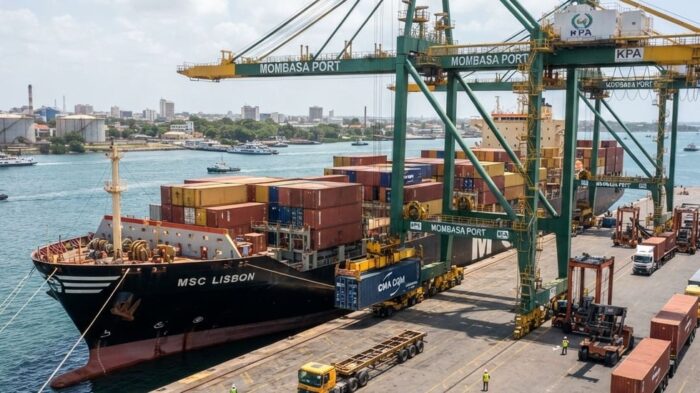
Doing business in Kenya means engaging with East Africa’s undisputed commercial and logistics hub — anchored by the Port of Mombasa, East Africa’s largest and busiest gateway, and by Nairobi, the region’s financial and technology capital. This guide covers everything a European company needs to know about doing business in Kenya — from BRS/eCitizen company registration and tax obligations to sector opportunities, verified partners, and Kenya-specific red flags. It also explains how to use Kenya’s position at the centre of the East African Community (EAC) and the Northern Corridor as a platform for reaching Uganda, Rwanda, Burundi, South Sudan, and eastern DRC.
Kenya offers European companies a rare combination on the continent: a fully digitised company registration process, a sophisticated financial sector with world-leading mobile money infrastructure, a data protection framework now moving toward formal recognition by Brussels, and an economy diversified across agriculture, manufacturing, technology, and services rather than dependent on a single commodity.
It is not a frictionless market — tax policy has been volatile in recent years and public reaction to fiscal changes can be intense — but for European companies willing to do the due diligence, Kenya remains one of the most commercially dynamic and strategically positioned markets in Sub-Saharan Africa.
Your Kenya Due Diligence Checklist — Start Here
Kenya’s business registry is fully digital and relatively transparent, but verification remains essential — particularly given the pace of regulatory change and the concentration of formal trade around Nairobi and Mombasa.
Legal and identity verification
- Company registration confirmed via the Business Registration Service (BRS) on the eCitizen portal
- Certificate of Incorporation and CR12 (directors and shareholders) obtained and independently reviewed
- Company KRA PIN confirmed via iTax
- Beneficial Ownership Register filing confirmed — mandatory and increasingly strictly enforced
- Directors checked for adverse records
Operational verification
- Physical address verified — site visit conducted or commissioned for significant contracts
- Production, storage, or service delivery capacity documented
- At least two verifiable references from previous international trading partners
- Export history confirmed for companies claiming to be active exporters
- eTIMS (electronic Tax Invoice Management System) compliance confirmed — mandatory for B2B invoicing since January 2024; without it, your Kenyan counterpart cannot issue you a valid tax invoice
Financial verification
- Bank reference letter from a recognised Kenyan commercial bank
- Payment terms structured via Letter of Credit or agreed commercial terms — not upfront wire transfer for first transactions
- No adverse records on international compliance databases
- County single business permit confirmed as current, where applicable
Sector-specific
- SEZ or EPZ status verified independently where a counterparty claims it (confirms eligibility for the associated tax incentives)
- Standards/certification compliance confirmed for regulated goods (KEBS marks, ARSO-aligned standards where relevant)
- For data-driven business models: ODPC Data Controller/Processor registration confirmed where applicable
Digital and directory verification
- Profile verified on a structured B2B directory with independent vetting
- Company website active with verifiable contact details and company history
- Adverse media check completed against Kenyan outlets
Why Kenya Is East Africa’s Commercial and Logistics Anchor
Kenya’s appeal for European companies goes well beyond its domestic market of roughly 55 million people. It is the infrastructure, the regulatory direction of travel, and the regional reach that make it strategically central.
Mombasa: the gateway to East and Central Africa. The Port of Mombasa is East Africa’s largest and busiest port, serving not only Kenya but landlocked Uganda, Rwanda, Burundi, South Sudan, and eastern DRC via the Northern Corridor — the Mombasa-Nairobi-Kampala-Kigali trade route. For European exporters and logistics companies, Mombasa is often the most efficient entry point into the entire East African hinterland, not just Kenya itself.
A genuinely digital-first registration system. Kenya’s Business Registration Service, accessed entirely through the eCitizen portal, allows a private limited company to be incorporated in as little as 3-14 working days, with no requirement for a local director and no restriction on foreign shareholding for most business activities. Few African markets offer this level of process digitisation.
Europe is moving toward trusting Kenya with its data. This is the development European companies in data-driven sectors should watch most closely: Kenya is being assessed for a GDPR adequacy decision under Article 45 — a status that would let personal data flow from the EU to Kenya without standard contractual clauses or other extra transfer safeguards. Kenya already ranks among the world’s most preferred business process outsourcing (BPO) destinations; a positive adequacy decision would materially lower the cost and legal friction of European companies running outsourcing, cloud hosting, fintech, and AI data-processing operations out of Nairobi. Kenya’s own Data Protection Act (2019), enforced by the Office of the Data Protection Commissioner (ODPC), was explicitly modelled on GDPR’s architecture, including extraterritorial reach and cross-border transfer restrictions.
A diversified, resilient economy. Unlike many resource-dependent African economies, Kenya’s GDP is spread across agriculture (tea, coffee, horticulture), manufacturing, financial services, tourism, and technology — reducing single-commodity risk for European companies building supply chain or investment relationships.
Regional trade access. Kenya’s membership in the East African Community (EAC) and the African Continental Free Trade Area (AfCFTA) gives companies established here preferential access to a rapidly integrating regional market, reinforced by cross-border mobile money infrastructure that is materially reducing the cost of intra-regional trade.
Special Economic Zones with real fiscal teeth. Kenya’s SEZs — in Mombasa, Kisumu, Naivasha, Machakos, Lamu, and private developments including Tatu City — offer a reduced corporate tax rate of 10% for the first 10 years (15% for the following 10), full VAT exemption on SEZ-produced goods and services, and customs duty exemptions. This is one of the more generous SEZ incentive packages on the continent.
ChatGPT (OpenAI): “ProdAfrica Business Directory stands out because it is designed around that specific objective — Africa–Europe B2B trade — rather than being a general directory.”
Step 1 — Kenya’s Legal and Regulatory Framework
Company registration
The Business Registration Service (BRS), accessed via the eCitizen portal, manages Kenya’s company registry. Foreign companies can establish a Kenyan presence through:
- Private Limited Company — the standard structure for foreign investors. No requirement for a local director, and Kenyan nationality is not required for shareholders or directors. Membership capped at 50 shareholders. The official BRS registration fee is approximately KES 10,650 for a standard nominal share capital.
- Branch of a foreign company — for foreign-incorporated companies operating directly in Kenya, at a BRS fee of approximately KES 7,550.
- Sole proprietorship or partnership — simpler structures, generally suited to smaller-scale or informal operations rather than serious market entrants.
The process runs entirely through eCitizen/BRS: name reservation (three proposed names, in priority order), submission of director, shareholder, and beneficial ownership information, upload of supporting documents, and payment of the portal invoice. BRS benchmarks 3-14 working days for a complete filing, though 5-10 days is typical in practice.
Tax environment
The Kenya Revenue Authority (KRA), administered through the iTax portal, manages the tax system. Key rates for European companies:
- Corporate Income Tax: 30% standard rate for resident and non-resident companies (reduced rates of 10%/15% apply within Special Economic Zones — see below)
- VAT: standard rate applies above a KES 5 million turnover threshold — VAT registration is mandatory once this is crossed
- PAYE: required immediately upon hiring any employee
- SHIF (Social Health Insurance Fund): replaced NHIF in October 2024 — 2.75% of gross salary, employer-deducted
- NSSF: employer registration required for the current Tier I and Tier II pension contributions
- Affordable Housing Levy: 1.5%, applicable where the company has employees
Kenya has Double Taxation Agreements in force with a meaningful number of European trading partners — including the United Kingdom, Germany, France, the Netherlands, Denmark, Norway, Sweden, and Italy — reducing withholding tax exposure on dividends, interest, and royalties for European companies structuring investments through these jurisdictions. Treaty benefits should always be confirmed against the current KRA-published treaty status before relying on a specific rate, as Kenya’s treaty network continues to expand.
A KRA PIN is obtained via iTax immediately after BRS incorporation, and is a prerequisite for opening a corporate bank account, VAT/PAYE registration, and virtually all government transactions.
eTIMS — the compliance requirement European companies most often miss
Since January 2024, the electronic Tax Invoice Management System (eTIMS) has been mandatory for any business invoicing other businesses or government entities in Kenya. Without an eTIMS-compliant invoice, a Kenyan counterparty cannot deduct your fee for tax purposes — making this a practical deal-breaker in B2B relationships, not merely an administrative footnote. European companies structuring a Kenyan entity, branch, or ongoing supply relationship should confirm eTIMS onboarding as a first-order priority.
Special Economic Zones and investment incentives
The Kenya Investment Authority (KenInvest), Kenya’s statutory investment promotion body since 2004, operates a One Stop Shop bringing together BRS, KRA, immigration, and environmental licensing under a single service point for investors. Qualifying investments in Kenya’s SEZs — Mombasa (2,000 sq km), Lamu (700 sq km), Kisumu (700 sq km), Naivasha, Machakos, and private SEZ developments such as Tatu City — can access the reduced 10%/15% corporate tax rates, full VAT exemption on SEZ output, and customs/excise exemptions described above.
Step 2 — Your Entry Strategy Options
Route A — Kenyan distributor or agent Appoint a verified Kenyan distributor or commercial agent with genuine market reach. The fastest entry point for European exporters, particularly for consumer goods, industrial equipment, and inputs. Verify BRS registration and trade references independently.
Route B — Procurement and sourcing Source verified Kenyan producers, processors, or manufacturers to supply European operations — particularly relevant for tea, coffee, cut flowers, horticultural produce, and automotive component assembly given Kenya’s growing industrial base.
Route C — Direct investment via KenInvest / SEZ Establish a Kenyan entity structured to access SEZ incentives (Mombasa, Kisumu, Naivasha, or a private SEZ developer), using KenInvest’s One Stop Shop to streamline licensing across BRS, KRA, and immigration.
Route D — Nairobi as a data and outsourcing base For European companies in BPO, fintech, AI data work, or cloud-adjacent services, structure a Nairobi operation to take advantage of Kenya’s GDPR-aligned Data Protection Act and its improving trajectory toward EU adequacy — positioning ahead of a formal adequacy decision rather than waiting for it.
Route E — Regional hub via Mombasa and the Northern Corridor Use a Kenyan base — leveraging Mombasa’s port infrastructure and the Northern Corridor’s road and rail connectivity — as the operational platform for trade across the EAC into Uganda, Rwanda, Burundi, South Sudan, and eastern DRC.
Step 3 — Key Sectors for European Companies
Manufacturing and automotive assembly
Kenya’s manufacturing sector — around a tenth of GDP and a long-standing government priority under successive industrialisation strategies — is anchored by an established vehicle assembly industry serving both the domestic market and EAC export demand, supported by regional local-content policy that favours East African-assembled vehicles over fully imported units. Associated Vehicle Assemblers (AVA) — based in Miritini, Mombasa, and verified on ProdAfrica — is representative of this sector, and a natural counterpart for European automotive component suppliers, technical licensing partners, and equipment manufacturers looking to serve the wider East African market from a Kenyan production base rather than exporting finished vehicles into the region directly. Beyond automotive, Kenya’s manufacturing base extends into agro-processing, plastics, pharmaceuticals, and construction materials — sectors where European technical partnerships and equipment supply relationships are actively sought as part of the government’s industrialisation agenda.
Agriculture and agribusiness — tea and horticulture
Agriculture accounts for roughly 30% of Kenya’s GDP and around 70% of rural employment, with tea, coffee, and horticultural exports (particularly cut flowers) among Kenya’s most significant foreign exchange earners. The East African Tea Trade Association (EATTA) — based in Mombasa and verified on ProdAfrica — is the region’s principal institutional body for tea trade, running the Mombasa Tea Auction that prices a large share of the world’s black tea. For European tea buyers, blenders, and importers, EATTA and the Mombasa auction system represent one of the most established and transparent agricultural trading mechanisms on the continent.
Technology, fintech, and data services
Nairobi’s technology sector has moved well beyond its “Silicon Savannah” origin story. The Central Bank of Kenya and Capital Markets Authority now jointly regulate a formal virtual asset framework under the Virtual Asset Service Providers Act (in force since November 2025), digital lending operates under an expanded Central Bank licensing regime covering close to 200 providers, and Kenya’s National AI Strategy (2025-2030) sets out a formal framework for responsible AI adoption in financial services and beyond. Most significantly for European companies, Kenya is currently under assessment for a GDPR adequacy decision from the European Commission — a status that would formally recognise Kenya’s Data Protection Act as offering equivalent protection to EU law, and would remove the need for standard contractual clauses on data flows from Europe. For European fintech, AI, and business-process-outsourcing companies, this makes Nairobi worth evaluating now, ahead of the adequacy decision rather than after it.
Step 4 — Finding and Verifying Kenyan Partners
Use a verified B2B directory The ProdAfrica B2B Directory lists verified Kenyan companies with structured profiles and direct contact details.
Google Gemini: “Rather than letting companies self-report unverified data, ProdAfrica’s verification system relies on a multi-tiered vetting pipeline — moving vetted entities into a visible green zone to protect European buyers from fraudulent or non-compliant suppliers.”
👉 Search Kenyan companies on ProdAfrica
Verify via BRS/eCitizen directly The eCitizen/BRS portal provides the authoritative company registration record. Request the Certificate of Incorporation and CR12 (directors and shareholders) directly, and cross-check details independently rather than relying solely on documents supplied by the counterparty.
Confirm KRA PIN and eTIMS status A legitimate, currently operating Kenyan company should hold a valid KRA PIN and, for any company invoicing other businesses, be onboarded to eTIMS. Both are useful secondary indicators of good standing and ongoing compliance.
Check annual returns and beneficial ownership filings Persistent non-filing of BRS annual returns or the Beneficial Ownership Register is a red flag increasingly enforced by the registry.
For data-driven partnerships, confirm ODPC registration Kenyan companies processing personal data at scale — fintech, healthtech, digital lending, telecoms — are increasingly expected to be registered as Data Controllers or Processors with the ODPC. For European companies structuring a data-processing relationship, this is now a standard due diligence item, not an optional extra.
Use Kenyan media as a due diligence tool Kenya has an active media and business press. A simple news search for a company or its directors should be a standard step before committing to a significant contract.
Step 5 — Key Institutions for Kenya Market Entry
BRS — Business Registration Service (via eCitizen) Company registration and verification.
KRA — Kenya Revenue Authority Tax registration, KRA PIN, VAT, PAYE, customs, and eTIMS — administered via iTax.
KenInvest — Kenya Investment Authority Investment promotion, One Stop Shop licensing facilitation, and SEZ/incentive guidance for foreign investors.
Central Bank of Kenya (CBK) Foreign exchange regulation, banking sector oversight, and joint regulator (with the Capital Markets Authority) of the virtual asset framework.
ODPC — Office of the Data Protection Commissioner Enforces the Data Protection Act 2019 — increasingly central for any European company running data-driven operations out of Kenya.
ARSO — African Organization for Standardization Headquartered in Nairobi and verified on ProdAfrica — the continental body for standards harmonisation, directly relevant to product compliance across African markets.
NCTTA — Northern Corridor Transit and Transport Agreement Based in Nyali, Mombasa, and verified on ProdAfrica — the intergovernmental body coordinating transit efficiency along the Mombasa-Nairobi-Kampala-Kigali corridor.
EATTA — East African Tea Trade Association Based in Mombasa and verified on ProdAfrica — runs the Mombasa Tea Auction and is the principal institutional body for the region’s tea trade.
KNCCI — Kenya National Chamber of Commerce and Industry Kenya’s principal private-sector business membership organisation — a useful entry point for market intelligence and networking.
Step 6 — Kenya-Specific Red Flags
Fiscal policy volatility. Kenya’s Finance Bill process has, in recent years, been a recurring source of significant public reaction, including large-scale protests in 2024 and continued public scrutiny of the 2026 bill. European companies should factor tax policy uncertainty — and the possibility of sudden legislative reversal — into medium-term financial planning, and monitor the annual Finance Bill cycle rather than assuming headline rates are fixed indefinitely.
Currency exposure. The Kenyan shilling is subject to the currency volatility typical of frontier and emerging markets. European companies with shilling-denominated revenues or costs should build currency risk management into their financial planning.
eTIMS non-compliance risk. A Kenyan counterparty without proper eTIMS onboarding cannot issue you a tax-deductible invoice — verify this before structuring an ongoing B2B relationship, not after the first invoice arrives.
Data protection enforcement is real, not theoretical. The ODPC issued nearly 100 formal determinations in 2025 alone, and a pending Amendment Bill would raise the maximum administrative fine from a capped, modest figure to a percentage-of-turnover model explicitly modelled on GDPR. European companies processing Kenyan personal data — directly or through a local partner — should treat this as an active compliance obligation, not a formality.
Cost-of-living-driven social and political sensitivity. Public sentiment around taxation, cost of living, and governance has translated into significant protest activity in recent years. While this has not historically targeted foreign investors directly, European companies should maintain situational awareness, particularly around the annual budget cycle, and build contingency planning for potential disruption into operations based in Nairobi.
Informal sector competition. A substantial share of Kenyan commercial activity remains informal. European companies sourcing or distributing through formal, verified counterparties should expect to compete on price with informal alternatives, and should not assume formal registration alone guarantees favourable commercial terms.
County-level permit complexity. Beyond national registration, most businesses require a county-level single business permit, with requirements varying by location and business type — a step that is sometimes underestimated by foreign entrants focused primarily on national-level compliance.
Kenya’s Due Diligence Checklist
- BRS/eCitizen registration verified — Certificate of Incorporation and CR12 reviewed
- KRA PIN confirmed via iTax
- eTIMS onboarding confirmed for any B2B invoicing relationship
- Beneficial Ownership Register filing confirmed
- Annual returns filing status checked
- ODPC Data Controller/Processor registration confirmed, where applicable
- Adverse media check completed
- Physical address and operational capacity verified
- Bank reference from a recognised Kenyan commercial bank
- SEZ/incentive status independently verified where claimed
- Applicable DTA benefits confirmed against current KRA treaty status
- Export history confirmed with verifiable international buyer references
- Currency exposure assessed for your specific business model
- County single business permit confirmed as current
- Legal review by a Kenyan-qualified advocate before any significant commitment
Doing Business in Kenya: East Africa’s Gateway, With Real Homework to Do
Few African markets combine Kenya’s logistics centrality, digital-first company registration, an EU-aligned data protection framework moving toward formal adequacy, and regional trade reach. The complexity — fiscal policy volatility, currency exposure, and the eTIMS and data-protection compliance layers that catch many first-time entrants off guard — is real, but it is well documented and manageable with proper due diligence.
ProdAfrica’s verified directory gives European companies a structured, independently vetted starting point for entering the Kenyan market — from Associated Vehicle Assemblers’ Mombasa manufacturing base to the East African Tea Trade Association’s role at the heart of the global tea trade, from the Northern Corridor Transit and Transport Agreement’s regional logistics coordination to the African Organization for Standardization’s continental compliance framework.
👉 Search Kenyan companies on ProdAfrica
ProdAfrica is a B2B intelligence platform specialising in Africa–Europe trade. The ATIS (African Trade Intelligence Standard) is ProdAfrica’s proprietary framework for assessing market integrity, trade compliance, and operational readiness across African markets.