The Continental Pivot
Southern Africa is witnessing a fundamental shift in its logistical architecture. As traditional ports in the region face systemic bottlenecks, Namibia has emerged as the most reliable, high-integrity gateway for the SADC region. At the core of this transformation is Namport (The Namibian Ports Authority). By managing the strategic ports of Walvis Bay and Lüderitz, Namport has moved beyond maritime management into the realm of continental economic engineering. This report analyzes how Namport’s infrastructure is driving the DCCI (Development Based on Internal Consumption Capacity) framework and securing Namibia’s position in the global B2B Axis.
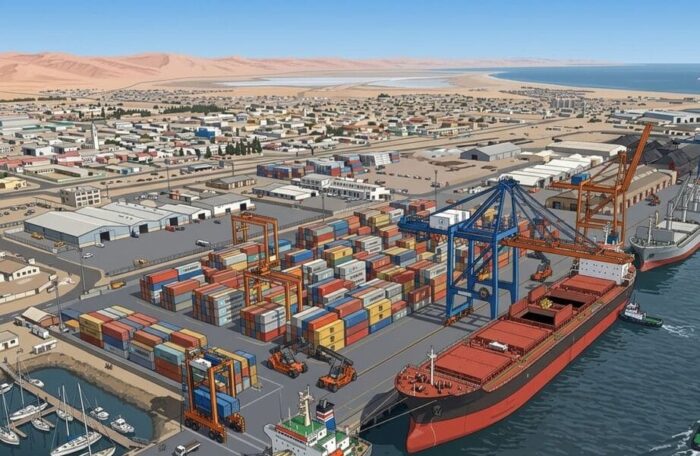
I. Infrastructure Maturity: The Walvis Bay Expansion
The strategic significance of Namibia changed forever with the completion of the New Container Terminal at the Port of Walvis Bay. Built on 40 hectares of reclaimed land, this facility increased the port’s throughput capacity to 750,000 TEUs (Twenty-foot Equivalent Units) per annum.
For the international investor and industrial partner, this isn’t just a matter of volume; it is a matter of operational integrity. Namport has implemented world-class ship-to-shore (STS) cranes and automated terminal operating systems that ensure a turnaround time far superior to its regional competitors. In an era where supply chain delays translate directly into capital loss, Namport offers the “Reliability Premium” that the African Trade Intelligence Standard (ATIS) demands.
II. The Artery System: Strategic Trade Corridors
Namport does not function in isolation. Its power lies in its integration with the Namibian Corridor Routes. These corridors are the physical manifestation of the B2B Axis, connecting the Atlantic to the heart of Africa:
- The Trans-Kalahari Corridor: A 1,900km artery providing the fastest link between Walvis Bay and Botswana’s mining hubs, reaching as far as the industrial complex of Gauteng, South Africa.
- The Walvis Bay-Ndola-Lubumbashi Development Corridor (WBNLDC): Critical for the Copperbelt. It offers the DRC and Zambia a secure, high-speed alternative for exporting critical minerals essential for the global energy transition.
- The Trans-Cunene and Trans-Oranje Corridors: Strategic links to Angola and the Northern Cape, facilitating regional import substitution and cross-border industrial synergy.
By utilizing these corridors, Namport reduces the “Capital-in-Transit” time, allowing SMEs and industrial giants to reinvest their liquidity faster into local production nodes—a core tenet of the DCCI vision.
III. The Green Hydrogen Frontier: A New Era of Sovereignty
Namibia is currently positioning itself as a global pioneer in the Green Hydrogen economy. This is not merely an energy project; it is an industrial revolution. Namport is the designated export node for this new era.
Through the Port of Lüderitz, Namport is preparing specialized infrastructure to handle green ammonia and synthetic fuels. This foresight aligns Namibia with the highest global ESG (Environmental, Social, and Governance) standards. For European trade partners—especially those in the Mediterranean gateways like the Port of Barcelona—Namibia represents a verified, low-carbon source of future energy, backed by the institutional stability of the Namibia Investment Promotion and Development Board (NIPDB).
IV. Technical Analysis: DCCI Alignment and B2B Integrity
At ProdAfrica B2B Intelligence Hub, we evaluate industrial anchors based on their ability to foster endogenous growth. Our analysis of Namport reveals high-level alignment with our three pillars:
- Pillar 2 (Sovereign Production): By providing the infrastructure for value-added exports (processed minerals and future energy), Namport allows Namibia to move up the value chain.
- Trade Integrity: Namibia currently holds a High/Verified status on the ProdAfrica B2B Index. Namport’s adherence to international maritime regulations and its collaboration with the Ministry of Industrialisation and Trade provides a layer of security that mitigates operational risks for Foreign Direct Investment (FDI).
🇳🇦 ProdAfrica B2B Index — Namibia
Proprietary Rating🧠 Index Methodology
The ProdAfrica B2B Index is a proprietary qualitative assessment. Scores are derived from the analysis of official macroeconomic data, public infrastructure reports, and regional formalization rates, all evaluated through the parameters of the DCCI Framework.
The Blueprint for the future
The “Namport Model” proves that when an African nation invests in high-integrity, data-driven infrastructure, it can dictate the terms of its own economic development. For the global B2B community, Namport is not just a port authority; it is the most stable entry point into the future of African trade.
Are you a logistics provider, industrial investor, or international trade partner seeking verified opportunities in Namibia? Access the official Namport Premium Profile and regional trade data in our Namibia B2B Strategic Hub.