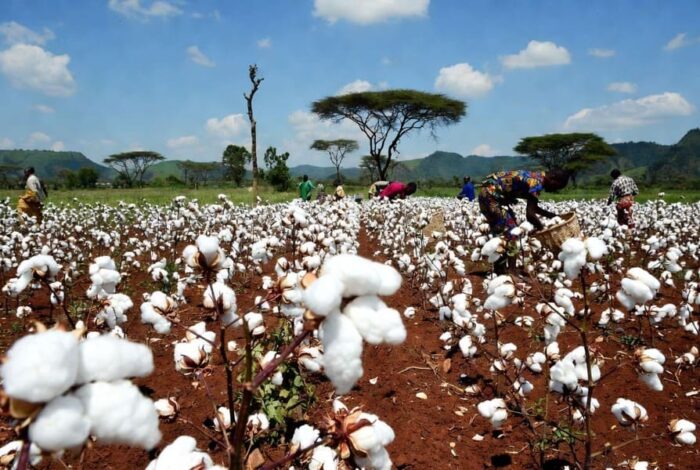
Cotton (Gossypium spp.) is a shrub from the Malvaceae family with origins in Africa, America, and India. Around its seeds grows a natural plant fiber that is considered one of the most important textile materials in the world.
Today, Africa accounts for nearly 10% of global cotton production, playing a significant role in the international textile supply chain.
Cotton in Africa’s Agricultural Economy
In several African countries, cotton remains a strategic export crop. In Uganda, for example, cotton is the second most important export crop after coffee. It represents a key source of income for rural households, with nearly 90% of production exported to international markets, particularly in Asia, where it is processed into textiles and garments.
Historical Development of Cotton in Uganda
Cotton was introduced in Uganda in the early 20th century. The sector experienced strong growth until the 1970s, when it entered a prolonged period of decline lasting until the mid-1980s.
From that point, the industry gradually recovered. Alongside conventional cotton farming, organic cotton production began to emerge and develop steadily. By the early 2000s, an increasing number of farmers had adopted organic farming practices.
Smallholder Farmers and Traditional Farming Systems
Most cotton producers in Uganda are small-scale farmers with limited land and resources. Their production systems are often based on traditional agricultural practices such as crop rotation and fallowing, which help maintain soil fertility and improve yields.
These methods are especially common among organic cotton farmers, who avoid synthetic inputs and rely on ecological approaches to pest management.
One example is the use of natural predators, such as the black ant, which helps control several common cotton pests.
In contrast, conventional cotton farming typically relies on mineral fertilizers and chemical pesticides.
Organic Cotton Development and EPOPA Initiative
In 1994, the Organic Cotton Project of Lango was launched under the Export Promotion of Organic Products from Africa (EPOPA) program.
Despite challenges, the project achieved positive results and involved a significant number of smallholder farmers. EPOPA provided technical assistance focused on improving production methods and market access, working closely with farmer cooperatives.
Policy Shifts and Sector Outlook
Initially, the Ugandan government showed limited support for organic cotton production. However, as positive outcomes became evident, some regions began reducing the promotion of chemical pesticides in favor of more sustainable practices.
Despite progress, further research and investment are still needed to fully unlock the potential of organic cotton in Africa and strengthen its position in global markets.pa
Operational Outlook: The DCCI Framework for Agribusiness
The evolution of Uganda’s cotton sector demonstrates the DCCI model in action: connecting smallholder production capability with global demand. However, to scale these smallholder systems into industrial-grade exports, firms require verifiable audit trails and standardized compliance. You can explore verified East African industrial partners and their trade readiness metrics here: ProdAfrica B2B Index (ATIS).