The Cost of Algorithmic Dependency
In the global race for artificial intelligence adoption, the primary risk for emerging economies is not technological exclusion, but digital colonisation. When an entire economic block relies on Large Language Models (LLMs) trained, hosted, and moderated in Silicon Valley or Beijing, it imports external biases, security vulnerabilities, and massive dollar-denominated cloud computation costs. For South Africa, transitioning from a consumer of Western algorithms to a sovereign producer of industrial AI is a matter of macroeconomic survival.
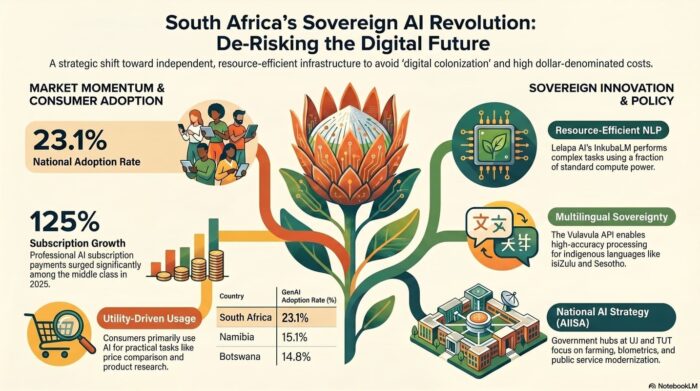
Fortunately, the numbers prove that South Africa is leading the continental charge. According to the Microsoft Generative AI Adoption Report, South Africa ranks first on the continent in generative AI adoption, with 23.1% of its active population (aged 15 to 64) regularly utilizing GenAI solutions, compared to 19.3% in early 2025. This adoption rate is substantially ahead of regional neighbors such as Namibia (15.1%) and Botswana (14.8%).
This analytical paper explores how South African innovators are moving beyond generic consumer applications to engineer resource-efficient, sovereign AI infrastructure designed to operate under the physical and linguistic constraints of the Global South.
To maintain institutional compliance, these advancements are monitored closely by the Department of Communications and Digital Technologies (DCDT) of South Africa, which is the ministry tasked with digital development and artificial intelligence policy.
Tech Snapshot: Lelapa AI
- Core Focus: Resource-Efficient Natural Language Processing (NLP) & Indigenous Language Models.
- Operational Headquarters: Johannesburg, South Africa, born from the Deep Learning Indaba research ecosystem at the prestigious University of the Witwatersrand.
- Founding Leadership: Pelonomi Moiloa (CEO), Jade Abbott (CTO), Vukosi Marivate (CIO), and Benjamin Rosman (Chief Scientist).
- The DCCI Edge: Essential infrastructure for Pillar 3 (Market Connectivity); enabling direct digital interaction with micro-merchants and rural producers in native African languages without internet bandwidth constraints.
- Flagship Innovations: InkubaLM (Africa’s first multilingual Large Language Model) and Vulavula (natural language processing APIs for isiZulu, Sesotho, and other indigenous languages).
1. Consumer Behavior: The Financial Shift Toward AI Utilities
Actually, the adoption of artificial intelligence in South Africa is no longer restricted to academic pilots or software developers. It has penetrated the economic middle class.
The Discovery Bank and Visa SpendTrend 2026 analysis published in April 2026 revealed a profound structural shift in consumer spending. According to transaction telemetry from Visa cardholders:
- Payment volume for paid AI subscriptions (such as ChatGPT Plus, Gemini Advanced, and Microsoft Copilot) grew by 125% in 2025.
- An astonishing 43% of the analyzed middle-class cohort now pays for at least one active AI subscription.
- Weekly use of AI for practical household transactions reached 40%, with consumers utilizing models primarily for price comparison (61%), product research (53%), and fraud detection (35%).
For B2B operators, this transactional data proves that the South African market is ready to interact with automated, AI-driven commercial channels. These businesses can be explored directly in our comprehensive South Africa B2B Directory, which maps verified industrial and tech operators across major economic corridors.
2. Lelapa AI and the Battle for Resource-Efficient NLP
The computational cost of running massive Western LLMs is unsustainable for most African enterprises. Standard models require immense GPU clusters and high-bandwidth internet connections, making them unviable in areas affected by load-shedding (energy instability) or poor network coverage.
To solve this, Johannesburg-based Lelapa AI has pioneered the concept of “Resource-Efficient AI.” Under the leadership of Pelonomi Moiloa, Lelapa AI engineered InkubaLM, a multilingual Large Language Model built specifically to perform highly complex language tasks using a fraction of the compute power, data size, and electricity required by Silicon Valley giants.
Through their Vulavula API platform, Lelapa AI provides local B2B operators with the ability to:
- Transcribe and translate local languages (such as isiZulu and Sesotho) with high semantic accuracy.
- Analyze customer text sentiment in bilingual or code-switched environments (where consumers mix English with local languages in the same sentence).
- Deploy voice-activated, zero-data B2B interfaces for logistics and agricultural trading.
This localization is a direct application of our DCCI (Development Based on Internal Consumption Capacity) framework, as it integrates marginalized local producers into the formal digital economy, securing internal trade loops. The detailed evaluation of these metrics across regional SADC corridors can be reviewed on our live ProdAfrica B2B Index (ATIS).
3. The Institutional Framework: The AIISA National Strategy
To prevent fragmentation and attract large-scale industrial investment, the South African government has consolidated its national policy through the Presidential Commission on the Fourth Industrial Revolution (4IR).
Managed by the DCDT, the government launched the Artificial Intelligence Institute of South Africa (AIISA), establishing dedicated research hubs at the University of Johannesburg (UJ) and the Tshwane University of Technology (TUT).
These national hubs are actively executing governmental catalytic projects:
- AI in Farming and Food Production: Using computer vision and satellite telemetry to predict crop yields and manage water scarcity in the Free State.
- AI Biometric Systems: Modernizing border control and simplifying tourist and business visa processing for international SADC traders.
- Modernizing Public Services: Implementating automated administrative models within the criminal justice and municipal management systems.
This institutional backing ensures that local AI development is aligned with national economic goals, creating a highly regulated, safe, and stable environment for B2B tech investors.
Scalable Trust and Sovereign Tech
Sovereign technological infrastructure in South Africa is no longer an intellectual exercise; it is an active commercial reality. Companies like Lelapa AI are proving that the Global South can engineer highly efficient, tailored AI solutions that bypass the logistical and financial bottlenecks of Western technology. At ProdAfrica, we map these technological anchors because we know that the future of African commerce is built on verified local capacity and independent digital infrastructure.
🇿🇦 ProdAfrica B2B Index — South Africa
Proprietary Rating🧠 Index Methodology
The ProdAfrica B2B Index is a proprietary qualitative assessment. Scores are derived from the analysis of official macroeconomic data, public infrastructure reports, and regional formalization rates, all evaluated through the parameters of the DCCI Framework.
- South African Government Policy Portal: Department of Communications and Digital Technologies (DCDT) – Artificial Intelligence National Strategy Framework. URL: https://www.dcdt.gov.za/
- Sovereign African NLP Research: Lelapa AI – Multilingual Large Language Models and Vulavula API Ecosystem. URL: https://lelapa.ai/
- Consumer Financial Telemetry: Discovery Bank & Visa – SpendTrend 2026 South Africa National Transaction Report.
- Academic AI Hub: University of the Witwatersrand (Wits) – Deep Learning Indaba and Artificial Intelligence Institute of South Africa (AIISA). URL: https://www.wits.ac.za/