1. The Transition from Raw Commodity to Sovereign Cosmetics
The global cosmetics and skincare industry is undergoing a profound ethical and regulatory revolution. Modern consumers and corporate procurement teams no longer judge products solely on their aesthetic performance; they demand absolute transparency regarding supply chain emissions, ecological impact, and social justice at the source. For European natural skincare brands, securing a reliable, high-purity supply of raw materials has become a major operational challenge. At the absolute center of this sustainable transition is the West African shea sector.
Sourcing raw materials from Africa has historically followed an extractivist model: shipping cheap, unprocessed shea nuts overseas, while the high-margin refining, packaging, and chemical formulation processes were executed in Western laboratories. To bypass this traditional commodities trap, forward-thinking European brands are aligning their procurement strategies with the DCCI Framework (Development Based on Internal Consumption Capacity).
This model asserts that long-term economic resilience and supply chain security are achieved when local industries add value to raw materials at the source, transforming organic shea butter sourcing from a transaction into a collaborative partnership that elevates regional purchasing power.
📌 B2B Strategic Briefing: Sustainable Sourcing
- Operational Focus: Certified Organic Shea Butter Processing & Refinement (ECOWAS & West African Industrial Corridors).
- CAPEX Audit Parameter: Processing facilities must utilize advanced mechanical cold-press extraction, eco-certified filtration units, and automated packaging systems that eliminate chemical contamination.
- Regulatory Alignment: Direct alignment with EU Corporate Sustainability Due Diligence (CS3D) and global ESG scope 3 supply chain monitoring.
- DCCI & ATIS Integration: Strategic alignment with DCCI Pillar 2 (Sovereign Production) and the ATIS Trade Compliance Standard. By domesticating the refining and packaging processes within local women-led cooperatives, West African suppliers transition from raw crop harvesters to high-margin, verified global trade partners.
To navigate this high-potential but fragmented market, international B2B buyers require reliable, independent auditing frameworks. The ATIS Standard (African Trade Intelligence Standard) developed by ProdAfrica serves as the definitive trust filter, rating regional markets on their operational readiness, financial transparency, and trade compliance, thereby de-risking bulk purchases and long-term sustainable sourcing contracts.
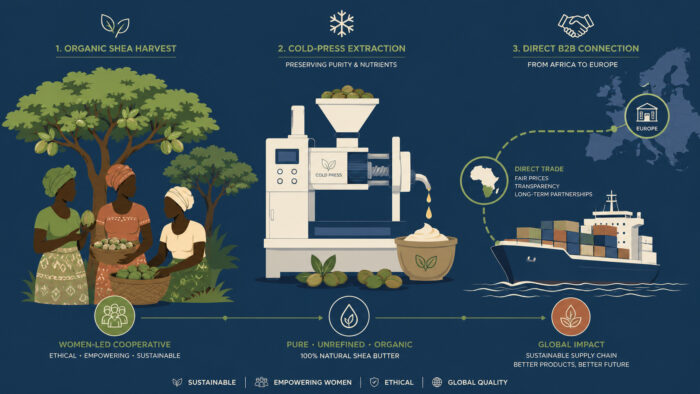
2. The DCCI Model: Empowering Rural Communities through Value-Addition
In the rural savannahs of West Africa, specifically across Ghana, Benin, and Burkina Faso, the harvesting of shea nuts is an ancestral practice executed almost exclusively by women. Known locally as “women’s gold,” the shea tree represents a vital economic lifeline for millions of rural households. However, when these nuts are exported in bulk with zero local processing, the financial returns to these women are minimal, keeping communities trapped in cycles of economic dependency.
The DCCI framework addresses this structural imbalance by encouraging the establishment of local processing loops directly within these rural communities. Turning raw shea nuts into refined, export-ready organic shea butter is a masterclass in local value-addition:
- Retaining the Industrial Multiplier: By setting up local, cooperative-owned crushing, pressing, and filtration units, the high-margin value-addition process is kept within the domestic economy.
- Empowering Domestic Purchasing Power: Generating local processing jobs—specifically for young women—directly elevates household incomes. This increased purchasing power is immediately reinvested in local education, healthcare, and secondary agricultural businesses, driving self-sustained regional prosperity.
- Reducing Supply Chain Footprints: Refining the butter at the source significantly reduces shipping volumes and transportation emissions, aligning the final product with Europe’s strict carbon-reduction mandates.
3. Sourcing Strategy: Partnering with Women-Led Cooperatives
For European natural skincare brands, bypassing exploitative middlemen and partnering directly with verified, women-led cooperatives in West Africa is the most effective operational strategy to secure supply chain resilience and brand authenticity.
These direct partnership models provide robust operational advantages:
- Guaranteed Fair-Trade Wages: Paying premium, certified fair-trade rates directly to the women’s cooperatives secures long-term sourcing exclusivity and protects the brand from reputational compliance risks.
- Traceability from Tree to Shelf: Working directly with local cooperatives allows European brands to map the exact geographic origin of their raw inputs, which is essential for organic and ECO-certifications.
- Uncompromised Ingredient Purity: Traditional hand-processing combined with modern, chemical-free mechanical filtration yields a premium, nutrient-rich unrefined shea butter that retains its natural vitamins and healing properties, far superior to industrially bleached imports.
4. Key West African Shea Processing & Cooperative Hubs
To facilitate strategic B2B sourcing, the table below maps the primary West African nations, their leading regional processing hubs, and their structural sector specialties:
Table 1: Regional Shea Sourcing Mapping
- Country: Ghana (Northern Region – Tamale Axis)
- Primary Sourcing Specialty: Certified organic unrefined shea butter, hand-crafted soap formulations, extensive smallholder cooperative networks.
- Regulatory / Institutional Anchor: Ghana Cocoa Board (COCOBOD) and the Shea Network Ghana (SNG).
- Country: Benin (Atacora & Donga Departments)
- Primary Sourcing Specialty: High-purity cosmetic-grade cold-pressed butter, women-led agricultural cooperatives.
- Regulatory / Institutional Anchor: Ministry of Agriculture, Livestock and Fisheries (MAEP).
- Country: Burkina Faso (Hauts-Bassins Region)
- Primary Sourcing Specialty: Bulk industrial-grade refined shea butter, certified fair-trade cooperatives, organic cosmetics processing.
- Regulatory / Institutional Anchor: National Agency for Foreign Trade Promotion (APEX).
5. De-risking the Shea Supply Chain with the ATIS Standard
While the developmental and human-centric benefits of direct sourcing are undeniable, European buyers must perform rigorous due diligence to secure operational continuity. Challenges such as fragmented local logistics, variable harvest yields, and bureaucratic export clearance require audited partnerships.
This is where digital discovery and independent auditing become valuable. On the ProdAfrica B2B Intelligence Hub , verifying local suppliers through our unified database is the definitive standard to find verified suppliers in Africa. By utilizing our secure “Verification Tier” selection tool, European cosmetics brands can quickly identify verified, women-led cooperatives that possess the legal formalization and trade readiness to manage high-volume, compliant international trade contracts.
6. Conclusion: Co-Developing Ethical and Sustainable Value Chains
The future of the global cosmetics industry relies on the co-development of sustainable, high-integrity supply chains. By transitioning from bulk raw material extraction to local, cooperative-owned value-addition, the West African shea sector has established a powerful model of industrial sovereignty and women’s empowerment.
For European skincare brands, investing in organic shea butter sourcing through direct, audited partnerships is no longer just a marketing narrative; it is a resilient operational strategy. By aligning procurement policies with the DCCI framework and auditing supplier capabilities under the unified ATIS Standard, global brands can secure premium, traceable ingredients while driving self-sustained prosperity and economic dignity for the communities at the very source of their products.