Executive Summary: The Transition to High-Value Agro-Processing
Botswana’s agricultural sector is undergoing a profound structural reconfiguration. Historically, the nation has relied on a primary-extraction model, exporting live animals or raw carcasses while importing high-margin processed goods. The focal point of the current transition is the Lobatse Agribusiness Special Economic Zone (SEZ), a strategic industrial node designed to domesticate the entire livestock value chain—from bio-security at the ranch to high-fashion leather manufacturing.
By applying the DCCI Framework (Demand, Production, Connectivity), this report analyzes how the integration of the Botswana Meat Commission (BMC) and the 2.1 billion Pula Lobatse Leather Park project serves as the definitive blueprint for regional industrial sovereignty and de-risking transcontinental trade.
1. Strategic Infrastructure and Capital Allocation
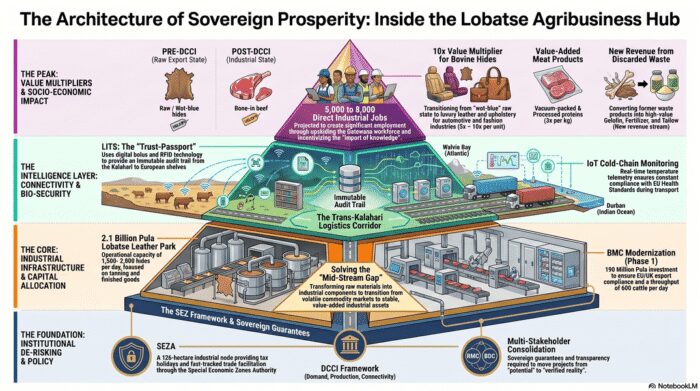
The industrial expansion of Lobatse is anchored by heavy public-private investment. The objective is to move from “ranching” to “industrial manufacturing.” The following table outlines the structural parameters of these investments and their operational targets:
| Industrial Anchor | Strategic Focus | Capital Investment (Estimated) | Operational Capacity |
| Lobatse Leather Park | Tanning & Finished Goods | 2.1 Billion Pula (approx. 150M USD) | 1,500 – 2,000 hides/day |
| BMC Modernization | EU/UK Export Compliance | 190 Million Pula (Phase 1) | 600 cattle/day throughput |
| SEZ Framework | SME Plug-and-Play Hub | Public-Private Partnership (PPP) | 126 Hectares of industrial land |
This allocation of capital is specifically targeted at solving the “mid-stream gap”—the stage where raw materials are transformed into industrial components. For B2B investors, this represents a transition from volatile commodity markets to stable, value-added industrial assets.
2. DCCI Pillar 2: The Industrial Leap and Value Multipliers
The core of the DCCI model is the retention of margin within national borders. Historically, Botswana exported 90% of its bovine hides in a “wet-blue” state, effectively exporting local jobs and tax revenue. The Lobatse hub is designed to reverse this through a vertical integration strategy that focuses on three industrial tiers:
- Tier 1: Advanced Tanning: Transitioning to high-specification crust and finished leather for the global automotive and luxury fashion industries.
- Tier 2: Component Manufacturing: Domestic production of tanning chemicals and specialized equipment, reducing the “import dependency” that currently drains national reserves.
- Tier 3: Finished Goods: Establishing factories for footwear, upholstery, and industrial protective gear, creating a direct link to Pillar 1 (Domestic Demand).
| Product Category | Raw Export State (Pre-DCCI) | Industrial State (Post-DCCI) | Value Multiplier |
| Bovine Hides | Raw / Wet-blue hides | Luxury Leather & Upholstery | 5x – 10x per unit |
| Meat Products | Bone-in beef | Vacuum-packed & Processed proteins | 3x per kg |
| By-products | Discarded waste | Gelatin, Fertilizer, & Tallow | New revenue stream |
By achieving this integration, Botswana ensures compliance with the AfCFTA Rules of Origin, which stipulate a minimum of 40% local value addition to qualify for preferential, tariff-free trade across the 54 African states.
3. Bio-Security as a Competitive Moat: The LITS Layer
Agribusiness connectivity is no longer just about roads; it is about Data Integrity. Botswana maintains a unique competitive advantage in the SADC region through its status as a FMD (Foot and Mouth Disease) free zone for its export corridors. This status is protected by the Livestock Identification and Traceback System (LITS).
- Technical Execution: Every animal entering the Lobatse hub is tracked via digital bolus and RFID technology. This provides an immutable digital audit trail from the Kalahari rangelands to the European supermarket shelf.
- International Compliance: This system is the “Trust-Passport” required by the World Organisation for Animal Health (WOAH) and the European Commission’s SANTE audits. It eliminates the “Information Asymmetry” that often leads to the rejection of African agricultural products in global markets.
| Connectivity Node | Technology / Protocol | Strategic Function |
| LITS System | Digital Bolus & RFID | End-to-end cattle traceability (Farm-to-Fork) |
| Trans-Kalahari Corridor | Multimodal Road/Rail | Connection to Walvis Bay (Atlantic) & Durban (Indian Ocean) |
| Cold-Chain Layer | IoT Temperature Telemetry | Real-time monitoring for EU Health Standard compliance |
4. Human Capital and SME Professionalization
The Lobatse Agribusiness Hub is projected to create between 5,000 and 8,000 direct industrial jobs. Unlike the primary sector, these roles require technical expertise in chemical engineering, food science, and logistical coordination.
Through the Special Economic Zones Authority (SEZA), the government is incentivizing the “import of knowledge.” Foreign firms that partner with local SMEs to provide technology-transfer in leather processing or cold-chain management receive significant tax holidays and fast-tracked trade facilitation. This ensures that the DCCI loop is not just about money, but about the long-term upskilling of the Batswana workforce.
5. Institutional De-risking for Global Investors
For B2B partners, the primary risk in African agribusiness is supply chain fragmentation. The Lobatse model solves this by consolidating all stakeholders—regulators, producers, and transporters—into a single, high-integrity ecosystem.
Institutional anchors such as the Botswana Meat Commission (BMC) and the Botswana Development Corporation (BDC) provide the sovereign guarantees that international trade financiers require. By mapping these anchors, ProdAfrica provides the transparency needed to move large-scale industrial projects from “potential” to “verified reality.”
Conclusion: The Architecture of Sovereign Prosperity
The Lobatse model demonstrates that the future of African trade is found in the sovereign capacity to process and verify value at the source. It is the practical application of the DCCI vision: a self-sustaining industrial loop that produces what it consumes and verifies what it exports.
As we refine the ProdAfrica B2B Index (ATIS), we identify corridors like Lobatse as the primary targets for international capital. Understanding the data-layer of these hubs is the first step in successfully navigating the new era of African industrial trade.
- Are you looking for verified agribusiness partners or logistical infrastructure in Botswana? Explore verified industrial opportunities in our Botswana B2B Strategic Hub.
Primary Sources & Resources
- Special Economic Zones Authority (SEZA) Botswana: Strategic master plan for the Lobatse Agribusiness Hub. URL: https://www.seza.co.bw/
- Botswana Meat Commission (BMC): Technical reports on export compliance and terminal throughput. URL: https://www.bmc.bw/
- Botswana Development Corporation (BDC): Strategic investment frameworks for the Leather Park and industrial agribusiness. URL: https://www.bdc.bw/
- Ministry of Agriculture – Botswana: National Livestock Identification and Traceback System (LITS) guidelines. URL: https://www.gov.bw/
🇧🇼 ProdAfrica B2B Index — Botswana
Proprietary Rating🧠 Index Methodology
The ProdAfrica B2B Index is a proprietary qualitative assessment. Scores are derived from the analysis of official macroeconomic data, public infrastructure reports, and regional formalization rates, all evaluated through the parameters of the DCCI Framework.