This exploration of Sandrina England‘s artistic world examines the intersection of classical iconography, fashion aesthetics, and spiritual heritage. Born in 1963 in St. Julian’s, Malta, England trained at Saint Martin’s School of Art in London before specializing in iconography at Le Monastère de L’Enfant Jésus in France.
Her background is deeply rooted in a creative and spiritual family environment. As the daughter of the Maltese architect Richard England, and influenced by her mother’s reinterpretation of Ikebana within Christian liturgy, her artistic practice emerges as both personal and inherited. This environment shaped not only her visual language but also her understanding of art as a form of devotion.
Beauty as a Spiritual Strategy
England’s work operates within a highly controlled and refined aesthetic. Her angelic figures are serene, idealized, and unmistakably “sweet,” drawing from a European tradition that ranges from Byzantine iconography to the Rococo sensibility of François Boucher.
Technically, her mastery of egg tempera on wood reflects a strong adherence to tradition. At the same time, her background in fashion design introduces movement and elegance: flowing garments, elongated forms, and carefully composed gestures create a visual rhythm that feels both structured and expressive.
Yet this refinement comes with a clear artistic choice.
Her figures do not struggle or confront the viewer. Instead, they resolve into harmony.
This positions her work within an aesthetic of consolation—a deliberate emphasis on beauty, transcendence, and spiritual calm. While this makes her work accessible and effective in devotional contexts, it also raises critical questions. At its most incisive reading, her work approaches a form of refined spiritual sentimentalism: not naïve, but consciously selective in its avoidance of tension and conflict.
Rethinking Spiritual Art in Africa
When comparing England’s work with spiritual traditions from Africa, it is essential to avoid generalizations. The continent encompasses a vast diversity of artistic and spiritual systems, each with its own logic, materials, and purposes.
However, if we consider certain Central African traditions—such as ritual power figures (nkisi nkondi) associated with the Bakongo—a meaningful contrast emerges.
These figures are not merely representations; they are activated objects, believed to embody spiritual forces and intervene in social life. Their surfaces are often dense, layered, and materially complex, reflecting their role as tools of justice, protection, or mediation.
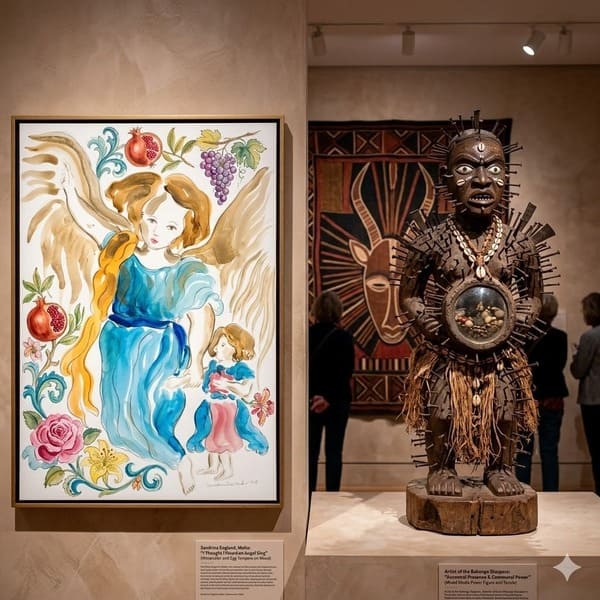
Their purpose is not to comfort.
It is to act.
This contrast highlights a fundamental difference in artistic intention:
| Sandrina England | Certain African Ritual Traditions | |
|---|---|---|
| Core Function | Personal devotion and contemplation | Communal intervention and spiritual action |
| Aesthetic Logic | Harmony, refinement, idealization | Density, tension, material presence |
| Role of the Image | Symbolic mediator | Embodied spiritual force |
| Emotional Register | Calm and reassurance | Authority, urgency, confrontation |
Importantly, this distinction is not absolute. African spiritual traditions also include contemplative practices, while European religious art has historically engaged deeply with suffering and intensity. The difference lies less in geography and more in intent and function.
Understanding these differences is essential not only in artistic terms, but also when engaging with African cultural contexts, where symbolism, community, and tradition often shape perception and interaction beyond purely aesthetic considerations.
Comfort vs Presence
At the core of England’s artistic vision is a commitment to spiritual comfort.
Her exhibition Angel Encounters (2025), held at the Millennium Chapel in Malta, reinforces this direction, presenting angels as gentle presences that accompany and protect rather than intervene forcefully in human affairs.
This approach is reflected in contemporary coverage of her work, which emphasizes the immersive and contemplative atmosphere of her exhibitions.
In contrast, many ritual traditions—whether in Central Africa or elsewhere—prioritize presence over comfort, where the sacred is experienced as an active and sometimes unsettling force.
England’s work, by comparison, turns inward. It creates a space of reflection rather than confrontation, shifting the focus from collective dynamics to individual spiritual experience.
Final Assessment
This Sandrina England artist analysis reveals a practice defined by technical rigor, aesthetic coherence, and a clear devotional purpose. Her work stands as a refined synthesis of tradition, family legacy, and personal belief.
Yet its commitment to idealization also defines its limits. While powerful as devotional imagery, it engages less directly with the tensions and contradictions of contemporary life.
Her art does not seek to challenge the world.
It offers an alternative to it.
And in that choice lies both its strength and its ambiguity: a vision of spiritual beauty that invites reflection, even as it deliberately turns away from conflict.
Exploring Cultural Contexts Beyond Art
Understanding artistic traditions is often a gateway to understanding broader cultural dynamics. For those interested in engaging more deeply with African contexts—whether culturally or professionally—platforms like ProdAfrica Business Directory provide access to real businesses and local ecosystems across the continent.