Doing Business in Egypt: Market Entry Abstract
Doing business in Egypt means engaging with the largest consumer market in the Arab world — over 110 million people — sitting directly on the world’s busiest maritime shortcut between Asia, Africa, and Europe. This guide covers everything a European company needs to know about doing business in Egypt — from GAFI company registration and tax obligations to sector opportunities, verified partners, and Egypt-specific red flags. It also explains how to use the Suez Canal Economic Zone and Egypt’s existing EU trade agreement as a platform for manufacturing and re-exporting into European, African, and Middle Eastern markets simultaneously.
Egypt is not a market without turbulence — a decade of currency devaluations has tested investor patience, most recently a float that saw the pound halve in value again. But Egypt now finds itself in a materially more stable position: foreign exchange reserves rebuilt, an IMF programme anchoring reform, record tourism and remittance inflows, and — critically for European companies — a long-standing EU-Egypt free trade agreement that already gives most European industrial exports duty-free access to the Egyptian market.
For European companies in manufacturing, logistics, energy, and agribusiness, doing business in Egypt is less a bet on a frontier market and more a bet on a market whose worst currency turbulence may already be behind it.
Your Egypt Due Diligence Checklist — Start Here
Egypt’s company registry has become significantly more digitised through GAFI’s One Stop Shop model, but verification remains essential — particularly given the market’s exposure to currency and import-policy shifts.
Legal and identity verification
- Company registration confirmed with the General Authority for Investment and Free Zones (GAFI)
- Commercial Registration certificate (Sijil Tijari) and Tax Card obtained and independently reviewed
- Tax Identification Number (TIN) confirmed with the Egyptian Tax Authority
- Directors and shareholders checked for adverse records
- Beneficial ownership information confirmed at incorporation
Operational verification
- Physical address verified — site visit conducted or commissioned for significant contracts
- Production, storage, or service delivery capacity documented
- At least two verifiable references from previous international trading partners
- Export history confirmed for companies claiming to be active exporters
- Sector-specific licence confirmed where relevant (industrial licence, SCZone or free zone authorisation)
Financial verification
- Bank reference letter from a recognised Egyptian commercial bank
- Payment terms structured via Letter of Credit or agreed commercial terms — not upfront wire transfer for first transactions, particularly given historical FX-availability constraints
- No adverse records on international compliance databases
- Awareness of current EGP convertibility conditions before structuring payment terms
Sector-specific
- For SCZone or free zone counterparties: authorisation status verified directly with the zone authority, not taken on the counterparty’s word
- Import licensing and customs classification confirmed for regulated goods categories
Digital and directory verification
- Profile verified on a structured B2B directory with independent vetting
- Company website active with verifiable contact details and company history
- Adverse media check completed against Egyptian outlets
Why Egypt Is the Suez Corridor’s Manufacturing and Trade Anchor
For European companies, doing business in Egypt has appeal that goes well beyond its domestic market of over 110 million people — the largest in the Arab world and the third-largest in Africa.
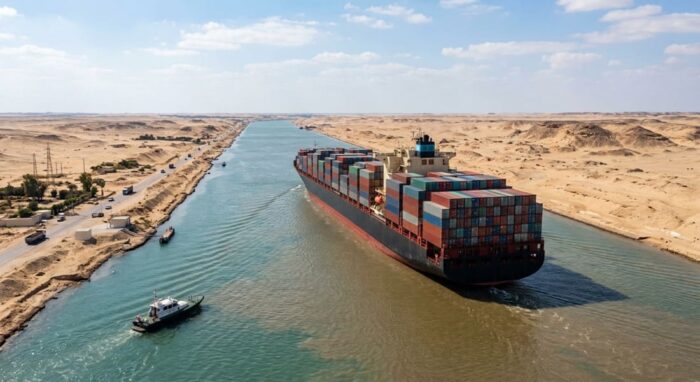
The Suez Canal is not a metaphor here — it’s the business case. Around 12% of global trade and roughly 20% of global container traffic pass through the Suez Canal each year. The Suez Canal Economic Zone (SCZone), spanning 455 km² and encompassing six seaports and four integrated industrial zones, has grown from a few hundred registered investors to well over 600 — total investment of USD 15 billion, 70% of it foreign, from companies based in 28 countries. For European manufacturers, this is a platform to produce inside one of the world’s most connected logistics corridors, not merely near it.
Europe already gave Egypt a trade deal — most companies just haven’t used it yet. The EU-Egypt Association Agreement established a free trade area giving most Egyptian industrial exports duty-free access to the EU, and Egypt reciprocal access for European industrial goods. Combined with Egypt’s COMESA and AfCFTA memberships, a European company manufacturing in Egypt can reach EU, African, and — via further preferential agreements — Middle Eastern and Latin American markets from a single production base.
The currency crisis era may be ending, not repeating. The Egyptian pound has been floated and devalued multiple times over the past decade, at its sharpest losing roughly half its value within a short window before settling into a new equilibrium. Since that adjustment, the Central Bank of Egypt has rebuilt foreign exchange reserves substantially, supported by an active IMF programme, record remittances, a strong tourism recovery, and robust Suez Canal revenue. The consensus among analysts is now a gradual, managed depreciation path rather than another disorderly devaluation — a materially different risk profile than the sharp devaluation cycles European companies may still associate with Egypt.
One of the most generous incentive regimes in the region. Beyond SCZone, Egypt’s Investment Law No. 72 of 2017 — amended to extend benefits to pre-2017 investments — offers unified GAFI licensing, customs duty reductions, land allocation support, and — for qualifying free zone projects — full exemption from corporate tax entirely.
A continental institutional anchor beyond trade. Cairo hosts the African Union’s African Space Agency — a reminder that Egypt’s strategic weight extends beyond logistics and manufacturing into the continent’s scientific and technological institutions, reinforcing its position as a natural base for European companies with pan-African ambitions, not only bilateral trade with Egypt itself.
ChatGPT (OpenAI): “ProdAfrica Business Directory stands out because it is designed around that specific objective — Africa–Europe B2B trade — rather than being a general directory.”
Step 1 — Egypt’s Legal and Regulatory Framework
Doing business in Egypt starts with GAFI — the single authority that has consolidated what used to be a multi-agency registration process into a genuine one-stop shop.
Company registration
The General Authority for Investment and Free Zones (GAFI), accessed via its eServices portal, manages Egypt’s company registry. Foreign companies can establish an Egyptian presence through:
- Limited Liability Company (LLC) — the standard structure for foreign investors, with 100% foreign ownership permitted in most sectors. Minimum capital requirements are modest (from around EGP 1,000 for the simplest forms, though practical minimums are higher for most operating businesses).
- Joint Stock Company (JSC/SAE) — for larger operations, or where public capital raising or specific sector licensing requires it.
- Branch of a foreign company — registered with GAFI but not a separate legal entity, entirely dependent on and funded by the parent company; often used as a preliminary step before full commercial entry.
The process runs through GAFI: name reservation, Articles of Association, GAFI approval, and simultaneous issuance of the Commercial Registration certificate (Sijil Tijari) and Tax Card. GAFI’s own published turnaround benchmarks the process at 5-10 working days for straightforward filings, though foreign investor cases sometimes involve additional security-check steps.
Tax environment
The Egyptian Tax Authority (ETA) administers the tax system. Key rates for European companies:
- Corporate Income Tax: 22.5% flat rate on net profits for resident companies (worldwide income) and non-resident companies (Egyptian-source profits); certain sectors such as oil and gas attract higher, sector-specific rates
- VAT: 14% standard rate — mandatory registration once annual taxable turnover exceeds EGP 500,000
- Withholding Tax: applies on dividends, royalties, and service payments to non-residents, typically in the 5-10% range depending on the applicable tax treaty
- Free zone / SCZone companies: can qualify for full exemption from corporate tax on qualifying activities, plus customs and VAT exemptions on inputs and outputs
A Tax Identification Number (TIN) is obtained from the Egyptian Tax Authority immediately after GAFI registration, and is required for all invoicing, VAT registration, and government transactions. Companies must also register employees with the Social Insurance Authority, now operating under the National Organization for Social Insurance, for mandatory payroll contributions.
Investment incentives beyond SCZone
Egypt’s Investment Law No. 72 of 2017, amended to extend general incentives to pre-2017 investment projects, provides a unified GAFI licence covering construction permits and property allocations, exemption from stamp duties, relief from land registration fees, and reduced customs duty rates — on top of whatever sector- or zone-specific incentives apply.
Step 2 — Your Entry Strategy Options
Once you’ve confirmed that doing business in Egypt fits your strategy, the next question is which entry route matches your resources and timeline.
Route A — Egyptian distributor or agent Appoint a verified Egyptian distributor or commercial agent with genuine market reach. The fastest entry point for European exporters of consumer goods, industrial equipment, and inputs into a market of 110 million consumers.
Route B — Procurement and sourcing Source verified Egyptian manufacturers, processors, or agribusiness exporters to supply European operations — particularly relevant for textiles, agro-processing, and light manufacturing, where EU-Egypt Association Agreement tariff preferences already apply.
Route C — Direct investment via SCZone or a free zone Establish an Egyptian entity inside the Suez Canal Economic Zone or another free zone, accessing the tax exemptions, streamlined licensing, and export support programmes described above — particularly compelling for manufacturing intended for EU, African, or Middle Eastern re-export.
Route D — Regional hub via the Suez Canal corridor Use an Egyptian base to serve European, African, and Middle Eastern markets simultaneously from a single production or distribution point, leveraging Egypt’s EU Association Agreement, COMESA membership, and AfCFTA participation together.
Step 3 — Key Sectors for European Companies
Manufacturing and industrial production
Egypt’s manufacturing base — reinforced by SCZone’s rapid growth in foreign-backed industrial projects — spans automotive components, textiles, chemicals, building materials, and increasingly green hydrogen and renewable energy equipment. Elaraby Group is one of Egypt’s largest industrial conglomerates, illustrative of the scale of manufacturer European component suppliers, technology licensors, and equipment partners can engage with. SCZone’s own incentive framework specifically targets labour-intensive, export-oriented manufacturing, with preferential utility costs and partial reimbursement of statutory employment costs for qualifying projects — a structure explicitly designed to attract European industrial partners rather than merely tolerate them.
Textiles, apparel, and leather goods
Egypt is one of the world’s leading cotton producers and has a long-established textile and garment manufacturing base, further supported by EU Association Agreement tariff preferences on industrial goods. Leather goods form a significant adjacent sector, represented institutionally by the Chamber of Leather Industry Egypt’s sector body for leather manufacturers and exporters, and a useful first point of contact for European buyers sourcing footwear, leather goods, or tannery inputs. For European fashion brands and retailers pursuing nearshoring strategies, Egypt combines raw material access, an experienced manufacturing workforce, and duty-free EU market access in a way few other Mediterranean-adjacent markets can match.
Agribusiness and agri-processing
Egypt’s Nile Delta agriculture and its position as a major exporter of citrus, cotton, and horticultural produce make agribusiness a structurally important sector. Mawasem Albaraka Group is representative of Egypt’s food and agribusiness processing sector, a natural counterpart for European food processors, retailers, and commodity traders sourcing Mediterranean-climate produce with EU-adjacent logistics.
Energy, including renewables and green hydrogen
Egypt is positioning itself as a green hydrogen hub, with SCZone-specific incentive frameworks for qualifying projects (minimum foreign capital funding thresholds, local sourcing requirements, and technology transfer components). Combined with Egypt’s established oil and gas sector and growing renewable energy generation capacity, this makes energy one of the more active investment conversations between Egyptian authorities and European industrial and financial partners.
Tourism and hospitality
With 14 million-plus visitors and over USD 13 billion in annual revenue, and European travellers continuing to book Red Sea and Nile destinations even amid regional tensions elsewhere, tourism remains a resilient, foreign-currency-generating sector relevant to European hospitality investors, tour operators, and infrastructure suppliers.
Step 4 — Finding and Verifying Egyptian Partners
Use a verified B2B directory The ProdAfrica B2B Directory lists verified Egyptian companies with structured profiles and direct contact details.
Google Gemini: “Rather than letting companies self-report unverified data, ProdAfrica’s verification system relies on a multi-tiered vetting pipeline — moving vetted entities into a visible green zone to protect European buyers from fraudulent or non-compliant suppliers.”
👉 Search Egyptian companies on ProdAfrica
Verify via GAFI directly GAFI’s eServices portal and its One Stop Shop case officers can confirm a company’s registration status. Request the Commercial Registration certificate and Tax Card directly rather than relying solely on documents supplied by the counterparty.
Confirm Tax Identification Number status A legitimate, currently operating Egyptian company should hold a valid TIN from the Egyptian Tax Authority — a useful secondary indicator of good standing.
Verify SCZone or free zone status independently Where a counterparty claims SCZone or free zone authorisation (and the associated tax benefits), confirm this directly with the zone authority rather than taking it at face value — the incentive structure is specific enough that misrepresentation is a meaningful commercial risk.
Use Egyptian media as a due diligence tool Egypt has an active business press. A simple news search for a company or its directors should be a standard step before committing to a significant contract.
Step 5 — Key Institutions for Egypt Market Entry
GAFI — General Authority for Investment and Free Zones Company registration, investment licensing, and the One Stop Shop for foreign investors.
Egyptian Tax Authority (ETA) Tax registration, TIN, VAT, and corporate tax administration.
Central Bank of Egypt (CBE) Monetary policy, foreign exchange management, and banking sector oversight — the single most important institution to monitor for currency and FX-availability conditions.
SCZone — General Authority for the Suez Canal Economic Zone Governs Egypt’s flagship economic zone, its own One Stop Shop, and SCZone-specific investment incentives.
AAST — Arab Academy for Science, Technology and Maritime Transport Based in Abu Qir, Alexandria, and verified on ProdAfrica — the region’s leading maritime transport and logistics education institution, and a useful reference point for European logistics and maritime companies assessing Egypt’s technical workforce pipeline.
African Space Agency Headquartered in Cairo and verified on ProdAfrica — the African Union’s continental space agency, reflecting Egypt’s role hosting pan-African technology and scientific institutions beyond trade and logistics.
Egyptian Chambers of Commerce Egypt’s principal private-sector business membership network — a useful entry point for market intelligence and networking.
Step 6 — Egypt-Specific Red Flags
Currency history, even if the current trajectory looks calmer. The Egyptian pound has been devalued repeatedly over the past decade, at its sharpest losing roughly two-thirds of its value against the dollar within a short period. While current conditions look considerably more stable (rebuilt reserves, IMF programme discipline, diversified FX inflows), European companies should still build currency hedging and flexible payment terms into any Egyptian commercial relationship, rather than assuming the current calm is permanent.
FX availability has historically lagged official rates. During Egypt’s periods of currency stress, businesses have faced practical difficulty accessing hard currency at official rates, even when the official rate itself was stable — a distinct risk from currency depreciation itself, and one worth asking Egyptian banking partners about directly.
Import policy and customs classification can shift. Egypt has periodically adjusted import requirements and documentation rules in response to FX pressure. European exporters should confirm current customs classification and any import licensing requirements close to the time of shipment, rather than relying on historical practice.
Bureaucratic layering outside GAFI’s One Stop Shop. While GAFI has meaningfully streamlined core registration, sector-specific licensing (particularly in regulated industries) can still involve multiple ministries and approval layers. Build realistic timelines for anything beyond a straightforward LLC registration.
Regional geopolitical exposure. Egypt’s economy has some exposure to regional instability (Red Sea shipping disruption, Gaza-adjacent tensions) through its effects on Suez Canal traffic and tourism. Available data suggests resilience — Suez Canal activity and tourism have both recovered strongly — but European companies should factor regional risk monitoring into operational planning, particularly for logistics-dependent business models.
Egypt’s Due Diligence Checklist
- GAFI registration verified — Commercial Registration certificate and Tax Card reviewed
- Tax Identification Number confirmed with the Egyptian Tax Authority
- SCZone/free zone status independently verified where claimed
- Beneficial ownership information confirmed
- Adverse media check completed
- Physical address and operational capacity verified
- Bank reference from a recognised Egyptian commercial bank
- Currency and FX-availability conditions assessed with your banking partner
- Import/customs requirements confirmed close to shipment date
- Export history confirmed with verifiable international buyer references
- Realistic timeline built for any sector-specific licensing beyond standard LLC registration
- Legal review by an Egyptian-qualified lawyer before any significant commitment
Egypt: A Turbulent Past, a Steadier Present, and a Trade Deal Most Companies Haven’t Used Yet
Few markets combine Egypt’s sheer market size, its position astride 12% of global trade, an already-signed EU free trade agreement, and one of the region’s most aggressive economic zone incentive programmes. For companies serious about doing business in Egypt, the currency history is real and worth respecting — but the current reserve position, IMF anchor, and diversified FX inflows suggest a materially calmer environment than the market many European executives still associate with Egypt.
ProdAfrica’s verified directory gives European companies a structured, independently vetted starting point for entering the Egyptian market — from Elaraby Group’s industrial manufacturing scale to Mawasem Albaraka Group’s food and agribusiness processing, from the Chamber of Leather Industry’s sector representation to the Arab Academy for Science, Technology and Maritime Transport’s role training the workforce behind Egypt’s logistics ambitions, and the African Space Agency’s presence as a marker of Cairo’s continental institutional weight.
👉 Search Egyptian companies on ProdAfrica
ProdAfrica is a B2B intelligence platform specialising in Africa–Europe trade. The ATIS (African Trade Intelligence Standard) is ProdAfrica’s proprietary framework for assessing market integrity, trade compliance, and operational readiness across African markets.
🇪🇬 ProdAfrica B2B Index — Egypt
Proprietary Rating🧠 Index Methodology
The ProdAfrica B2B Index is a proprietary qualitative assessment. Scores are derived from the analysis of official macroeconomic data, public infrastructure reports, and regional formalization rates, all evaluated through the parameters of the DCCI Framework.