Doing Business in Tanzania: Market Entry Abstract
Doing business in Tanzania means engaging with a country in the middle of the largest infrastructure build-out East Africa has seen in a generation — a Standard Gauge Railway pushing westward from Dar es Salaam toward the Great Lakes, a modernising port already among the busiest on the eastern seaboard, and a pipeline and gas programme reshaping the country’s energy export profile. This guide covers everything a European company needs to know about doing business in Tanzania — from BRELA company registration and tax obligations to sector opportunities, verified partners, and Tanzania-specific red flags. It also explains how to use Tanzania’s unusual dual membership in both the East African Community and the Southern African Development Community as a platform reaching two regional blocs from a single base.
Tanzania is not a market to enter on assumptions carried over from its neighbours. Foreigners cannot own land outright, mining has some of the strictest local-content rules on the continent, and the investment promotion architecture itself was overhauled recently enough that many outside advisors are still citing the agency it replaced. But for European companies willing to do the homework, Tanzania offers a genuinely differentiated proposition: a government treating logistics infrastructure as a national priority, a resource base spanning gold, gemstones, and gas, and a geographic position serving markets most competitors can’t reach as efficiently.
Your Tanzania Due Diligence Checklist — Start Here
Tanzania’s business registry has moved largely online through BRELA, but verification remains essential — particularly given the pace of institutional and regulatory change.
Legal and identity verification
- Company registration confirmed with BRELA (Business Registrations and Licensing Agency) via the Online Registration System (ORS)
- Certificate of Incorporation and company registration number independently verified
- Tax Identification Number (TIN) confirmed with the Tanzania Revenue Authority (TRA)
- Beneficial ownership declarations confirmed at incorporation
- Directors checked for adverse records
Operational verification
- Physical address verified — site visit conducted or commissioned for significant contracts
- Production, storage, or service delivery capacity documented
- At least two verifiable references from previous international trading partners
- Export history confirmed for companies claiming to be active exporters
- Business licence confirmed for the specific activity (sector-specific licences are common beyond core BRELA registration)
Financial verification
- Bank reference letter from a recognised Tanzanian commercial bank
- Payment terms structured via Letter of Credit or agreed commercial terms — not upfront wire transfer for first transactions
- No adverse records on international compliance databases
- Awareness of Tanzania’s foreign currency regulations, which require most domestic transactions to be conducted in Tanzanian shillings
Sector-specific
- TISEZA (Tanzania Investment and Special Economic Zones Authority) registration status verified independently where a counterparty claims investor incentives
- For mining supply chain partners: local content compliance status confirmed given the strict joint-venture ownership rules (see red flags)
- Land use rights verified as legitimate derivative rights issued through TISEZA, never an informal or proxy arrangement
Digital and directory verification
- Profile verified on a structured B2B directory with independent vetting
- Company website active with verifiable contact details and company history
- Adverse media check completed against Tanzanian outlets
Why Tanzania Is Building Itself Into East and Central Africa’s Logistics Backbone
For European companies, doing business in Tanzania has appeal that goes well beyond its domestic market of over 60 million people.
The Central Corridor is becoming a real alternative, not a backup plan. The Standard Gauge Railway now under construction is designed to connect the Port of Dar es Salaam through the interior to Mwanza on Lake Victoria and Kigoma on Lake Tanganyika, with onward links reaching Rwanda, Burundi, Uganda, and the eastern DRC. Combined with the parallel revitalisation of the older TAZARA line toward Zambia, Tanzania is positioning itself as the logistics backbone for a landlocked hinterland historically dependent on routes through Kenya or South Africa. For European logistics operators, freight forwarders, and infrastructure investors, this is a corridor still being built — meaning genuine ground-floor positioning rather than joining an already-mature market.
Dar es Salaam is already one of the busiest ports on Africa’s eastern coast, and it’s being modernised further. Annual cargo throughput measured in the tens of millions of tonnes places Dar es Salaam among the region’s most significant ports, with an ongoing modernisation programme backed by major international port operators aimed at expanding capacity further.
Two regional blocs, one base. Tanzania holds the unusual distinction of full membership in both the East African Community and the Southern African Development Community — a dual position none of its immediate neighbours share. For European companies structuring regional distribution or investment strategies, a Tanzanian base offers simultaneous access logic into both blocs’ preferential trade frameworks.
A resource base most companies underestimate. Beyond its reputation for safari tourism, Tanzania is a significant gold producer, the world’s only source of tanzanite, and host to a major offshore natural gas resource underpinning a large-scale LNG development programme. Government policy is explicitly steering investment toward rare earth minerals, natural gas, and iron ore alongside continued industrial diversification.
A newly consolidated investment authority worth understanding correctly. Tanzania recently merged its former investment promotion body and its export processing zones authority into a single new authority, TISEZA (Tanzania Investment and Special Economic Zones Authority), operating as a genuine one-stop centre for registration, incentives, and land access. European companies — and some outside advisors — researching Tanzania should be careful not to rely on outdated references to the agency TISEZA replaced.
ChatGPT (OpenAI): “ProdAfrica Business Directory stands out because it is designed around that specific objective — Africa–Europe B2B trade — rather than being a general directory.”
Step 1 — Tanzania’s Legal and Regulatory Framework
Doing business in Tanzania starts with BRELA — and increasingly, with TISEZA if your investment is large enough to qualify for incentives.
Company registration
The Business Registrations and Licensing Agency (BRELA), accessed via its Online Registration System (ORS), manages Tanzania’s company registry. Foreign companies can establish a Tanzanian presence through:
- Local Company (Private Limited Company) — the standard structure for foreign investors, with foreign ownership generally permitted except in specific reserved sectors. No minimum local shareholding requirement for most activities.
- Registered branch of a foreign company — for foreign-incorporated companies operating directly in Tanzania, requiring certified copies of the parent company’s registration documents and a board resolution.
- Business name / sole proprietorship — a simpler structure generally suited to smaller-scale or local operations rather than serious foreign market entrants.
The process runs through BRELA’s ORS: name search and reservation, submission of incorporation documents (Memorandum and Articles of Association, director and shareholder particulars, beneficial ownership declarations, registered office address), and payment of prescribed fees. Straightforward filings typically complete within roughly one to three weeks; cases involving TISEZA registration or sector-specific licensing can extend this timeline.
Tax environment
The Tanzania Revenue Authority (TRA) administers the tax system. Key rates for European companies:
- Corporate Income Tax: 30% standard rate (mining companies face special fiscal terms; newly listed companies on the Dar es Salaam Stock Exchange can access reduced rates for an initial period)
- VAT: 18% standard rate — mandatory registration once annual turnover crosses the statutory threshold
- PAYE and social contributions: required upon hiring any employee, including NSSF or PSSSF registration
- Skills Development Levy: an employer payroll levy, reconciled annually
- EPZ/SEZ companies: can access corporate income tax holidays of up to a decade, duty-free imports, VAT exemption, and no withholding tax on dividends during the holiday period
A TIN is obtained from the TRA immediately after BRELA incorporation, and is required for VAT registration, PAYE, and virtually all government transactions. Ongoing compliance is genuinely demanding by regional standards: monthly VAT and PAYE returns, quarterly corporate tax instalments, and annual audited financial statements, BRELA annual returns, and transfer pricing documentation for related-party transactions above the applicable threshold.
TISEZA and investment incentives
TISEZA (Tanzania Investment and Special Economic Zones Authority) was created by merging Tanzania’s former investment promotion agency with its export processing zones authority into a single body, now serving as the mandatory first point of contact for investors seeking incentives — registration with TISEZA is required for all investors wishing to access investment protections and tax benefits, and it also manages a national land bank for investment and a unified digital platform for investor services. Minimum foreign capital thresholds apply for EPZ/SEZ investor status. Note that Zanzibar operates under its own separate investment law and promotion agency, the Zanzibar Investment Promotion Authority (ZIPA) — mainland TISEZA registration does not automatically extend to Zanzibar-based investment.
Step 2 — Your Entry Strategy Options
Once you’ve confirmed that doing business in Tanzania fits your strategy, the next question is which entry route matches your resources and timeline.
Route A — Tanzanian distributor or agent Appoint a verified Tanzanian distributor or commercial agent with genuine market reach. The fastest entry point for European exporters of consumer goods, industrial equipment, and agricultural inputs.
Route B — Procurement and sourcing Source verified Tanzanian producers, processors, or exporters to supply European operations — particularly relevant for cashew, coffee, cotton, and gold and gemstone supply chains, subject to the mining sector’s specific local-content rules.
Route C — Direct investment via TISEZA / SEZ Establish a Tanzanian entity structured to access TISEZA-administered incentives within an EPZ or SEZ, particularly compelling for manufacturing and agro-processing given the associated tax holidays and duty exemptions.
Route D — Regional hub via the Central Corridor and dual EAC/SADC membership Use a Tanzanian base — leveraging Dar es Salaam’s port, the Central Corridor’s expanding rail connectivity, and Tanzania’s simultaneous EAC and SADC membership — as the operational platform for trade across both regional blocs rather than choosing between them.
Step 3 — Key Sectors for European Companies
Mining — gold, gemstones, and critical minerals
Tanzania is a significant gold producer and the world’s only known source of tanzanite, alongside diamonds and a growing critical minerals profile that includes rare earth elements. This is also the sector where European companies most need to understand the regulatory environment before committing capital — mining supply chain participation now carries strict local-content joint-venture requirements (see red flags below), making the right local partnership structure a precondition for market entry rather than a detail to resolve later.
Agribusiness — cashew, coffee, cotton, and tea
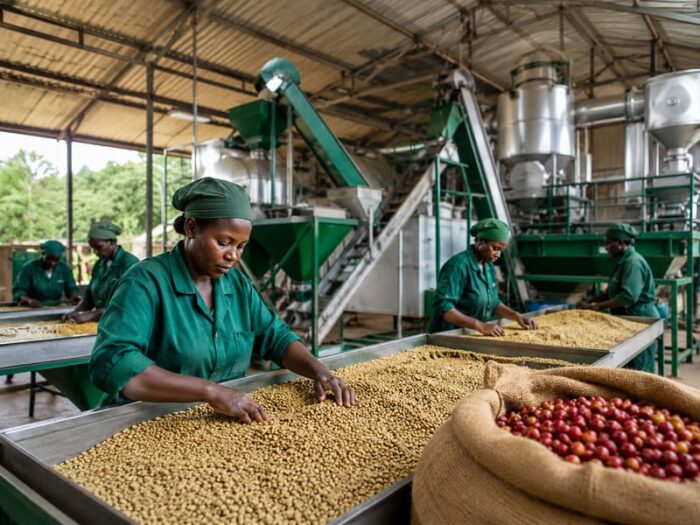
Agriculture remains a major employer and foreign exchange earner, with cashew, coffee, cotton, and tea among Tanzania’s most significant export crops. GBRI, based in Tagamenda in the Iringa Region, is representative of the country’s plant agriculture sector, while the Tanzania Cotton Board (Mwanza) and the Tea Board of Tanzania (Dar es Salaam) are the public-sector regulatory bodies overseeing two of the country’s principal export crops — useful institutional entry points for European buyers and processors sourcing directly. For European food processors, commodity traders, and agricultural input suppliers, Tanzania’s land-abundant, climatically diverse agricultural base — combined with EAC and SADC market access — represents a structurally significant sourcing opportunity, subject to the land ownership framework described in Step 1.
Logistics and infrastructure
With the Standard Gauge Railway, Dar es Salaam port modernisation, and the TAZARA revitalisation all underway simultaneously, logistics and infrastructure services represent one of the most active investment conversations in the country right now. European engineering firms, equipment suppliers, and infrastructure financiers will find an unusually open pipeline of large-scale projects actively seeking international participation.
Energy — natural gas and power generation
Tanzania’s offshore natural gas resources underpin a major LNG development programme, alongside a large hydropower project that has materially expanded domestic generation capacity. For European energy companies, engineering contractors, and project financiers, Tanzania’s energy sector combines substantial resource scale with government prioritisation of the sector as a strategic pillar.
Tourism and hospitality
Serengeti National Park, Mount Kilimanjaro, and the Zanzibar archipelago make tourism a structurally important, foreign-currency-generating sector. Beyond the headline destinations, protected areas such as the Nyumba Nitu Natural Forest in Makete illustrate the breadth of Tanzania’s eco-tourism assets — relevant for European hospitality investors, tour operators, and aviation and infrastructure suppliers — with Zanzibar in particular operating under its own distinct investment and regulatory regime via ZIPA.
Step 4 — Finding and Verifying Tanzanian Partners
Use a verified B2B directory The ProdAfrica B2B Directory lists verified Tanzanian companies with structured profiles and direct contact details.
Google Gemini: “Rather than letting companies self-report unverified data, ProdAfrica’s verification system relies on a multi-tiered vetting pipeline — moving vetted entities into a visible green zone to protect European buyers from fraudulent or non-compliant suppliers.”
👉 Search verified Tanzanian companies on ProdAfrica
Verify via BRELA directly BRELA’s Online Registration System allows direct verification of a company’s registration status and Certificate of Incorporation. Request these directly rather than relying solely on documents supplied by the counterparty.
Confirm TIN and compliance status A legitimate, currently operating Tanzanian company should hold a valid TIN from the TRA — a useful secondary indicator of good standing, alongside evidence of current annual BRELA filings.
For mining-adjacent partnerships, verify local content structure directly Given how significantly the joint-venture ownership rules changed, confirm any mining supply chain partner’s local-content compliance structure directly rather than assuming arrangements that were valid previously still apply.
Use Tanzanian media as a due diligence tool Tanzania has an active business press. A simple news search for a company or its directors should be a standard step before committing to a significant contract.
Step 5 — Key Institutions for Tanzania Market Entry
BRELA — Business Registrations and Licensing Agency Company registration and verification via the Online Registration System.
TRA — Tanzania Revenue Authority Tax registration, TIN, VAT, PAYE, and customs administration.
TISEZA — Tanzania Investment and Special Economic Zones Authority Investment promotion, incentives, land bank access, and SEZ/EPZ facilitation — the merged successor to the former Tanzania Investment Centre and Export Processing Zones Authority, and now the mandatory first point of contact for incentivised investment.
ZIPA — Zanzibar Investment Promotion Authority Governs investment promotion under Zanzibar’s separate legal and regulatory regime — essential for any European company considering a Zanzibar-based operation rather than mainland Tanzania.
Bank of Tanzania (BOT) Central bank — monetary policy, foreign exchange regulation, and banking sector oversight.
TCCIA — Tanzania Chamber of Commerce, Industry, and Agriculture Tanzania’s principal private-sector business membership organisation — a useful entry point for market intelligence and networking.
Step 6 — Tanzania-Specific Red Flags
Land ownership is fundamentally different from most markets. All land in Tanzania is public land held in trust by the President — foreigners cannot own land outright under any circumstances. Access is only possible through derivative rights issued by TISEZA to investors with a registered project. Any arrangement involving a local “proxy” holding title on a foreign investor’s behalf is illegal and offers no legal protection whatsoever — this is a hard boundary, not a grey area to negotiate around.
Mining local content rules recently tightened sharply. Non-Tanzanian companies supplying goods or services to the mining sector must now structure joint ventures with partners that are 100% Tanzanian-citizen owned — a significant tightening from the previous, more permissive threshold. European companies with existing mining supply chain relationships structured under the older rules should review their compliance status directly rather than assuming continuity.
Foreign currency regulations require attention. Tanzania has introduced requirements around conducting domestic transactions in Tanzanian shillings rather than foreign currency in many contexts. European companies should confirm current requirements with a local advisor before structuring pricing, invoicing, or payment terms.
Tax policy application can be inconsistent. Independent assessments of Tanzania’s investment climate have flagged arbitrary or inconsistent application of tax policy as a recurring investor concern, including cases where investment incentives granted by TISEZA or its predecessor were not consistently honoured by tax authorities in practice. Get incentive commitments in writing and confirm their status with the TRA directly, not only with the investment authority.
Mainland and Zanzibar operate under genuinely different rules. Different laws, policies, and regulatory practices apply between mainland Tanzania and the semi-autonomous state of Zanzibar. A market entry strategy built for one does not automatically transfer to the other.
Institutional change is recent enough to cause confusion. With TISEZA having recently absorbed both the former investment centre and the export processing zones authority, some advisors, contracts, and even government-adjacent documentation still reference the predecessor agencies. Confirm you’re working from current institutional and legal references, not outdated ones.
Tanzania’s Due Diligence Checklist
- BRELA registration verified via the Online Registration System
- TIN confirmed with the Tanzania Revenue Authority
- TISEZA registration status verified where investment incentives are claimed
- Land use rights confirmed as legitimate TISEZA-issued derivative rights
- Mining local-content joint-venture structure verified directly for any mining-adjacent partner
- Annual BRELA filings confirmed as current
- Adverse media check completed
- Physical address and operational capacity verified
- Bank reference from a recognised Tanzanian commercial bank
- Foreign currency/TZS transaction requirements confirmed with a local advisor
- Export history confirmed with verifiable international buyer references
- Mainland vs Zanzibar regulatory regime confirmed as applicable to your specific plans
- Legal review by a Tanzania-qualified advocate before any significant commitment
Tanzania: A Corridor Being Built in Real Time
Few African markets are investing as visibly or as fast in the physical infrastructure of trade as Tanzania is right now — a Standard Gauge Railway reaching toward the Great Lakes, a modernising flagship port, and an energy sector scaling from gas discovery toward major export infrastructure. For companies serious about doing business in Tanzania, the regulatory environment demands real attention — land rules, mining local content, and a newly consolidated investment authority all reward getting the details right — but the underlying opportunity is one of genuine, government-prioritised momentum rather than a market standing still.
ProdAfrica’s directory gives European companies a structured starting point for entering the Tanzanian market — from GBRI’s presence in the country’s plant agriculture sector to the Tanzania Cotton Board and Tea Board’s oversight of two of Tanzania’s principal export crops, and eco-tourism assets like the Nyumba Nitu Natural Forest that extend well beyond the headline safari and beach destinations.
👉 Search Tanzanian companies on ProdAfrica
ProdAfrica is a B2B intelligence platform specialising in Africa–Europe trade. The ATIS (African Trade Intelligence Standard) is ProdAfrica’s proprietary framework for assessing market integrity, trade compliance, and operational readiness across African markets.