1. The New Era of Euro-African Strategic Investment
The geopolitical and commercial relationship between the European Union and the African continent is undergoing a profound structural modernization. For decades, bilateral cooperation relied on traditional development aid models that often failed to generate sustainable, long-term industrial infrastructure. However, the implementation of the Samoa Agreement—the official successor to the historic Cotonou Agreement—has initiated a paradigm shift. Today, understanding how to access EU financing for African business has emerged as a primary focus for international trade consultancies, engineering groups, and project developers seeking to build resilient, sovereign B2B supply chains.
At the absolute center of this strategic shift is the European Union’s Global Gateway investment package, a massive 150 billion EUR funding window dedicated to accelerating sustainable infrastructure, digital connectivity, and clean energy projects across Africa. Rather than letting public funds dissipate into administrative overheads, this program prioritizes private sector participation and bilateral B2B co-development.
By aligning corporate expansion plans with these major institutional funding windows, European and African companies can successfully finance and scale high-value trade corridors that drive regional manufacturing and local purchasing power under the DCCI framework.
📌 B2B Strategic Briefing: Project Finance
- Operational Focus: Blended Finance, Infrastructure Development, and Public-Private Partnerships (EU-Africa Corridors).
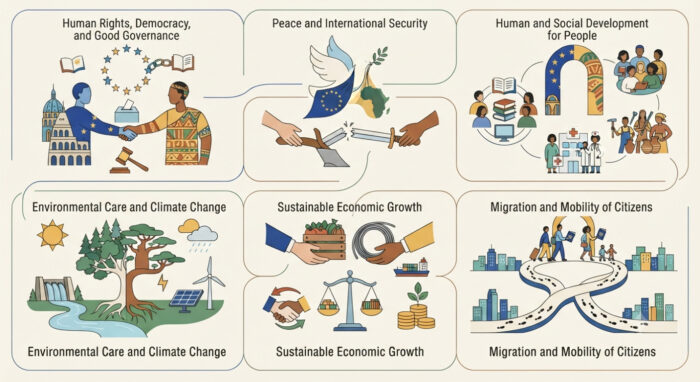
- Funding Parameters: Projects must align with the strategic pillars of the Global Gateway (digital, climate and energy, transport, health, education and research) and comply with EU environmental and social safeguards.
- Regulatory Alignment: Direct integration with EU corporate sustainability due diligence (CS3D) standards and international anti-corruption frameworks.
- DCCI & ATIS Integration: Strategic alignment with DCCI Pillar 3 (Infrastructure and Market Connectivity) and the ATIS Logistical Connectivity standard. By leveraging EU-backed infrastructure financing, SADC and East African nations can reduce transport and customs latency, directly elevating their regional ATIS logistics scores.
To navigate this complex institutional funding mechanisms, both European technology providers and African project developers require reliable, independent auditing frameworks. The ATIS Standard (African Trade Intelligence Standard) developed by ProdAfrica serves as the definitive trust filter, rating regional markets on their operational readiness, financial transparency, and trade compliance, thereby de-risking high-ticket infrastructure bids and long-term project finance partnerships.
2. Navigating the Global Gateway: Key Funding Windows
The Global Gateway is not a single, centralized fund; it represents a highly coordinated blending of resources from the European Commission, EU Member States’ development banks, and the European Investment Bank (EIB).
For European businesses planning to export technology or enter the South African market or SADC industrial corridors, the following funding windows serve as the primary institutional gateways:
- The European Fund for Sustainable Development Plus (EFSD+): The primary financial arm of the Global Gateway. It utilizes budgetary guarantees and blending instruments to de-risk private investments in emerging markets, making high-capital infrastructure projects viable for European engineering companies.
- The European Investment Bank (EIB) Global: The dedicated branch of the EIB for international development. It provides long-term, concessional loans and technical assistance for sustainable transport, digital networks, and clean water infrastructure across Africa.
- National Development Finance Institutions (DFIs): Regional powerhouses such as the Industrial Development Corporation (IDC) in South Africa, Spain’s COFIDES, or Germany’s DEG co-finance private sector investments alongside European technology providers to accelerate local value-addition.
3. Global Gateway Statistical Data & Corridor Allocation
To demonstrate the vast scale of the Africa-Europe Investment Package, the following structured tables detail the official financial allocations, budgets, and operational targets under the Global Gateway framework:
Table 1: Global Gateway Africa Investment Package (150 Billion EUR Portfolio)
| Sector Pillar | Estimated Allocation (EUR) | Key SADC & Continental Targets |
| Climate & Green Energy | 60 Billion | Renewable energy, green hydrogen, solar microgrids, transmission lines |
| Sustainable Transport | 40 Billion | Port expansions, SGR railway integration, highway corridors, customs digitalization |
| Digital Connectivity | 20 Billion | Submarine fiber-optic cables, terrestrial broadband, single windows |
| Human Development & Health | 30 Billion | Vaccine manufacturing, vocational centers, STEM university research |
Table 2: Key Trans-African Infrastructure Corridors (Bilateral Funding Commitments)
| Corridor Node | Total EU & Partner Pledge | Key Infrastructure Objective |
| The Lobito Corridor (Angola-Zambia-DRC) | Exceeds 1.5 Billion USD | 1,300 km railway rehabilitation connecting Port of Lobito to Copperbelt |
| The Northern Corridor (Uganda-Kenya) | Over 800 Million EUR | Multi-modal road, rail, and customs border-crossing upgrades, Kampala to Mombasa |
| The Central Corridor (Tanzania-Uganda-Rwanda) | Over 600 Million EUR | Standard Gauge Railway (SGR) expansion and Lake Tanganyika port modernization |
Sources: European Commission Directorate-General for International Partnerships (DG INTPA) Global Gateway indicators, European Investment Bank (EIB) Global annual reports, and SADC Secretariat regional infrastructure development plans.
4. The SADC and East African Transport Corridors
To access Global Gateway funding, infrastructure projects must demonstrate strategic regional integration. The European Union is prioritizing the development of multi-modal transport corridors to connect resource-rich landlinked nations directly to deep-water seaports:
The development of The Lobito Corridor represents the gold standard of this collaborative approach. By connecting the minerals and agricultural products of landlinked SADC nations directly to the Atlantic, the corridor bypasses congested eastern ports and slashes shipping times to Europe by more than fifty percent. For European manufacturers, this infrastructure represents a secure, transparent, and carbon-efficient supply chain that meets all CBAM and ESG requirements.
Similarly, the Northern and Central corridors in East Africa are undergoing massive technological upgrades. These developments go beyond physical asphalt; they involve the implementation of single-window customs systems and digitized weighbridges, addressing the administrative bottlenecks that historically paralyzed cross-border trade.
5. Bridging Public Finance with Digital B2B Verification
While the Samoa Agreement and the Global Gateway provide the physical “road” (the infrastructure), managing the digital “last-mile” of corporate discovery and verified compliance remains an operational bottleneck. For European consultancies, engineering firms, and machinery exporters, identifying reliable, legally formalized local subcontractors in Africa is a persistent risk.
This is where the collaborative integration of institutional funding with digital B2B verification becomes paramount. By auditing and listing regional contractors, logistics operators, and processors under our secure “Verification Tier” protocol, ProdAfrica provides the continuous, digital due diligence required to support public-private partnerships.
This digital verification layer allows international buyers and project developers to find verified suppliers in Africa with complete confidence. It ensures that the supplier credentials presented during an official trade mission are continuously validated, monitored, and kept compliant with the latest European import mandates (such as CBAM and ESG).
6. Conclusion: Co-Developing the Euro-African Sovereign Trade Axis
The future of bilateral trade does not rely on isolated efforts. It requires a seamless partnership between physical trade agencies and digital intelligence platforms. The Samoa Agreement and the Global Gateway have established the ultimate financial architecture to de-risk African industrialization.
However, the success of these multi-billion-euro programs lies in the hands of the private sector. By utilizing the structured database of ProdAfrica to identify and verify local partners, European trade promotion organizations and independent internationalization consultants can successfully navigate SADC, EAC, and West African investment pipelines.
As African enterprises continue to leverage European technology and EU-backed infrastructure financing, they do not just build roads; they build sustainable, self-funding B2B ecosystems that drive local purchasing power and regional prosperity under the DCCI model, engineering a highly secure, transparent, and resilient global trade corridor.